
- UPSC Exam
- State PCS
- One Day Exam
- Current Affairs
- PT Quiz
- Downlaods
- About Coaching
- Blog
- Videos

| Prelims: (Geography + CA) Mains: (GS 1: Physical Geography; GS 3: Disaster Management, Climate Change, Environment) |
A powerful bomb cyclone recently swept across the northern United States, triggering severe winter weather across the Midwest and the East Coast. The storm led to intense snowfall, blizzards, strong winds, and widespread disruption, once again drawing attention to extreme mid-latitude weather systems.
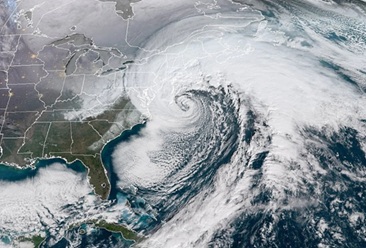
Mid-latitude regions frequently experience extratropical cyclones, which derive their energy from the interaction between contrasting air masses. While most such systems intensify gradually, some undergo explosive intensification, leading to exceptionally powerful storms known as bomb cyclones.
In recent years, bomb cyclones have gained prominence in climate discussions due to their increasing frequency, intensity, and associated socio-economic impacts, particularly during winter months in the Northern Hemisphere.
A bomb cyclone is a large mid-latitude storm resulting from explosive cyclogenesis (also known as bombogenesis).
Structurally, a bomb cyclone is indistinguishable from other intense extratropical cyclones but is defined by its rate of intensification rather than its structure.
The rapid deepening of the low-pressure system is the defining feature.
Bomb cyclones typically form when:
They most commonly occur in winter, when temperature gradients are strongest.
The four most active regions for extratropical explosive cyclogenesis are:
These regions combine strong jet streams, oceanic heat sources, and sharp thermal contrasts.
Bomb cyclones are associated with extreme and rapidly changing weather conditions, including:
Such storms can cause widespread disruption to transport, power supply, agriculture, and public safety.
While bomb cyclones are not new phenomena, climate scientists suggest that:
This raises concerns about more frequent or intense winter storms in mid-latitude regions.
For countries in temperate regions, bomb cyclones are a growing concern for resilience planning.
FAQsQ1. How is a bomb cyclone different from a normal extratropical cyclone ? A bomb cyclone intensifies extremely rapidly due to explosive cyclogenesis, whereas normal extratropical cyclones deepen gradually. Q2. Why do bomb cyclones mostly occur in winter ? Winter provides strong temperature contrasts between cold polar air and warm ocean air, which is essential for explosive intensification. Q3. Are bomb cyclones the same as hurricanes ? No. Bomb cyclones are mid-latitude systems driven by temperature contrasts, while hurricanes are tropical systems powered by warm ocean waters. |



Our support team will be happy to assist you!

 Contact Us
  New Batch : 9555124124/ 7428085757
  Tech Support : 9555124124/ 7428085757