
- UPSC Exam
- State PCS
- One Day Exam
- Current Affairs
- PT Quiz
- Downlaods
- About Coaching
- Blog
- Videos

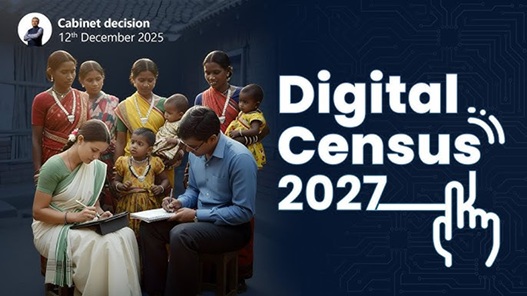
The Central Government has approved the proposal to conduct the 2027 Census of India. ₹11,718.24 crore has been approved for this purpose. This decision was taken at the Union Cabinet meeting on December 12, 2025. Census 2027 will be the eighth census of independent India and the 16th census of the country overall.
|
Parameter |
Details |
|
Census Year |
2027 |
|
Approved Cost |
₹11,718.24 crore |
|
Significance |
16th Census of India; 8th Census after Independence |
|
Legal Framework |
Census Act, 1948 and Census Rules, 1990 |
|
Previous Census |
2021 Census could not be conducted due to COVID-19 |
This will be the 'first digital census', adopting the following methodologies:
According to the government, Census 2027 is considered to be the "world's largest administrative and statistical exercise." Under this initiative, the Census-as-a-Service initiative will be launched, which will provide clean, machine-readable, and usable data to various ministries. The data will be disseminated through improved visualization tools to ensure quick availability of information needed for policymaking.
Census 2027 is being conducted in two phases:
|
Phase |
Duration |
Details |
|
First Phase |
April – September 2026 |
Houselisting and Housing Census; conducted over 30 days as per convenience of States/UTs |
|
Second Phase |
February 2027 |
Population Enumeration (PE) |
Non-synchronous Areas: The population census for the snow-affected areas of the Union Territories of Ladakh and Jammu & Kashmir, and the states of Himachal Pradesh and Uttarakhand, will be conducted in September 2026.
Census 2027 will play a pivotal role in India's administrative, social, and economic planning. The inclusion of digital technology and caste data will make this exercise more inclusive, transparent, and policy-oriented, which is expected to significantly improve the effectiveness of governance and development plans.



Our support team will be happy to assist you!

 Contact Us
  New Batch : 9555124124/ 7428085757
  Tech Support : 9555124124/ 7428085757