
- UPSC Exam
- State PCS
- One Day Exam
- Current Affairs
- PT Quiz
- Downlaods
- About Coaching
- Blog
- Videos

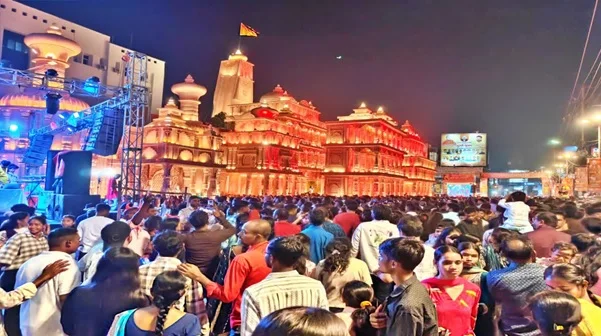
| Prelims: National Disaster Management Authority (NDMA), Crowd Crush, Compressive Asphyxia, Crowd Density, Incident Response System. Mains: GS Paper II Governance and Administrative Accountability; GS Paper III Disaster Management, Preparedness and Risk Reduction. Keywords: Kolkata Stampede, Chorbagan Durga Puja Pandal, Crowd Disaster, Crowd Management, NDMA Guidelines, Compressive Asphyxia, Public Safety. |
|
Term |
Meaning |
|
Stampede |
Commonly describes the sudden, rapid movement of a crowd, often following fear, excitement or an unexpected event. |
|
Crowd crush |
Occurs when people become so tightly packed that they lose control over their movement and experience dangerous pressure. |
|
Progressive crowd collapse |
Occurs when people lose balance and fall, causing others nearby to fall into the space created. |
A crowd does not necessarily have to run for a fatal incident to occur. At extreme density, individuals may be unable to move independently or escape pressure.
Crowd disasters generally emerge from several interacting weaknesses rather than one isolated cause.
|
Risk factor |
How it increases danger |
|
Excessive crowd density |
Reduces personal space and the ability to move independently. |
|
Narrow entrances and exits |
Creates bottlenecks where people accumulate. |
|
Opposing pedestrian flows |
Brings incoming and outgoing groups into conflict. |
|
Obstructed routes |
Stalls, parking and poorly positioned barriers reduce usable space. |
|
Unexpected events |
Rain, electrical failures or security scares can trigger sudden movement. |
|
Poor communication |
Unclear announcements may send large groups towards the same location. |
|
Weak coordination |
Delays decisions on entry restrictions, diversion and emergency response. |
A small disturbance becomes especially dangerous when a venue is already overcrowded and has limited capacity to absorb changes in movement.
|
Incident |
Date/Year |
Reported deaths |
|
Nashik Kumbh, Maharashtra |
August 2003 |
29 |
|
Mandhardevi–Kalubai Yatra, Maharashtra |
January 2005 |
293 |
|
Hathras religious gathering, Uttar Pradesh |
2 July 2024 |
121 |
|
New Delhi Railway Station |
15 February 2025 |
18 |
|
RCB victory celebrations, Bengaluru |
4 June 2025 |
11 |
|
Chorbagan Durga Puja pandal, Kolkata |
17 October 2026 |
19 |
This is a selection of incidents, not a comprehensive national dataset. The historical figures follow the NDMA account; subsequent figures follow the cited reporting.
The NDMA framework emphasises matching demand with venue capacity and coordinating the agencies involved.
Key measures include:
Prelims MCQIn the context of crowd disasters, “compressive asphyxia” refers to: A. Loss of hearing caused by intense noise Mains Question“Effective crowd-disaster prevention requires capacity planning, clear communication and administrative coordination.” Discuss with reference to major crowd disasters in India. |
1. What happened at Kolkata’s Chorbagan Durga Puja pandal?A crowd disaster on 17 October 2026 killed 19 people and injured approximately 25. The circumstances and responsibility remain under investigation. 2. Can a crowd crush happen without people running?Yes. Extreme crowd density can create dangerous pressure even when people are standing or moving slowly. 3. What is compressive asphyxia?It is impaired breathing caused by external pressure that prevents normal expansion of the chest and respiratory movement. 4. What is the central principle of crowd management?Authorities must match admission and movement with the capacity of the venue and its individual routes, while maintaining safe exits. 5. How can technology help prevent crowd disasters?Monitoring tools can help identify congestion, but their effectiveness depends on trained staff and timely decisions to regulate or redirect movement. |


Our support team will be happy to assist you!


 Contact Us
 New Batch : 9555124124/ 7428085757
 Tech Support : 9555124124/ 7428085757
