New
Final Result - UPSC CSE Result, 2025 GS Foundation (P+M) - Delhi : 1st April 2026, 11:30 AM GS Foundation (P+M) - Prayagraj : 3rd April 2026, 5:30PM Final Result - UPSC CSE Result, 2025 GS Foundation (P+M) - Delhi : 1st April 2026, 11:30 AM GS Foundation (P+M) - Prayagraj : 3rd April 2026, 5:30PM

Current Affairs for 01 April 2026

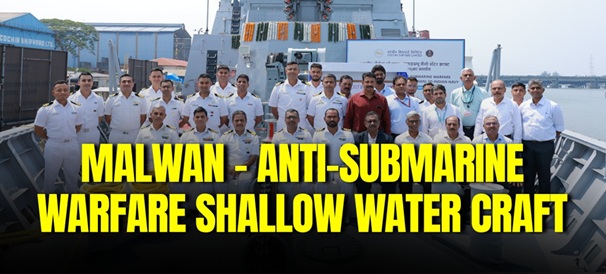
INS Malwan (ASW-SWC) Explained: India’s Indigenous Anti-Submarine Warfare Craft

Prelims : (Security + CA)
Mains : GS 3 – Internal Security, Defence Technology, Indigenisation

Why in News?

  • The Indian Navy has inducted INS Malwan, an Anti-Submarine Warfare Shallow Water Craft (ASW-SWC), strengthening India’s coastal defence and underwater surveillance capabilities.
  • The vessel has been built indigenously by Cochin Shipyard Limited, marking progress under the Aatmanirbhar Bharat initiative.
  • It is the second of eight ASW-SWC vessels being developed for the Indian Navy.

Background and Context

  • With increasing submarine activity in the Indian Ocean Region (IOR), particularly from strategic competitors, India faces growing challenges in securing its maritime domain.
  • Coastal waters are particularly vulnerable due to :
    • Shallow depths that limit large warship operations
    • High maritime traffic
    • Proximity to key ports and strategic infrastructure
  • Traditional large warships are less effective in shallow waters, necessitating specialised vessels like ASW-SWC designed specifically for :
    • Detection and neutralisation of submarines
    • Coastal defence and surveillance

About INS Malwan (ASW-SWC)

  • INS Malwan is an indigenously designed and constructed anti-submarine warfare vessel, tailored for operations in shallow coastal waters.
  • It is part of a larger programme to enhance India’s littoral warfare capabilities, focusing on near-shore security.
  • Key highlights :
  • Built by Cochin Shipyard Limited at Kochi
  • Second vessel in a series of eight ASW-SWC ships
  • Named after Malwan, reflecting India’s maritime heritage
  • Carries forward the legacy of the earlier INS Malwan, which served till 2003

Key Features of INS Malwan

1. Displacement and Design

  • The vessel has a displacement of around 1,100 tonnes, making it :
    • Compact yet capable for coastal operations
    • Suitable for manoeuvring in shallow and confined waters
  • The design prioritises :
    • High agility
    • Low acoustic signature (important for stealth in ASW operations)

2. Propulsion System

  • The ship uses waterjet propulsion, which offers : 
    • Greater manoeuvrability in shallow waters
    • Reduced noise levels, critical for anti-submarine detection
    • Lower risk of damage in debris-prone coastal environments

3. Advanced Armaments

  • INS Malwan is equipped with a range of modern weapon systems for anti-submarine operations :
  • Torpedoes :
    • Used for precise underwater targeting of enemy submarines
  • Anti-Submarine Rockets :
    • Capable of engaging submarines at varying depths and distances
  • These systems ensure multi-layered offensive capability in underwater warfare.

4. State-of-the-Art Sensors

  • The vessel is fitted with advanced detection and surveillance systems :
  • Sonar Systems :
    • Detect and track underwater threats
  • Advanced Radars :
    • Provide situational awareness in surface and aerial domains
  • These sensors enable :
    • Early threat detection
    • Real-time tracking and response

5. Operational Capabilities

  • INS Malwan is designed for multi-role operations, including :
  • Anti-Submarine Warfare (ASW) :
    • Detection, tracking, and neutralisation of enemy submarines
  • Underwater Surveillance :
    • Monitoring of maritime zones for hidden threats
  • Low Intensity Maritime Operations (LIMO) :
    • Handling non-conventional threats such as smuggling, infiltration, and piracy
  • Mine Warfare :
    • Capability to detect and counter naval mines

6. Indigenous Content

  • The vessel has over 80% indigenous content, reflecting :
    • Strong domestic shipbuilding capabilities
    • Reduced dependence on foreign technology
  • It aligns with :
    • Government’s Aatmanirbhar Bharat initiative
    • Defence indigenisation goals

Significance of INS Malwan

  • Strengthening Coastal Security :
    • Enhances India’s ability to monitor and secure coastal waters
  • Countering Submarine Threats :
    • Addresses increasing underwater presence in the Indian Ocean
  • Boost to Indigenous Defence Manufacturing :
    • Demonstrates India’s growing capability in warship construction
  • Strategic Maritime Advantage :
    • Improves operational readiness in shallow water environments

Core Analysis: Strategic Importance vs Challenges

Strategic Importance

  • Enhances India’s layered maritime defence
  • Strengthens surveillance in vulnerable coastal zones
  • Supports India’s role as a net security provider in the IOR

Challenges

  • Rapid technological advancement by adversaries
  • Need for integration with broader naval systems
  • Maintenance and lifecycle costs of advanced platforms

Way Forward

Short-Term Measures

  • Ensure timely induction of remaining ASW-SWC vessels
  • Integrate ships with naval surveillance networks

Long-Term Measures

  • Invest in advanced sonar and unmanned underwater systems
  • Strengthen domestic R&D in naval technologies
  • Enhance coordination between Navy and Coast Guard

Policy Focus

  • Promote defence indigenisation
  • Expand shipbuilding capacity
  • Strengthen maritime domain awareness

Practice Questions

Prelims :
Q. What is the primary role of Anti-Submarine Warfare systems ?
(a) Air defence
(b) Surface warfare
(c) Detection and destruction of submarines
(d) Cyber warfare

Mains :
“Discuss the importance of Anti-Submarine Warfare capabilities for India’s maritime security.”

FAQs

1. What is INS Malwan ?

It is an anti-submarine warfare shallow water craft of the Indian Navy.

2. Who built it ?

Cochin Shipyard Limited.

3. What is its main role ?

Detecting and neutralising submarines in coastal waters.

4. What is special about it ?

Over 80% indigenous content.

5. Why is it important ?

It strengthens India’s coastal and maritime security.

Global Tensions and India’s Economy: Oil Shock, Rupee Pressure and Fiscal Stress Explained

Prelims : (Economy + CA)
Mains : GS 3 – Indian Economy, External Sector, Energy Security, Fiscal Policy

Why in News ?

  • Rising geopolitical instability in West Asia, particularly involving Iran, is impacting India’s economy through : 
    • Surge in crude oil prices
    • Depreciation of the rupee
    • Pressure on fiscal and external balances
  • These developments highlight how global conflicts directly influence domestic macroeconomic stability, especially for import-dependent economies like India.

Background and Context

  • India’s economy is deeply integrated with global markets, making it highly sensitive to geopolitical disruptions, particularly in energy-rich regions.
  • West Asia is strategically important because :
    • It supplies a major share of India’s crude oil imports
    • It hosts critical shipping routes such as the Strait of Hormuz
    • It influences global energy prices and supply chains
  • With India importing over 85% of its crude oil requirements, any disruption leads to :
    • Immediate inflationary pressures
    • Exchange rate volatility
    • Fiscal strain

Channels of Transmission of Global Shocks

1. Energy Prices as the Primary Shock Channel

  • Crude oil prices act as the most direct and immediate transmission mechanism through which global tensions affect India’s economy.
  • Recently, the Indian crude basket surged to around $156 per barrel, reflecting sharp global volatility.
  • A sustained increase in oil prices leads to :
    • Higher transportation and logistics costs, increasing the price of goods and services across sectors
    • Increased cost of production for industries, particularly energy-intensive sectors such as manufacturing and fertilisers
    • A rise in overall inflation, especially cost-push inflation, which affects both consumers and producers
  • Additionally, a $10 increase in crude prices can significantly :
    • Widen the current account deficit (CAD)
    • Increase inflationary pressures, forcing monetary tightening

2. Exchange Rate Pressure and Currency Depreciation

  • The Indian rupee has depreciated to around ₹95 per US dollar, reflecting strong external pressures.
  • Depreciation occurs due to :
    • Rising oil import bills increasing demand for dollars
    • Capital outflows amid global uncertainty
    • Strengthening of the US dollar globally
  • Currency depreciation has multiple consequences :
    • Makes imports more expensive, further fuelling inflation
    • Increases the burden of external debt repayment
    • Weakens investor confidence in the economy
  • The Reserve Bank of India (RBI) has intervened by :
    • Using foreign exchange reserves
    • Regulating forex market exposure

3. External Sector Stress

  • India’s external sector has come under pressure due to :
    • Decline in foreign exchange reserves (around $709 billion)
    • Increased Foreign Portfolio Investor (FPI) outflows
  • These developments lead to :
    • Reduced buffer against external shocks
    • Increased vulnerability to sudden capital flight
    • Pressure on the balance of payments
  • External instability can further :
    • Amplify currency depreciation
    • Increase macroeconomic uncertainty

Fiscal Impact of Oil Price Volatility

  • India’s fiscal framework is structurally vulnerable to fluctuations in global oil prices.
  • Key impacts include :
  • Rising Subsidy Burden:
    • Higher crude prices increase government spending on : 
      • LPG subsidies
      • Fertiliser subsidies
  • Revenue Losses :
    • To control inflation, governments often reduce : 
      • Excise duties on fuel
    • This leads to significant loss of revenue
  • Increased Fiscal Deficit :
    • Higher expenditure combined with lower revenues widens the fiscal deficit
    • If high oil prices persist:
    • Government finances may face dual pressure of rising costs and falling revenues, affecting fiscal sustainability

Changing Nature of Government Revenue

  • India’s revenue system has evolved significantly in recent years, with increasing dependence on transaction-based taxation.
  • Goods and Services Tax (GST) collections have risen to around ₹22.8 lakh crore, reflecting :
    • Strong consumption and economic activity
  • However, this structure creates vulnerabilities :
  • Dependence on Consumption :
    • Revenue growth is linked more to spending than income
  • Impact of Economic Slowdown :
    • During crises, reduced consumption leads to lower GST collections
  • This makes fiscal stability highly sensitive to demand-side shocks.

Impact on Households and Consumption

  • Households act as a critical transmission channel for economic shocks.
  • Key features :
  • High Contribution to GDP :
    • Private consumption accounts for about 61.4% of GDP
  • Rising Household Debt :
    • Household liabilities have crossed 41% of GDP, increasing financial vulnerability
  • Impact of Rising Prices :
    • Higher fuel and energy costs increase household expenditure
    • Reduced disposable income leads to lower consumption
  • Energy Access Issues :
    • LPG price increases and supply disruptions further burden households
  • This leads to :
    • Weak demand
    • Slower economic growth

Industrial and Investment Trends

  • India’s industrial sector shows a mixed performance under global stress conditions.
  • Manufacturing Sector :
    • Growth remains strong in capital-intensive industries
  • Labour-Intensive Sectors :
    • Continue to face demand constraints and structural challenges
  • Private Investment :
    • Remains subdued despite government-led capital expenditure
  • Project Completion Issues :
    • A low proportion of announced projects are completed, reflecting : 
      • Investor caution
      • Uncertainty in demand conditions
  • Impact on MSMEs :
    • Small businesses and informal sectors are more vulnerable due to : 
      • Limited financial buffers
      • Higher sensitivity to demand shocks

Macroeconomic Contradiction: Growth vs Vulnerability

  • India’s economy currently exhibits a dual or contradictory trend:

Positive Indicators

  • Strong GDP growth (~8.1%)
  • High government capital expenditure
  • Resilient manufacturing output

Underlying Weaknesses

  • Weak income growth
  • Rising household debt
  • External sector vulnerabilities
  • This divergence indicates that :
    • Growth is being driven by public investment, not broad-based demand
    • Household consumption and private investment remain fragile
  • Such a growth model may not be sustainable in the long run without addressing structural issues.

 Key Concepts

1. Current Account Deficit (CAD)

  • Occurs when imports exceed exports in goods and services

2. Fiscal Deficit

  • Difference between government expenditure and revenue

3. Cost-Push Inflation

  • Inflation caused by rising input costs (e.g., fuel prices)

4. Foreign Exchange Reserves

  • Assets held by RBI to manage currency stability

5. Capital Account Flows

  • Movement of investments (FPI, FDI) across borders

Significance

  • Energy Security : Highlights India’s dependence on imported oil
  • Macroeconomic Stability : Shows vulnerability to global shocks
  • Policy Challenge : Balancing inflation control with growth
  • Strategic Planning : Need for diversification and resilience

Core Analysis: External Shock vs Domestic Resilience

Strengths

  • Strong GDP growth
  • High forex reserves
  • Active policy intervention by RBI

Vulnerabilities

  • High oil import dependence
  • Weak consumption demand
  • Fiscal and external sector pressures

Way Forward

Short-Term Measures

  • Use forex reserves to stabilise currency
  • Adjust fuel taxes and subsidies carefully
  • Monitor inflation and supply chains

Long-Term Measures

  • Diversify energy sources (renewables, alternative fuels)
  • Reduce dependence on crude oil imports
  • Strengthen domestic manufacturing and supply chains

Structural Reforms

  • Boost employment and income growth
  • Broaden tax base beyond consumption
  • Enhance resilience to external shocks

Practice Questions

Prelims :
Q. Which of the following can lead to currency depreciation ?

  1. Rising oil imports
  2. Capital outflows
  3. Increase in exports

Select the correct answer :
(a) 1 and 2
(b) 2 and 3
(c) 1 and 3
(d) All of the above

Mains :
“Global geopolitical tensions increasingly influence India’s macroeconomic stability.” Discuss.

FAQs

1. Why do global tensions affect India’s economy ?

Due to dependence on oil imports and global trade linkages.

2. What is the biggest impact channel ?

Rising crude oil prices.

3. How does it affect the rupee ?

Increases demand for dollars, causing depreciation.

4. What is the fiscal impact ?

Higher subsidies and lower tax revenues.

5. What is the long-term solution ?

Energy diversification and economic resilience.

RBI Extends Export Realisation Timeline: Supporting Exporters Amid Global Disruptions

Prelims : (Economy + CA)
Mains : GS 3 – Indian Economy, External Sector, Trade, Monetary Policy

Why in News ?

  • The Reserve Bank of India (RBI) has extended : 
    • The export realisation and repatriation timeline to 15 months
    • The export credit period to 450 days (till June 30, 2026)
  • The move comes in response to global disruptions and West Asia tensions, which have affected shipping routes, payment cycles, and trade flows.
  • The decision aims to provide liquidity support and operational flexibility to exporters, ensuring continuity in India’s external trade.

Background and Context

  • India’s export sector is closely linked to global supply chains, geopolitical stability, and financial flows, making it vulnerable to external shocks.
  • Recent disruptions due to tensions involving Iran and surrounding regions have :
    • Increased shipping risks and insurance costs
    • Caused delays in cargo movement
    • Disrupted payment cycles
  • Strategic chokepoints such as the Strait of Hormuz play a critical role in global trade, and any instability in these regions directly impacts India’s exports.
  • In such a scenario, rigid export timelines can strain exporters’ liquidity, necessitating policy flexibility.

Understanding Export Realisation and Export Credit

Export Realisation

  • Export realisation refers to the receipt of payment in foreign exchange for goods and services exported from India.
  • It is governed under the Foreign Exchange Management Act, which mandates that :
    • Export proceeds must be realised and repatriated within a specified timeframe
  • Timely realisation is critical because it :
    • Ensures steady foreign exchange inflows
    • Supports balance of payments stability
    • Maintains confidence in the external sector

Export Credit

  • Export credit is a vital component of trade finance, helping exporters manage working capital requirements.
  • It includes :
  • Pre-shipment Credit :
    • Provided before export to finance procurement of raw materials, production, and packaging
  • Post-shipment Credit :
    • Provided after goods are shipped, covering the period until payment is received
  • These mechanisms ensure that exporters have continuous liquidity despite delayed payments.

Role of RBI in Export Regulation

  • The RBI plays a central role in managing India’s external sector stability through multiple regulatory and monetary tools.
  • Key functions include :
  • Setting Export Timelines :
    • Determines the permissible period for realisation and repatriation
  • Regulating Export Credit :
    • Defines credit duration, interest norms, and eligibility
  • Forex Market Intervention :
    • Manages currency volatility through regulatory and market operations
  • Balancing Growth and Stability :
    • Ensures export promotion without compromising macroeconomic stability

Need for Relaxation in Export Timelines

  • Global disruptions have significantly impacted the efficiency and predictability of international trade.
  • Key challenges include :
  • Logistical Delays :
    • Shipping routes have become longer and more uncertain
  • Rising Costs :
    • Freight charges and insurance premiums have increased sharply
  • Extended Payment Cycles :
    • Importers are delaying payments due to global uncertainty
  • In this environment, strict timelines can :
    • Force exporters into financial stress
    • Disrupt working capital cycles
    • Reduce export competitiveness
  • Therefore, extending timelines provides critical breathing space for exporters.

Key Measures Announced by RBI

  • The RBI has introduced several relief measures to address current challenges:

1. Extension of Export Realisation Timeline

  • The permissible period for realisation and repatriation has been extended :
    • From 9 months to 15 months
  • This allows exporters :
    • More time to receive payments
    • Greater flexibility in managing delayed transactions

2. Extension of Export Credit Period

  • The enhanced export credit period of 450 days has been extended :
    • Now applicable for disbursals till June 30, 2026
  • This ensures :
    • Continued access to affordable working capital
    • Reduced financial stress during delayed payments

3. Forex Market Stabilisation Measures

  • RBI has also directed banks to :
    • Limit their net open forex exposure to $100 million per day
  • This aims to :
    • Reduce currency volatility
    • Stabilise the rupee amid global uncertainty

Performance of India’s Exports

  • Despite global challenges, India’s exports have shown resilience:
  • Total exports (goods + services) :
    • Estimated at $76.13 billion in February 2026
    • Growth of 11.05% year-on-year
  • This indicates :
    • Strong demand for Indian exports
    • Ability to withstand global disruptions

Implications for India’s Economy

Positive Impacts

  • Liquidity Support :
    • Exporters gain more time to realise payments, reducing working capital stress
  • Trade Continuity :
    • Ensures uninterrupted export activity despite logistical challenges
  • Cost Management :
    • Allows exporters to absorb higher freight and insurance costs
  • External Sector Stability :
    • Sustains export momentum, supporting long-term forex inflows

Potential Concerns

  • Delayed Forex Inflows :
    • Longer timelines may temporarily reduce foreign exchange inflows
  • Balance of Payments Pressure :
    • Prolonged delays could affect external account stability
  • Moral Hazard Risk :
    • Extended timelines may reduce urgency in payment recovery

Key Concepts

1. Balance of Payments (BoP)

  • Record of all economic transactions between a country and the rest of the world

2. Current Account

  • Includes trade in goods, services, remittances, and income flows

3. Exchange Rate

  • Value of one currency relative to another (e.g., ₹ per US dollar)

4. Net Open Position (NOP)

  • Difference between a bank’s foreign currency assets and liabilities

5. Trade Deficit

  • Occurs when imports exceed exports

Significance

  • Export Competitiveness :
    • Enhances flexibility for exporters in uncertain times
  • Macroeconomic Stability :
    • Supports external sector during global volatility
  • Policy Responsiveness :
    • Demonstrates RBI’s proactive approach to emerging risks
  • Confidence Building :
    • Reassures exporters and investors

Core Analysis: Relief vs Risks

Advantages

  • Provides immediate liquidity support
  • Helps sustain export growth
  • Reduces financial stress on exporters

Risks

  • Temporary decline in forex inflows
  • Increased exposure to external vulnerabilities
  • Dependence on global recovery

Way Forward

Short-Term Measures

  • Continue flexible policy support for exporters
  • Monitor forex inflows and currency stability
  • Improve trade logistics and shipping resilience

Long-Term Measures

  • Diversify export markets
  • Strengthen domestic supply chains
  • Enhance trade financing mechanisms

Policy Focus

  • Balance export promotion with macroeconomic stability
  • Reduce dependence on volatile trade routes
  • Build resilience against geopolitical shocks

Practice Questions

Prelims :
Q. What does export realisation refer to ?
(a) Exporting goods
(b) Receiving payment for exports in foreign exchange
(c) Importing goods
(d) Currency depreciation

Mains :
“Discuss the role of the Reserve Bank of India in managing India’s external sector during global disruptions.”

FAQs

1. What is export realisation ?

It is the receipt of payment in foreign exchange for exports.

2. Why did RBI extend timelines ?

Due to global disruptions and delays in trade and payments.

3. What is export credit ?

Financial support provided to exporters before and after shipment.

4. What is the new timeline ?

Up to 15 months for export realisation.

5. What is the benefit ?

Improves liquidity and reduces financial stress on exporters.

Iran War and Food Inflation in India: Why Risks Are Limited Now but Rising Ahead

Prelims : *Economy + CA)
Mains : GS 3 – Indian Economy, Agriculture, Food Security, External Sector

Why in News ?

  • The ongoing geopolitical tensions in West Asia involving Iran have raised concerns about food inflation in India, particularly through disruptions in fertiliser and agrochemical supply chains.
  • While India currently remains insulated due to strong foodgrain stocks and a promising rabi harvest, emerging risks for the upcoming kharif season indicate potential inflationary pressures in the near future.
  • The situation highlights the interlinkages between geopolitics, agriculture, and inflation, especially for an import-dependent economy like India.
Background and Context

  • Food inflation in India is influenced not only by domestic agricultural output but also by global supply chains, input costs, and geopolitical disruptions.
  • The West Asia region plays a critical role in :
    • Supply of fertilisers and raw materials such as ammonia, sulphur, and LNG
    • Petrochemical inputs used in agrochemicals
    • Energy markets, which indirectly impact transportation and production costs
  • Past crises, such as the COVID-19 pandemic, demonstrated that strong buffer stocks and good harvests can shield India from immediate inflation shocks, even during global disruptions.
  • The current scenario presents a two-phase risk :
    • Short-term stability due to strong domestic buffers
    • Medium-term vulnerability due to rising input costs and supply disruptions

Current Food Security Position: Strong Buffers

  • India’s food security situation remains comfortable due to substantial buffer stocks held by the government.
  • As of March 1 :
    • Wheat stocks stood at 23.6 million tonnes
    • Rice stocks stood at 36.5 million tonnes
  • These levels are significantly higher than in previous years, ensuring :
    • Adequate supply for the Public Distribution System (PDS)
    • Ability to stabilise prices through market interventions
  • Such buffer stocks act as a shock absorber, preventing sudden spikes in food prices despite external disruptions.

Strong Rabi Crop Prospects

  • The outlook for the rabi season further strengthens India’s food security position.
  • Favourable Monsoon and Acreage Expansion :
    • Good rainfall in 2025 encouraged farmers to increase sowing under key crops such as wheat, mustard, chana, and maize.
  • Favourable Weather Conditions :
    • Cooler temperatures due to western disturbances supported better grain filling, especially for wheat, leading to higher productivity.
  • This combination of higher acreage and improved yields is expected to ensure :
    • Sufficient domestic supply
    • Stable food prices in the short term

Crop-Wise Performance Analysis

  • Wheat :
    • Harvesting has begun in central India and is expected to expand to northern regions, indicating a normal to above-normal production outlook.
  • Mustard :
    • Harvest largely completed with minimal weather damage, ensuring stable edible oil supply.
  • Potato and Maize :
    • Potato output is estimated to be 8–10% higher, while maize yields in Bihar are expected to remain robust, supporting both food and feed demand.
  • Seed Spices :
    • Crops like jeera and isabgol may witness lower output due to weather anomalies, indicating localized supply concerns.
  • Overall, the diversified crop performance suggests broad-based agricultural stability, reducing immediate inflation risks.

Fertiliser Availability: Comfortable but Temporary

  • India currently has adequate fertiliser stocks, which are sufficient to meet immediate agricultural needs.
  • Available stocks include :
    • Urea: 6.1 million tonnes
    • DAP: 2.4 million tonnes
    • Complex fertilisers: 5.7 million tonnes
    • SSP: 2.5 million tonnes
  • These reserves provide short-term security, particularly for the ongoing agricultural cycle.
  • However, this comfort is time-bound, as replenishment depends heavily on imports.

Emerging Risks for Kharif Season

  • The real challenge lies in the upcoming kharif season, where input availability becomes critical.
  • Supply Chain Disruptions :
    • The Iran conflict has disrupted imports from the Gulf region, a major supplier of fertiliser inputs.
  • Rising Global Prices :
    • Ammonia prices have surged to $725–750 per tonne
    • Sulphur prices have crossed $700 per tonne
    • DAP prices have reached around $825 per tonne
  • These rising costs may :
    • Increase input costs for farmers
    • Translate into higher food prices over time

Supply-Demand Pressures in Fertiliser Sector

  • India has a large annual fertiliser demand, making it vulnerable to global disruptions :
    • Urea : ~40 million tonnes
    • DAP : ~10 million tonnes
    • Complex fertilisers : ~14 million tonnes
  • Current stock levels may only support initial phases of kharif cultivation, necessitating timely imports.
  • Policy responses being considered include :
    • Recalibration of fertiliser subsidies to absorb price shocks
    • Encouraging use of complex fertilisers and SSP, which are more nutrient-efficient

Agrochemical Supply Risks

  • Beyond fertilisers, the crisis also affects crop protection chemicals, which are essential for maintaining agricultural productivity.
  • These include :
    • Insecticides
    • Fungicides
    • Herbicides
  • Supply disruptions can :
    • Increase pest and disease risks
    • Reduce crop yields

Dependence on Petrochemical Inputs

  • A critical vulnerability lies in India’s dependence on petrochemical supply chains linked to West Asia.
  • Around 55% of global naphtha supply originates from or passes through this region.
  • Naphtha is a key raw material for :
    • Ethylene
    • Propylene
    • Benzene
  • These chemicals are essential for producing agrochemical inputs, making the sector highly sensitive to geopolitical disruptions.

Rising Input and Packaging Costs

  • Supply disruptions have already led to increased prices of intermediate chemicals, such as :
    • Isopropylamine (used in herbicides like glyphosate)
  • Additionally, packaging costs have risen by 30–40%, affecting :
    • HDPE bottles
    • PET containers
    • Labels and cartons
  • This adds to the overall cost of agricultural inputs, indirectly influencing food prices.

Uncertain Impact on Food Inflation

  • While immediate food inflation risks remain low due to strong buffers, the medium-term outlook is uncertain.
  • The final impact will depend on :
    • Duration of geopolitical disruptions
    • Extent of cost pass-through to farmers
    • Government policy interventions
  • If input costs continue to rise, they may eventually translate into higher food prices, especially during the next agricultural cycle.

 Key Concepts

1. Food Inflation

  • Refers to the rise in prices of food items, a major component of CPI in India.
  • Highly sensitive to supply shocks and agricultural output.

2. Buffer Stock

  • Foodgrain reserves maintained by the government (through FCI) to : 
    • Ensure food security
    • Stabilise prices

3. Rabi and Kharif Crops

  • Rabi : Sown in winter, harvested in spring (e.g., wheat)
  • Kharif : Sown in monsoon, harvested in autumn (e.g., rice)

4. Fertiliser Types

  • Urea : Nitrogen-based
  • DAP : Phosphorus-rich
  • Complex fertilisers : Balanced nutrients

5. Public Distribution System (PDS)

  • Government mechanism to distribute food grains at subsidised rates

Significance

  • Food Security : Highlights importance of buffer stocks and domestic production
  • Economic Stability : Food inflation directly impacts CPI and monetary policy
  • Geopolitical Sensitivity : Shows India’s vulnerability to external shocks
  • Agricultural Policy : Emphasises need for input diversification and self-reliance

Core Analysis: Stability vs Emerging Risks

Current Stability

  • Strong foodgrain stocks
  • Good rabi harvest prospects
  • Adequate fertiliser availability

Emerging Risks

  • Rising global fertiliser prices
  • Supply chain disruptions from West Asia
  • Increasing agrochemical and packaging costs

Way Forward

Short-Term Measures

  • Ensure timely fertiliser imports
  • Adjust subsidy framework to shield farmers
  • Monitor food prices and intervene if necessary

Long-Term Measures

  • Promote domestic fertiliser production
  • Encourage balanced nutrient use
  • Diversify import sources

Policy Focus

  • Strengthen agricultural resilience
  • Reduce dependence on volatile regions
  • Integrate food security with external sector policy

Practice Questions

Prelims :
Q. Which of the following factors can directly lead to food inflation ?

  1. Increase in fertiliser prices
  2. Decline in agricultural output
  3. Rise in crude oil prices

Select the correct answer :
(a) 1 and 2
(b) 2 and 3
(c) 1, 2 and 3
(d) 1 only

Mains :
“Food inflation in India is increasingly influenced by global factors rather than domestic production alone.” Discuss.

FAQs

1. Why is food inflation low currently ?

Due to strong buffer stocks and a good rabi harvest.

2. What is the main future risk ?

Rising fertiliser and input costs due to global disruptions.

3. How does Iran conflict affect India ?

Through supply disruptions of fertilisers and petrochemical inputs.

4. What role do buffer stocks play ?

They stabilise prices and ensure food availability.

5. Will food prices rise soon ?

Possibly, depending on input costs and policy response.

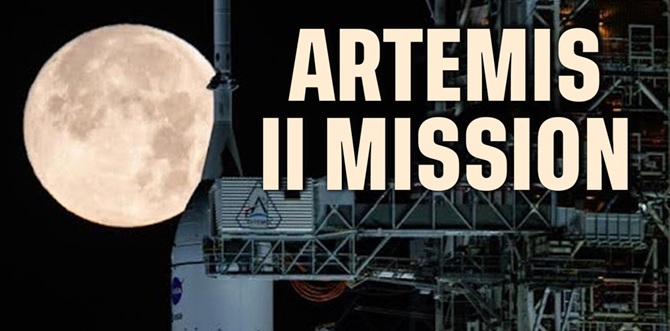
Artemis II Mission Explained: How NASA Plans to Take Astronauts Around the Moon and Back

Prelims : (Science & Technology + CA)
Mains : GS 3 – Space Technology, International Cooperation, Emerging Technologies

Why in News ?

  • The NASA is preparing for the Artemis II mission, which will send four astronauts on a 10-day journey around the Moon, marking the first human mission beyond low Earth orbit since 1972.
  • Unlike earlier missions, Artemis II will be a lunar flyby mission (no landing), acting as a crucial step toward a planned human Moon landing later in the decade.
  • The mission signals the beginning of a new era of sustained lunar exploration, involving multiple countries and private players.

Background and Context

  • The last human mission to the Moon occurred during the Apollo 17, concluding the Apollo programme that focused on short-duration lunar landings.
  • The new Artemis programme represents a paradigm shift in space exploration, moving from symbolic visits to :
    • Long-term human presence
    • Sustainable lunar infrastructure
    • Preparation for future Mars missions
  • The initiative reflects a broader transformation in global space dynamics :
    • From Cold War-era competition to multi-country collaboration and commercial participation
    • Increasing involvement of emerging space powers such as India and China

What is Artemis II Mission ?

  • Artemis II is the first crewed mission under the Artemis programme, following the successful uncrewed Artemis I.
  • It aims to :
    • Test life-support and safety systems in deep space
    • Demonstrate crewed navigation beyond Earth orbit
    • Validate technologies required for future Moon landings
  • The mission is essentially a high-risk, high-value test flight, ensuring that all systems are reliable before humans attempt to land on the Moon again.

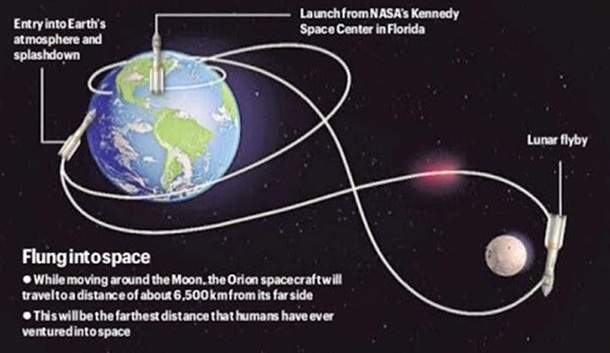
Mission Profile and Flight Path

  • The Artemis II mission follows a carefully designed trajectory to maximise both safety and scientific validation :
  • Initial Phase :
    • The spacecraft will orbit Earth twice to check system performance and trajectory accuracy before heading toward deep space.
  • Trans-Lunar Injection :
    • After Earth orbits, the spacecraft will be propelled toward the Moon using a powerful rocket burn.
  • Lunar Flyby :
    • The spacecraft will travel around the Moon, reaching up to 6,500 km beyond its far side, marking the farthest distance humans have ever travelled in space.
  • Return Journey :
    • After completing the flyby, the spacecraft will re-enter Earth’s atmosphere and safely land.
  • This trajectory ensures :
    • Testing of navigation systems
    • Validation of communication over long distances
    • Assessment of human endurance in deep space

Technology Behind Artemis II

1. Space Launch System (SLS)

  • The mission will use the Space Launch System, currently the most powerful operational rocket.
  • Key features :
    • Designed for deep space missions beyond Earth orbit
    • Provides the high thrust required for fast lunar travel
    • Enables heavier payload capacity compared to earlier systems

2. Orion Spacecraft

  • Astronauts will travel in the Orion spacecraft, designed for :
    • Long-duration human spaceflight
    • Advanced life-support systems
    • High-speed re-entry from deep space
  • The Orion capsule was successfully tested during Artemis I, validating :
    • Heat shield performance
    • Navigation systems
    • Communication capabilities

Travel Time: Speed vs Efficiency

  • Artemis II will reach the Moon in 3–4 days, similar to Apollo missions.
  • This contrasts with missions like Chandrayaan-3, which used :
    • Slower, fuel-efficient trajectories
    • Gravity-assisted orbits to reduce energy consumption
  • The difference highlights a key trade-off in space missions :
    • Fast trajectories: Require powerful rockets but reduce travel time
    • Efficient trajectories: Save fuel but increase mission duration

NASA’s Long-Term Plan: Permanent Moon Presence

  • Artemis II is part of a broader roadmap to establish a sustained human presence on the Moon.
  • Key elements of the plan include :
    • Regular lunar missions every six months
    • Development of a lunar base camp for long-duration stays
    • Use of the Moon as a staging ground for Mars exploration
  • This marks a shift from :
    • Exploration → Habitation
    • Short missions → Continuous presence

Role of Artemis Programme

  • The Artemis programme is structured as a step-by-step progression toward long-term lunar exploration :
  • Artemis I (2022) :
    • Uncrewed test mission to validate systems
  • Artemis II :
    • First crewed lunar flyby mission
  • Future Missions :
    • Planned human Moon landing (around 2028)
    • Expansion toward permanent lunar infrastructure
  • This phased approach reduces risks and ensures technological reliability.

India’s Role in the New Lunar Race

  • India has emerged as a significant player in the evolving global space ecosystem, led by ISRO.
  • Strategic Alignment :
    • India is a signatory to the Artemis Accords, supporting: 
    • Peaceful use of space
    • Sustainable exploration
      • International collaboration
  • Technological Collaboration :
    • Joint missions like NISAR demonstrate growing cooperation between India and the US.
  • Future Ambitions :
    • India aims for a human Moon landing by 2040, positioning itself as a major space power.

Global Lunar Competition

  • The new space race includes multiple countries :
  • China :
    • Plans human Moon landing by 2030
  • Japan & Europe :
    • Active participants in collaborative missions
  • Private Sector :
    • Increasing role in launch systems, habitats, and logistics
  • This reflects a shift from US–USSR rivalry → multi-polar space competition and cooperation.

Key Concepts

1. Escape Velocity

  • Minimum speed required to break free from Earth’s gravitational pull (~11.2 km/s).

2. Low Earth Orbit (LEO) vs Deep Space

  • LEO : Up to ~2,000 km above Earth (used for satellites, ISS)
  • Deep Space : Beyond Earth orbit (Moon, Mars missions)

3. Lunar Orbit vs Flyby

  • Orbit : Spacecraft stays around the Moon
  • Flyby : Spacecraft passes around the Moon and returns

4. Trans-Lunar Injection

  • Rocket maneuver that sends a spacecraft from Earth orbit toward the Moon

5. Heat Shield Technology

  • Protects spacecraft during high-speed re-entry into Earth’s atmosphere

Significance of Artemis II Mission

  • Technological Advancement : Tests next-generation deep space systems
  • Human Spaceflight : Marks return of humans to lunar vicinity after 50+ years
  • Strategic Importance : Strengthens US leadership in space exploration
  • Scientific Exploration : Enables future research on Moon and beyond
  • International Cooperation : Opens opportunities for global partnerships

Core Analysis: Opportunities vs Challenges

Opportunities

  • Establishing a long-term human presence beyond Earth
  • Advancing space technology and innovation
  • Enhancing international collaboration

Challenges

  • High mission costs and technical risks
  • Human safety in deep space environment
  • Sustainability of long-term lunar missions

Way Forward

Short-Term Focus

  • Successful execution of Artemis II
  • Validation of life-support and navigation systems

Long-Term Vision

  • Establishment of lunar base infrastructure
  • Integration of international and private partners
  • Preparation for human missions to Mars

Policy Dimension

  • Promote global cooperation in space exploration
  • Ensure peaceful and sustainable use of outer space
  • Encourage participation of emerging space nations

Practice Questions

Prelims :
Q. What is the purpose of Trans-Lunar Injection ?
(a) To place a satellite in Earth orbit
(b) To send a spacecraft toward the Moon
(c) To land on the Moon
(d) To return from space

Mains :
“Discuss the significance of the Artemis programme in shaping the future of global space exploration.”

FAQs

1. What is Artemis II mission ?

It is NASA’s first crewed mission to travel around the Moon after 50 years.

2. Will astronauts land on the Moon ?

No, it is a flyby mission.

3. What rocket is used ?

The Space Launch System (SLS).

4. How long is the mission ?

About 10 days.

5. Why is it important ?

It prepares for future human Moon landings and long-term exploration.

« »
  • SUN
  • MON
  • TUE
  • WED
  • THU
  • FRI
  • SAT
Have any Query?

Our support team will be happy to assist you!

OR
X