Prelims : (Science & Technology + CA)
Mains : GS 3 – Space Technology, International Cooperation, Emerging Technologies |
Why in News ?
- The NASA is preparing for the Artemis II mission, which will send four astronauts on a 10-day journey around the Moon, marking the first human mission beyond low Earth orbit since 1972.
- Unlike earlier missions, Artemis II will be a lunar flyby mission (no landing), acting as a crucial step toward a planned human Moon landing later in the decade.
- The mission signals the beginning of a new era of sustained lunar exploration, involving multiple countries and private players.
Background and Context
- The last human mission to the Moon occurred during the Apollo 17, concluding the Apollo programme that focused on short-duration lunar landings.
- The new Artemis programme represents a paradigm shift in space exploration, moving from symbolic visits to :
- Long-term human presence
- Sustainable lunar infrastructure
- Preparation for future Mars missions
- The initiative reflects a broader transformation in global space dynamics :
- From Cold War-era competition to multi-country collaboration and commercial participation
- Increasing involvement of emerging space powers such as India and China
What is Artemis II Mission ?
- Artemis II is the first crewed mission under the Artemis programme, following the successful uncrewed Artemis I.
- It aims to :
- Test life-support and safety systems in deep space
- Demonstrate crewed navigation beyond Earth orbit
- Validate technologies required for future Moon landings
- The mission is essentially a high-risk, high-value test flight, ensuring that all systems are reliable before humans attempt to land on the Moon again.
Mission Profile and Flight Path
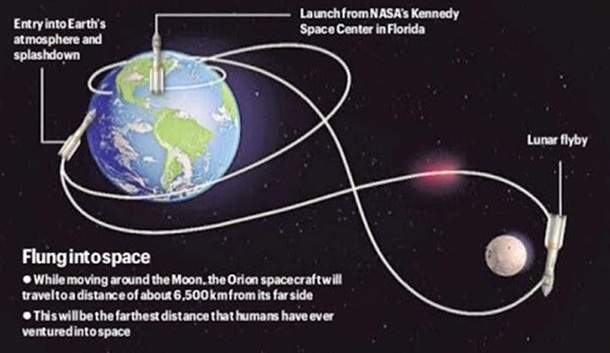
- The Artemis II mission follows a carefully designed trajectory to maximise both safety and scientific validation :
- Initial Phase :
- The spacecraft will orbit Earth twice to check system performance and trajectory accuracy before heading toward deep space.
- Trans-Lunar Injection :
- After Earth orbits, the spacecraft will be propelled toward the Moon using a powerful rocket burn.
- Lunar Flyby :
- The spacecraft will travel around the Moon, reaching up to 6,500 km beyond its far side, marking the farthest distance humans have ever travelled in space.
- Return Journey :
- After completing the flyby, the spacecraft will re-enter Earth’s atmosphere and safely land.
- This trajectory ensures :
- Testing of navigation systems
- Validation of communication over long distances
- Assessment of human endurance in deep space
Technology Behind Artemis II
1. Space Launch System (SLS)
- The mission will use the Space Launch System, currently the most powerful operational rocket.
- Key features :
- Designed for deep space missions beyond Earth orbit
- Provides the high thrust required for fast lunar travel
- Enables heavier payload capacity compared to earlier systems
2. Orion Spacecraft
- Astronauts will travel in the Orion spacecraft, designed for :
- Long-duration human spaceflight
- Advanced life-support systems
- High-speed re-entry from deep space
- The Orion capsule was successfully tested during Artemis I, validating :
- Heat shield performance
- Navigation systems
- Communication capabilities
Travel Time: Speed vs Efficiency
- Artemis II will reach the Moon in 3–4 days, similar to Apollo missions.
- This contrasts with missions like Chandrayaan-3, which used :
- Slower, fuel-efficient trajectories
- Gravity-assisted orbits to reduce energy consumption
- The difference highlights a key trade-off in space missions :
- Fast trajectories: Require powerful rockets but reduce travel time
- Efficient trajectories: Save fuel but increase mission duration
NASA’s Long-Term Plan: Permanent Moon Presence
- Artemis II is part of a broader roadmap to establish a sustained human presence on the Moon.
- Key elements of the plan include :
- Regular lunar missions every six months
- Development of a lunar base camp for long-duration stays
- Use of the Moon as a staging ground for Mars exploration
- This marks a shift from :
- Exploration → Habitation
- Short missions → Continuous presence
Role of Artemis Programme
- The Artemis programme is structured as a step-by-step progression toward long-term lunar exploration :
- Artemis I (2022) :
- Uncrewed test mission to validate systems
- Artemis II :
- First crewed lunar flyby mission
- Future Missions :
- Planned human Moon landing (around 2028)
- Expansion toward permanent lunar infrastructure
- This phased approach reduces risks and ensures technological reliability.
India’s Role in the New Lunar Race
- India has emerged as a significant player in the evolving global space ecosystem, led by ISRO.
- Strategic Alignment :
- India is a signatory to the Artemis Accords, supporting:
- Peaceful use of space
- Sustainable exploration
- International collaboration
- Technological Collaboration :
- Joint missions like NISAR demonstrate growing cooperation between India and the US.
- Future Ambitions :
- India aims for a human Moon landing by 2040, positioning itself as a major space power.
Global Lunar Competition
- The new space race includes multiple countries :
- China :
- Plans human Moon landing by 2030
- Japan & Europe :
- Active participants in collaborative missions
- Private Sector :
- Increasing role in launch systems, habitats, and logistics
- This reflects a shift from US–USSR rivalry → multi-polar space competition and cooperation.
Key Concepts
1. Escape Velocity
- Minimum speed required to break free from Earth’s gravitational pull (~11.2 km/s).
2. Low Earth Orbit (LEO) vs Deep Space
- LEO : Up to ~2,000 km above Earth (used for satellites, ISS)
- Deep Space : Beyond Earth orbit (Moon, Mars missions)
3. Lunar Orbit vs Flyby
- Orbit : Spacecraft stays around the Moon
- Flyby : Spacecraft passes around the Moon and returns
4. Trans-Lunar Injection
- Rocket maneuver that sends a spacecraft from Earth orbit toward the Moon
5. Heat Shield Technology
- Protects spacecraft during high-speed re-entry into Earth’s atmosphere
Significance of Artemis II Mission
- Technological Advancement : Tests next-generation deep space systems
- Human Spaceflight : Marks return of humans to lunar vicinity after 50+ years
- Strategic Importance : Strengthens US leadership in space exploration
- Scientific Exploration : Enables future research on Moon and beyond
- International Cooperation : Opens opportunities for global partnerships
Core Analysis: Opportunities vs Challenges
Opportunities
- Establishing a long-term human presence beyond Earth
- Advancing space technology and innovation
- Enhancing international collaboration
Challenges
- High mission costs and technical risks
- Human safety in deep space environment
- Sustainability of long-term lunar missions
Way Forward
Short-Term Focus
- Successful execution of Artemis II
- Validation of life-support and navigation systems
Long-Term Vision
- Establishment of lunar base infrastructure
- Integration of international and private partners
- Preparation for human missions to Mars
Policy Dimension
- Promote global cooperation in space exploration
- Ensure peaceful and sustainable use of outer space
- Encourage participation of emerging space nations
Practice Questions
Prelims :
Q. What is the purpose of Trans-Lunar Injection ?
(a) To place a satellite in Earth orbit
(b) To send a spacecraft toward the Moon
(c) To land on the Moon
(d) To return from space
Mains :
“Discuss the significance of the Artemis programme in shaping the future of global space exploration.”
FAQs
1. What is Artemis II mission ?
It is NASA’s first crewed mission to travel around the Moon after 50 years.
2. Will astronauts land on the Moon ?
No, it is a flyby mission.
3. What rocket is used ?
The Space Launch System (SLS).
4. How long is the mission ?
About 10 days.
5. Why is it important ?
It prepares for future human Moon landings and long-term exploration.
|






 Contact Us
  New Batch : 9555124124/ 7428085757
  Tech Support : 9555124124/ 7428085757