| Prelims: (International Relations + CA) Mains: (GS 2 – International Relations; GS 3 – Indian Economy, Agriculture, Digital Economy) |
The United States has revised its official factsheet on the India–US trade deal, softening language on India’s commitments and removing references to digital services taxes and tariff cuts on pulses. The joint statement has also been modified to reflect non-binding intent, signalling a recalibration of expectations on both sides.

India–US economic relations have expanded rapidly over the past decade, driven by:
However, trade negotiations between the two countries have often been marked by sensitivity around agriculture, digital taxation, and regulatory sovereignty. While both sides seek deeper economic integration, India has consistently emphasised protecting farmers, maintaining fiscal autonomy, and preserving policy space in emerging sectors such as the digital economy.
The latest US revisions to the trade factsheet reflect an effort to align public messaging with the actual, non-binding nature of commitments and to avoid misinterpretation or political backlash in India.
This change acknowledges that:
Farmer groups have raised objections citing:
These concerns have led to calls for agriculture to remain protected in bilateral and multilateral trade agreements.
The revised US factsheet removed claims that India would:
This clause was not part of the joint statement and its removal reflects India’s insistence on preserving fiscal and regulatory autonomy.
Concerns extend beyond taxation to:
A 2018 UN Trade and Development report highlighted that data localisation can:
Given India’s vast user base and rapidly growing digital economy, retaining regulatory space is seen as crucial for building globally competitive digital platforms.
1. Preserving Policy Sovereignty
The revised language safeguards India’s ability to regulate agriculture, taxation, and digital governance without binding external constraints.
2. Protecting Farmers and Food Security
Removing pulses from the factsheet reduces fears of large-scale agricultural market access concessions that could affect domestic producers.
3. Enhancing Negotiation Credibility
Aligning official communication with actual commitments strengthens transparency and trust in trade diplomacy.
4. Maintaining Strategic Economic Autonomy
India retains flexibility to recalibrate its trade and industrial policies in response to domestic needs and global uncertainties.
5. Supporting Balanced Economic Engagement
The revisions allow India to pursue deeper trade ties with the US while safeguarding national interests and social stability.
FAQs1. Why did the US revise its trade factsheet on India ? To align public messaging with the non-binding nature of the joint statement and avoid misinterpretation of India’s commitments. 2. What does the shift from “committed” to “intends” mean ? It clarifies that the $500 billion purchase target is aspirational and not a legally binding obligation. 3. Why is the removal of pulses from the factsheet significant ? Pulses are politically sensitive in India due to food security and farmer livelihoods, and their removal reduces fears of excessive agricultural concessions. 4. What is the significance of dropping the digital services tax clause ? It preserves India’s fiscal and regulatory sovereignty, allowing flexibility in taxing digital firms and regulating the digital economy. 5. How does this development affect India–US trade relations ? It enhances transparency, reduces domestic backlash in India, and enables more balanced and realistic trade engagement between the two countries. |
| Prelims: (Polity & Governance + CA) Mains: (GS 2 – Welfare Schemes, Social Justice; GS 3 – Inclusive Growth, MSMEs) |
The PM-SURAJ portal disbursed ₹1,389.61 crore in loans to 1.39 lakh entrepreneurs during the 2024–25 fiscal year, surpassing its initial target and marking a significant step toward digital, inclusive credit delivery for disadvantaged communities.

Access to affordable institutional credit remains one of the biggest barriers faced by entrepreneurs from Scheduled Castes (SCs), Scheduled Tribes (STs), Other Backward Classes (OBCs), Safai Karamcharis, and other disadvantaged groups.
Historically, such communities have struggled with:
While various development finance corporations have existed for targeted lending, beneficiaries often faced procedural delays, lack of transparency, and limited digital integration.
In this context, the government launched the Pradhan Mantri Samajik Utthan evam Rozgar Aadharit Jankalyan (PM-SURAJ) portal in 2024, aiming to create a single-window digital platform for credit support and entrepreneurial empowerment.
The PM-SURAJ portal is a centralised digital platform launched by the Ministry of Social Justice and Empowerment in 2024.
To provide credit support to entrepreneurs from disadvantaged sections of society through a transparent, technology-driven system.
The portal ensures that applicants can:
The PM-SURAJ portal operates through key government financial corporations:
These institutions:
The Ministry of Social Justice and Empowerment oversees policy design, supervision, and monitoring.
The scheme aims to extend credit assistance to one lakh entrepreneurs from disadvantaged communities, and early results indicate strong demand and uptake.
By targeting SCs, STs, OBCs, and other marginalized communities, the portal aligns with the constitutional vision of social and economic justice.
Rather than direct subsidies, the scheme promotes:
This reduces dependency and enhances dignity and economic agency.
The centralised portal:
By linking beneficiaries with formal banking institutions, PM-SURAJ:
Small enterprises generate employment and local economic activity, contributing to:
FAQs1. What is the PM-SURAJ portal ? It is a centralised digital platform launched in 2024 to provide credit support to entrepreneurs from disadvantaged communities. 2. Who is eligible to apply ? Individuals from marginalized sections such as SCs, STs, OBCs, Safai Karamcharis, and other disadvantaged groups intending to start a new business. 3. What is the maximum loan amount available ? Business loans up to ₹15 lakh are available at concessional interest rates. 4. Which institutions implement the scheme ? NSFDC, NSKFDC, and NBCFDC under the Ministry of Social Justice and Empowerment. 5. Why is PM-SURAJ significant ? It promotes inclusive entrepreneurship, financial inclusion, digital transparency, and social justice by empowering marginalized communities through access to institutional credit. |
| Prelims: (Polity & Governance + CA) Mains: (GS 3 – Digital Economy, Inclusive Growth, Infrastructure; GS 2 – Governance and E-Governance) |
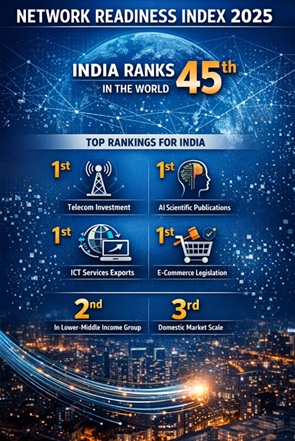
India has improved its global standing by four positions to secure the 45th rank in the Network Readiness Index (NRI) 2025, reflecting significant progress in digital infrastructure, innovation, governance, and socio-economic impact of information and communication technologies (ICTs).
In the contemporary digital economy, nations’ competitiveness increasingly depends on how effectively they:
India’s push toward a Digital India vision, expansion of broadband connectivity, promotion of fintech, e-commerce, artificial intelligence, and digital public infrastructure (DPI) such as Aadhaar, UPI, and DigiLocker has reshaped its technological landscape.
However, global assessments like the Network Readiness Index (NRI) provide a comparative framework to evaluate whether these digital transformations translate into sustained growth, innovation, and social inclusion. India’s improved ranking in NRI 2025 reflects the growing maturity of its digital ecosystem.
The Network Readiness Index is a global benchmarking tool that evaluates how well economies leverage information and communication technologies (ICTs) to promote:
The NRI evaluates countries based on four core pillars:
Each pillar is measured through multiple indicators, creating a composite score out of 100 for each country.
India secured 1st rank in:
These indicators highlight India’s strengths in infrastructure expansion, digital trade, AI research, and legal frameworks for e-commerce.
India’s strong performance reflects:
However, digital skill gaps persist across rural-urban and gender divides.
India’s leadership in e-commerce legislation and evolving frameworks for:
reflects improving digital governance capacity.
The economic and social impact of digital transformation is visible in:
A higher NRI ranking signals improved readiness to:
India’s performance validates its DPI approach, making it a global reference model for inclusive digital transformation.
Improved rankings enhance India’s:
Digital readiness enables:
Progress in NRI aligns with:
FAQs1. What is the Network Readiness Index (NRI) ? It is a global index that assesses how well countries leverage ICTs for economic growth, innovation, and social development. 2. Who publishes the NRI ? The index is published by the Portulans Institute, a non-profit research institute based in Washington DC. 3. What are the four pillars of the NRI ? Technology, People, Governance, and Impact. 4. What is India’s rank in NRI 2025 ? India is ranked 45th globally and second among lower-middle-income countries. 5. Why is India’s improved ranking significant ? It reflects India’s growing digital infrastructure, innovation capacity, governance frameworks, and socio-economic impact of digital transformation, strengthening its global competitiveness. |
| Prelims: (Polity + Economy + CA) Mains: (GS 2 – Federalism, Centre–State Relations; GS 3 – Public Finance) |
The 16th Finance Commission has submitted its report for 2026–31, and the Union government has accepted its recommendations on tax devolution to States, shaping Centre–State fiscal relations for the next five years.

India’s federal system rests on a delicate balance between:
The Finance Commission, constituted every five years under Article 280, is the constitutional mechanism to manage this balance by recommending how central tax revenues should be shared between the Centre and the States and among States themselves.
Over the past decade, this balance has come under strain due to:
Against this backdrop, the 16th Finance Commission’s recommendations carry major implications for fiscal autonomy, equity, and efficiency in India’s federal structure.
India’s fiscal federalism is anchored in:
Cess and surcharge, however, are excluded from the divisible pool.
For 2025–26, the divisible pool constitutes about 81% of the Centre’s gross tax revenue, after excluding cess and surcharge. This exclusion has been central to debates on fiscal equity and resource adequacy for States.
Vertical devolution refers to the share of States in the divisible pool of central taxes.
This marked a structural shift toward greater fiscal autonomy for States, though concerns remained over the Centre’s growing use of non-shareable cesses.
Horizontal devolution refers to how the States’ share is distributed among individual States.
Since the 13th Finance Commission, criteria have broadly emphasised:
This framework has generated persistent debates between:
These demands reflected a fundamental tension between:
Result: No major change in vertical devolution.
The Commission adopted two guiding principles:
Accordingly:
Outcome:
Overall, the outcome represents a calibrated shift toward efficiency while maintaining redistributive balance.
The Commission made several important observations:
These recommendations reflect concerns over fiscal sustainability, macroeconomic stability, and cooperative federalism.
1. Strengthening Cooperative Federalism
By maintaining stability in vertical devolution while refining horizontal criteria, the Commission reinforces trust between the Centre and States.
2. Balancing Equity and Efficiency
The introduction of GDP contribution as a criterion reflects a shift toward recognising performance, without abandoning redistribution.
3. Preserving Fiscal Stability
Retaining the 41% share avoids sudden fiscal shocks and helps the Union meet national expenditure priorities.
4. Encouraging Responsible State Finances
Emphasis on subsidy rationalisation, debt control, and power sector reforms pushes States toward fiscal discipline and long-term sustainability.
5. Shaping the Next Phase of Federal Governance
The report sets the tone for Centre–State fiscal relations in an era of:
FAQs1. What is the main role of the Finance Commission ? It recommends how central tax revenues should be shared between the Centre and the States and among States themselves. 2. What has the 16th Finance Commission decided on vertical devolution ? It retained the States’ share at 41% of the divisible pool for 2026–31. 3. Why is cess and surcharge a contentious issue ? Because they are excluded from the divisible pool, reducing the share of revenues available to States. 4. What new criterion has been introduced in horizontal devolution ? The States’ contribution to GDP, recognising efficiency and growth performance. 5. How do these recommendations affect Centre–State relations ? They seek to balance equity and efficiency while maintaining fiscal stability and strengthening cooperative federalism. |
| Prelims: (Science & Technology + CA) Mains: (GS 3 – Science and Technology, Space Research, Indigenous Innovation) |
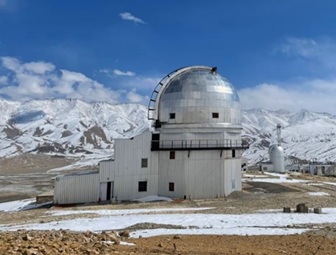
The Union Budget has approved the establishment of two new telescopes in Ladakh—one to study the Sun and another to explore the origins of the universe—along with the upgradation of an existing telescope. Ladakh, already a major astronomy hub and home to India’s first Dark Sky Reserve at Hanle, is set to play a transformative role in Indian and global astronomy.
India’s space and astronomical research ecosystem has expanded steadily over the past two decades, marked by landmark achievements such as Chandrayaan, Gaganyaan, and Aditya-L1. However, ground-based observational astronomy remains equally crucial for:
Ladakh’s unique geography—high altitude, dry climate, low atmospheric turbulence, and minimal light pollution—makes it one of the world’s best locations for optical and infrared astronomy. The designation of Hanle as India’s first Dark Sky Reserve further institutionalises conservation of night-sky conditions.
The Budget’s approval of three major telescope projects signals a strategic push to:
The NLST is a 2-metre aperture solar telescope planned in the Merak region near Pangong Tso in Ladakh. It will operate in the visible and near-infrared wavelengths, enabling high-resolution, ground-based observations of the Sun.
The NLST will enable detailed studies of:
These studies are critical for:
Once operational (expected within 5–6 years), NLST will become India’s third ground-based solar observatory, joining:
It will also complement ISRO’s Aditya-L1 mission (launched in 2023), creating a robust, integrated heliophysics research ecosystem combining space-based and ground-based observations.
The NLOT will be a 13.7-metre aperture segmented-mirror telescope built in Hanle, Ladakh. Its primary mirror will consist of 90 hexagonal segments, functioning together as a single giant mirror to capture extremely faint cosmic light with high precision.
Once completed (within the next decade), NLOT will rank among the largest optical–infrared telescopes in the world.
Ladakh’s:
minimise atmospheric distortion and absorption, enabling sharper and more accurate astronomical observations compared to many global sites.
NLOT will enable frontier research in:
Its optical–infrared capability is essential for observing distant, faint, and redshifted cosmic objects, making it a cornerstone for deep-sky cosmology.
India’s participation in the Thirty Meter Telescope (TMT) project has built strong expertise in segmented-mirror technology. TMT’s 30-metre mirror uses 494 hexagonal segments, and India contributes by:
This experience will significantly ease the design, construction, and precision alignment challenges involved in building NLOT.
Upgraded Himalayan Chandra Telescope: Strengthening India’s Transient Astronomy
The 2-metre HCT, established over 25 years ago in Ladakh, has been a pioneer in Indian observational astronomy. It has contributed significantly to:
The approved upgrade will transform HCT into a 3.7-metre segmented-mirror telescope, operating in the optical–infrared wavelengths. This will:
The upgraded HCT will work in synergy with major international projects such as:
By coordinating observations, HCT will help identify and study cosmic events detected via gravitational waves and radio signals, enabling multi-messenger astronomy.
NLST and NLOT will be among the most powerful facilities at this longitude and region, offering observational windows not fully covered by existing global telescopes.
These telescopes will generate high-quality, original data in:
This will significantly enhance India’s contribution to global scientific knowledge.
Unlike international telescopes where access is competitive and limited, these indigenous facilities will provide assured and preferential observation time to Indian scientists, boosting domestic research output and training.
Building and operating these telescopes will:
Together, NLST and NLOT position India as a leader in astronomy in the Global South, contributing critical insights to the international scientific community and shaping future collaborative research.
FAQs1. Why is Ladakh chosen for major astronomical observatories ? Ladakh offers high altitude, dry climate, low atmospheric turbulence, and minimal light pollution, making it ideal for optical and infrared astronomy. 2. What is the main purpose of the National Large Solar Telescope (NLST) ? NLST will study solar activity, magnetism, and space weather, helping protect satellites, communication systems, and space missions. 3. How significant is the National Large Optical–Near Infrared Telescope (NLOT) ? With a 13.7-metre segmented mirror, NLOT will be among the world’s largest telescopes, enabling deep-space and cosmological research. 4. What role will the upgraded Himalayan Chandra Telescope play ? The upgraded 3.7-metre HCT will enhance India’s capability in transient and multi-messenger astronomy, working with facilities like LIGO-India and SKA. 5. How do these telescopes strengthen India’s global scientific standing ? They position India as a leading astronomy hub in the Global South, enhance indigenous scientific capability, and contribute significantly to global astronomical research. |

Our support team will be happy to assist you!


 Contact Us
  New Batch : 9555124124/ 7428085757
  Tech Support : 9555124124/ 7428085757