New
GS Foundation (P+M) - Delhi : 19th Jan. 2026, 11:30 AM Spring Sale UPTO 75% + 10% Off, Valid Till : 6th Feb., 2026 GS Foundation (P+M) - Prayagraj : 09th Jan. 2026, 11:00 AM Spring Sale UPTO 75% + 10% Off, Valid Till : 6th Feb., 2026 GS Foundation (P+M) - Delhi : 19th Jan. 2026, 11:30 AM GS Foundation (P+M) - Prayagraj : 09th Jan. 2026, 11:00 AM

Network Readiness Index 2025: India’s Rising Digital Competitiveness

Prelims: (Polity & Governance + CA)
Mains: (GS 3 – Digital Economy, Inclusive Growth, Infrastructure; GS 2 – Governance and E-Governance)

Why in the News ?

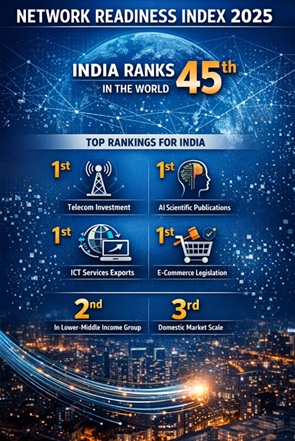
India has improved its global standing by four positions to secure the 45th rank in the Network Readiness Index (NRI) 2025, reflecting significant progress in digital infrastructure, innovation, governance, and socio-economic impact of information and communication technologies (ICTs).
Background and Context

In the contemporary digital economy, nations’ competitiveness increasingly depends on how effectively they:

  • Deploy digital infrastructure
  • Build human capital
  • Ensure digital governance
  • Translate technology into socio-economic impact

India’s push toward a Digital India vision, expansion of broadband connectivity, promotion of fintech, e-commerce, artificial intelligence, and digital public infrastructure (DPI) such as Aadhaar, UPI, and DigiLocker has reshaped its technological landscape.

However, global assessments like the Network Readiness Index (NRI) provide a comparative framework to evaluate whether these digital transformations translate into sustained growth, innovation, and social inclusion. India’s improved ranking in NRI 2025 reflects the growing maturity of its digital ecosystem.

About the Network Readiness Index (NRI)

The Network Readiness Index is a global benchmarking tool that evaluates how well economies leverage information and communication technologies (ICTs) to promote:

  • Economic growth
  • Innovation
  • Social development
  • Digital inclusion

Institutional Origin

  • Published by the Portulans Institute, an independent, non-profit research and educational institute based in Washington DC.

Methodology and Pillars

The NRI evaluates countries based on four core pillars:

  1. Technology Infrastructure, access, and future technologies (AI, cloud, broadband, etc.).
  2. People Digital skills, ICT usage by individuals, businesses, and governments.
  3. GovernanceTrust, regulation, cybersecurity, privacy, and digital policies.
  4. Impact Economic, social, and environmental outcomes of digital transformation.

Each pillar is measured through multiple indicators, creating a composite score out of 100 for each country.

Key Highlights of Network Readiness Index 2025

India’s Overall Performance

  • Global Rank: 45th (up from 49th in 2024)
  • Score: Improved from 53.63 (2024) to 43 (2025) (as per report methodology update)
  • Income Group Rank: 2nd among lower-middle-income countries

Top Global Ranks for India

India secured 1st rank in:

  • Annual investment in telecommunication services
  • AI scientific publications
  • ICT services exports
  • E-commerce legislation

Other High Rankings

  • 2nd rank in:
    • FTTH/Building Internet subscriptions
    • Mobile broadband internet traffic within the country
    • International Internet bandwidth
  • 3rd rank in:
    • Domestic market scale
    • Income inequality (as per index parameters)

These indicators highlight India’s strengths in infrastructure expansion, digital trade, AI research, and legal frameworks for e-commerce.

India’s Performance: Trends and Interpretation

1. Technology Pillar

India’s strong performance reflects:

  • Massive telecom investments
  • Rapid 4G/5G rollout
  • Expansion of fiber-to-the-home (FTTH) connectivity
  • Growth of AI research and data infrastructure

2. People Pillar

  • High digital adoption among individuals and businesses
  • Rapid fintech and e-commerce usage
  • Growing pool of digitally skilled workforce

However, digital skill gaps persist across rural-urban and gender divides.

3. Governance Pillar

India’s leadership in e-commerce legislation and evolving frameworks for:

  • Data protection
  • Cybersecurity
  • Digital payments regulation

reflects improving digital governance capacity.

4. Impact Pillar

The economic and social impact of digital transformation is visible in:

  • Growth of digital services exports
  • Financial inclusion through UPI and DBT
  • Expansion of MSMEs through online platforms

Significance of India’s Improved Ranking

1. Strengthening India’s Digital Economy

A higher NRI ranking signals improved readiness to:

  • Harness emerging technologies
  • Attract digital investment
  • Scale innovation ecosystems

2. Boost to Digital Public Infrastructure (DPI) Model

India’s performance validates its DPI approach, making it a global reference model for inclusive digital transformation.

3. Enhanced Global Competitiveness

Improved rankings enhance India’s:

  • Soft power in digital governance
  • Position in global tech supply chains
  • Attractiveness for global technology firms and investors

4. Supporting Inclusive Growth

Digital readiness enables:

  • Financial inclusion
  • E-governance delivery
  • Bridging service delivery gaps in health, education, and welfare

5. Alignment with National Development Goals

Progress in NRI aligns with:

  • Digital India
  • Make in India
  • Startup India
  • Vision of becoming a $5 trillion economy

Challenges and Way Forward

Challenges

  • Digital divide across regions and socio-economic groups
  • Cybersecurity risks and data protection concerns
  • Uneven digital skills distribution
  • Need for sustainable digital infrastructure

Way Forward

  • Expand digital literacy and skilling programs
  • Strengthen cybersecurity and data governance frameworks
  • Promote rural broadband and last-mile connectivity
  • Encourage innovation in emerging technologies like AI, quantum, and semiconductors
  • Foster public-private partnerships in digital infrastructure

FAQs

1. What is the Network Readiness Index (NRI) ?

It is a global index that assesses how well countries leverage ICTs for economic growth, innovation, and social development.

2. Who publishes the NRI ?

The index is published by the Portulans Institute, a non-profit research institute based in Washington DC.

3. What are the four pillars of the NRI ?

Technology, People, Governance, and Impact.

4. What is India’s rank in NRI 2025 ?

India is ranked 45th globally and second among lower-middle-income countries.

5. Why is India’s improved ranking significant ?

It reflects India’s growing digital infrastructure, innovation capacity, governance frameworks, and socio-economic impact of digital transformation, strengthening its global competitiveness.

Have any Query?

Our support team will be happy to assist you!

OR
X