Why in the News?
- The 30-year Ganges Water-Sharing Treaty signed between India and Bangladesh in 1996 is set to expire in December 2026.
- On November 3, 2026, Ministry of External Affairs (MEA) spokesperson Randhir Jaiswal stated that both countries have an institutional mechanism to discuss issues concerning all shared rivers, including the Ganges.
- The Joint Rivers Commission (JRC) serves as the institutional mechanism for discussions on transboundary rivers.
- India has invited Bangladesh Prime Minister Tarique Rahman to visit New Delhi. However, there has been no official update regarding the renewal of the treaty or the dates of his visit.
- Against this backdrop, climate change, river ecology and flood management are expected to become important issues in the upcoming negotiations, alongside water sharing.
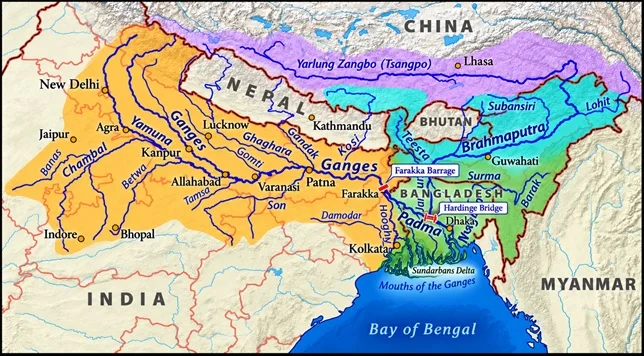
What is the Ganges Water-Sharing Treaty?
- The Ganges Water-Sharing Treaty was signed between India and Bangladesh on December 12, 1996.
- The agreement was concluded under the leadership of Indian Prime Minister H.D. Deve Gowda and Bangladesh Prime Minister Sheikh Hasina.
- Its primary objective is to share the available water of the Ganges during the dry season through the Farakka Barrage in West Bengal.
Key Features of the Treaty
- Duration: 30 years (1996–2026).
- Expiry Date: December 12, 2026.
- River: Ganges (known as the Padma in Bangladesh).
- Water-Sharing Period: January 1 to May 31 every year.
- Water Measurement Points: Farakka Barrage (India) and Hardinge Bridge (Bangladesh).
Water-Sharing Mechanism Under the Treaty
Under the treaty, the available water of the Ganges at the Farakka Barrage is distributed between the two countries in successive 10-day periods.
- When water availability is 70,000 cusecs or less: The water is shared equally between India and Bangladesh.
- When water availability is between 70,000 and 75,000 cusecs: Bangladesh receives 35,000 cusecs, while India receives the remaining water.
- When water availability exceeds 75,000 cusecs: India receives 40,000 cusecs, while Bangladesh receives the remaining water.
- Special Provision: If the water flow falls below 50,000 cusecs, both governments are required to enter into immediate consultations.
Significance of the Farakka Barrage
The Farakka Barrage is an important water infrastructure project located on the Ganges River in West Bengal. It was primarily constructed to maintain water flow in the Hooghly River and improve the navigability of the Kolkata Port.
Major Objectives:
- Maintaining adequate water flow in the Hooghly River.
- Helping reduce silt accumulation in the Kolkata-Haldia port system.
- Regulating and utilising river water.
- Meeting irrigation and other water requirements of West Bengal.
However, the impact of the Farakka Barrage on river flows and sediment movement has remained a subject of discussion between India and Bangladesh.
Major Causes of the Ganges Water Dispute Between India and Bangladesh
- Water Scarcity During the Dry Season: River flows decline between January and May. During this period, both countries have significant agricultural, drinking water and industrial requirements.
- Demand for Minimum Water Guarantees: Bangladesh seeks to ensure a guaranteed minimum quantity of water during the dry season. For India, providing such a guarantee is challenging due to natural variations in water availability and domestic requirements.
- Impact of the Farakka Barrage: Bangladesh believes that the Farakka Barrage affects the natural flow and hydrological characteristics of the river.
- Climate Change: Unpredictable monsoon patterns, glacier melting and changing rainfall patterns are affecting the flow of the Ganges.
- Political and Diplomatic Challenges: Political transitions, border management, security concerns and other bilateral issues can influence negotiations over the water-sharing agreement.
Major Environmental Issues Associated with the Ganges Water Treaty
The major limitation of the Ganges Water Treaty is its primary focus on the quantitative distribution of water, with insufficient attention to river ecology and sediment management.
- Sediment Imbalance: The Ganges carries large quantities of sediments from the Himalayas. These sediments play an important role in floodplain formation, delta development and maintaining soil fertility. Barrages and other human interventions can affect their natural movement.
- Impact on the Sundarbans: The Sundarbans, located within the Ganges-Brahmaputra-Meghna Delta, faces challenges such as sea-level rise, coastal erosion and saltwater intrusion.
- Impact on Agriculture and Fisheries: Reduced freshwater availability can increase soil salinity, adversely affecting agricultural production, fisheries and local livelihoods.
- Degradation of River Ecology: Changes in river flow can affect aquatic biodiversity, fish breeding patterns and the natural river ecosystem.
- Flood and Silt Management: Sediment accumulation, riverbank erosion and changes in river channels increase flood management challenges for both countries.
Significance of the Treaty for India and Bangladesh
Significance for India
- National Water Security: The Ganges supports agricultural, drinking water and industrial requirements across large parts of northern India.
- Requirements of West Bengal: Maintaining adequate water flow in the Hooghly River and protecting the Kolkata-Haldia port system and Sundarbans ecosystem are important Indian interests.
- Regional Stability: Stronger relations with Bangladesh are consistent with India's Neighbourhood First Policy.
- Regional Connectivity: Cooperation with Bangladesh can strengthen trade, transportation and regional connectivity, particularly with India's Northeast.
Significance for Bangladesh
- Agriculture and Food Security: Ganges water is important for irrigation and agricultural production.
- Drinking Water Availability: Ensuring adequate freshwater availability during the dry season is essential.
- Environmental Conservation: Freshwater flows are important for protecting the Sundarbans' mangrove forests, aquatic biodiversity and delta ecosystem.
- Livelihoods: Agriculture, fisheries and other river-based economic activities depend on the Ganges' water flows.
Major Challenges in the Renewal of the Ganges Water Treaty
- 1. Changing Political Landscape: Following the removal of Sheikh Hasina from power in 2024, Bangladesh has witnessed a political transition, with a BNP-led government under Tarique Rahman. This has changed the diplomatic environment for negotiations between the two countries.
- 2. Issue of Minimum Water Availability: Bangladesh seeks a guaranteed minimum water allocation, whereas India needs to consider natural water availability and its domestic requirements.
- 3. Balancing Internal Interests: Within India, the water requirements of West Bengal, particularly for the Hooghly River and ports, as well as Bihar's concerns regarding flooding, sedimentation and water availability, need to be considered.
- 4. Growing Chinese Influence: Bangladesh's expanding economic and strategic engagement with China adds another regional dimension to India-Bangladesh water diplomacy.
- 5. Climate Change Uncertainty: Predicting future river flows is becoming increasingly difficult. Therefore, an agreement based solely on historical water availability may not be sufficient.
- 6. Neglect of Ecological Requirements: The existing treaty primarily focuses on water quantity. Issues such as sediment transport, natural river variability and environmental flows also need to be incorporated.
Way Forward: Making the Treaty Climate-Resilient
- Comprehensive and Long-Term Agreement: Both countries should move beyond water allocation and adopt an agreement based on integrated river basin management.
- Ensuring Environmental Flows: Along with water quantity, the timing, quality and seasonal variability of river flows should be considered to maintain ecological balance.
- Incorporating Sediment Management: Joint studies should be undertaken to understand the natural movement, distribution and role of Ganges sediments in delta formation.
- Joint Scientific Studies: India and Bangladesh should share data concerning river flows, groundwater, rainfall, glaciers, floods and sea-level rise.
- Strengthening the Joint Rivers Commission: The Joint Rivers Commission (JRC) should be strengthened through greater technical capacity, regular meetings and an effective dispute-resolution mechanism.
- Involving States: The interests of relevant Indian states, particularly West Bengal and Bihar, should be incorporated into India's negotiating position.
- Flexible Water-Sharing Mechanism: Given fluctuations in water availability due to climate change, the agreement should include periodic reviews and provisions for emergency consultations.
- Trust-Based Diplomacy: Both countries should prioritise cooperation and mutual trust while addressing water disputes independently of broader bilateral tensions.
UPSC Prelims Practice Question
|
Q1. With reference to the Ganges Water-Sharing Treaty between India and Bangladesh, consider the following statements:
- The treaty was signed in 1996.
- The water-sharing arrangement under the treaty operates from January to May every year.
- The Joint Rivers Commission serves as a forum for discussions on issues concerning shared rivers between India and Bangladesh.
Which of the statements given above are correct?
(a) 1 and 2 only
(b) 2 and 3 only
(c) 1 and 3 only
(d) 1, 2 and 3
|