Prelims: Colombo Security Conclave (CSC), Member Countries, Indian Ocean Region, MAHASAGAR Vision, Maritime Security.
Mains: GS Paper II – International Relations, Regional Groupings and India's Neighbourhood Policy; GS Paper III – Internal Security, Maritime Security and Cybersecurity.
Keywords: Colombo Security Conclave, Indian Ocean Region, Ajit Doval, Maritime Cooperation, Regional Security, MAHASAGAR, Neighbourhood First Policy, Blue Economy, Counter-Terrorism. |
Why in News?
- The eighth National Security Adviser (NSA)-level meeting of the Colombo Security Conclave (CSC) was held on 25 November 2026 at Villa Nautica Paradise Island in the Maldives.
- Member countries adopted a Roadmap of Cooperation for 2026–2027 to strengthen regional security.
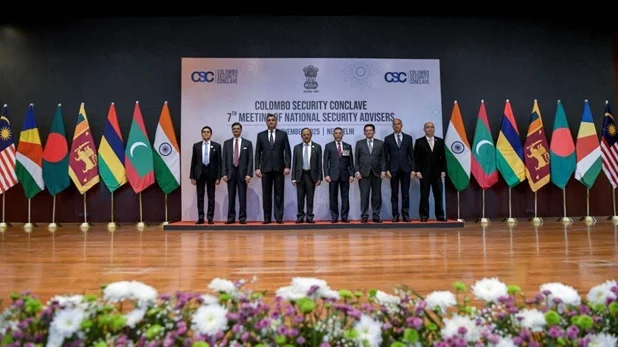
Key Highlights of the Meeting
- Roadmap adoption: India, Maldives, Sri Lanka and Mauritius signed the agreed minutes and adopted the cooperation roadmap.
- Bangladesh's participation: Bangladesh attended the meeting, while Mauritius participated virtually.
- Review of progress: CSC's first Secretary General, Vice Admiral S. N. Ghormade (Retd.), reviewed the implementation of decisions taken during the seventh NSA-level meeting.
- Capacity building: Members emphasised joint training, knowledge sharing and strengthening regional security capabilities.
- Regional stability: The meeting reaffirmed the importance of collective action against emerging security challenges.
About the Colombo Security Conclave (CSC)
The Colombo Security Conclave is a regional security cooperation mechanism that aims to promote peace, stability and security in the Indian Ocean Region (IOR).
|
Particulars
|
Details
|
|
Origin
|
2011
|
|
Revival
|
2020
|
|
Founding countries
|
India, Sri Lanka and Maldives
|
|
Secretariat
|
Colombo, Sri Lanka
|
|
Total members
|
Six
|
|
First Secretary General
|
Vice Admiral S. N. Ghormade (Retd.)
|
|
Major objective
|
Regional security cooperation
|
|
Nature
|
Multilateral security platform
|
Member Countries of the Colombo Security Conclave
Seychelles became the sixth member following its accession in November 2025. Australia and Malaysia participated as guests in the eighth NSA-level meeting.
Evolution of the Colombo Security Conclave
|
Year
|
Major Development
|
|
2011
|
Trilateral security initiative involving India, Sri Lanka and Maldives.
|
|
2020
|
Revival of regional security cooperation.
|
|
2022
|
Mauritius joined as the fourth member.
|
|
July 2024
|
Bangladesh became the fifth member.
|
|
August 2024
|
Charter and MoU for establishing the Secretariat were signed.
|
|
November 2025
|
Seychelles became the sixth member.
|
|
November 2026
|
Adoption of the 2026–27 cooperation roadmap.
|
Five Pillars of the Colombo Security Conclave
- Maritime Safety and Security: Maritime surveillance, safe navigation and combating piracy.
- Counter-Terrorism and Radicalisation: Intelligence cooperation and prevention of extremist activities.
- Combating Trafficking and Organised Crime: Addressing drug trafficking, human trafficking and cross-border crime.
- Cybersecurity and Critical Infrastructure: Protecting digital networks, essential infrastructure and technological systems.
- Humanitarian Assistance and Disaster Relief: Coordinated disaster response, rescue and humanitarian assistance.
Objectives of the 2026–27 Roadmap
- Strengthening coordination among maritime security agencies.
- Enhancing regional intelligence-sharing capabilities.
- Improving preparedness against cyberattacks and emerging technological threats.
- Promoting specialised training and capacity-building programmes.
- Strengthening cooperation against transnational organised crime.
- Improving collective preparedness for natural disasters and humanitarian emergencies.
Strategic Significance of the Colombo Security Conclave
- Security of Sea Lines of Communication (SLOCs): The Indian Ocean contains important maritime trade routes connecting Asia, Africa and Europe. Regional security cooperation helps protect commercial shipping and energy transportation.
- Countering Non-Traditional Security Threats: The CSC provides a common platform to address piracy, terrorism, illegal fishing, drug trafficking, cybercrime and other cross-border threats.
- Maritime Domain Awareness (MDA): Cooperation among member countries can improve maritime surveillance, information exchange and early identification of suspicious activities at sea.
- Regional Stability: Regular engagement among national security agencies promotes mutual confidence and reduces the possibility of misunderstandings.
- Protection of the Blue Economy: A secure maritime environment supports fisheries, coastal tourism, offshore energy resources and sustainable marine economic activities.
Importance of the Colombo Security Conclave for India
1. Strengthening India's Neighbourhood First Policy
- The CSC provides India with an institutional mechanism to deepen security relations with its maritime neighbours.
2. Counterbalancing China's Growing Influence
- China's expanding naval presence and investments in ports across the Indian Ocean have increased India's strategic concerns. The CSC can help India strengthen regional partnerships and maritime awareness. However, it is not formally an anti-China military alliance.
3. India's MAHASAGAR Vision
- MAHASAGAR stands for Mutual and Holistic Advancement for Security and Growth Across Regions. It builds upon India's earlier SAGAR vision and promotes regional cooperation, maritime security and sustainable development.
- At the eighth NSA-level meeting, Ajit Doval highlighted the connection between the CSC, India's Neighbourhood First Policy and the MAHASAGAR vision.
4. India as a Preferred Security Partner
- Through maritime surveillance, training, humanitarian assistance and capacity building, India can strengthen its position as a reliable regional security partner.
5. Protection of India's Economic and Energy Interests
- Security across the Indian Ocean is essential for India's international trade, energy imports, coastal infrastructure and economic development.
Challenges Before the Colombo Security Conclave
|
Challenge
|
Description
|
|
Geopolitical competition
|
Growing strategic rivalry among major powers.
|
|
Political instability
|
Domestic political changes may affect cooperation.
|
|
Capacity differences
|
Unequal technological and security capabilities among members.
|
|
Cyber threats
|
Increasing attacks on digital and maritime infrastructure.
|
|
Maritime crime
|
Piracy, illegal fishing and trafficking networks.
|
|
Climate change
|
Rising sea levels and extreme weather events.
|
|
Strategic differences
|
Different foreign policy priorities among member countries.
|
Way Forward
- Develop effective mechanisms for real-time maritime information sharing.
- Conduct regular joint maritime and cybersecurity exercises.
- Strengthen regional disaster-response capabilities.
- Promote technology sharing and specialised security training.
- Improve cooperation with IORA, BIMSTEC and other regional institutions.
- Respect the sovereignty and strategic autonomy of member countries.
- Ensure timely implementation and periodic review of the cooperation roadmap.
Conclusion
- The Colombo Security Conclave represents an important step towards developing a cooperative security architecture in the Indian Ocean Region.
- The adoption of the 2026–27 roadmap provides an opportunity to strengthen regional resilience against conventional and non-traditional security threats. For India, the CSC is a significant instrument for advancing its maritime interests, neighbourhood diplomacy and MAHASAGAR vision.
Prelims Practice Questions
Q. Which of the following are pillars of cooperation under the Colombo Security Conclave?
- Maritime security
- Counter-terrorism
- Monetary integration
- Cybersecurity
- Humanitarian assistance and disaster relief
Select the correct answer using the code given below:
(a) 1, 2 and 3 only
(b) 1, 2, 4 and 5 only
(c) 2, 3 and 5 only
(d) All five
Mains Practice Question
Q. Examine the significance of the Colombo Security Conclave in strengthening India's maritime security and promoting regional stability in the Indian Ocean Region.
|
FAQs
Q1. What is the Colombo Security Conclave?
A regional platform for cooperation against security threats.
Q2. When did the Colombo Security Conclave originate?
It originated as a trilateral initiative in 2011.
Q3. Where is the CSC Secretariat located?
The CSC Secretariat is located in Colombo, Sri Lanka.
Q4. How many members does the CSC have?
It currently comprises six Indian Ocean region countries.
Q5. Which country became the sixth CSC member?
Seychelles became the sixth member in November 2025
|