Why in News?
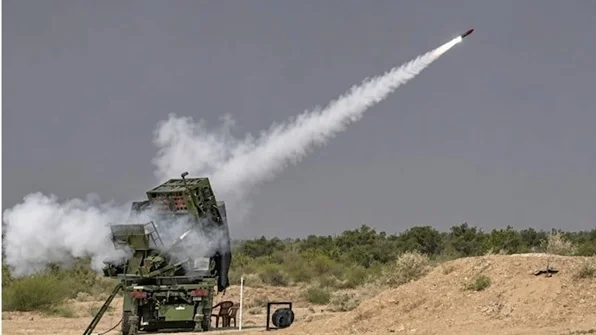
- India's indigenous counter-drone system Bhargavastra successfully completed its development trials at the Pokhran Field Firing Range in Rajasthan from 20 to 24 November 2026.
- The trials demonstrated the system's ability to engage drone swarms using air defence rockets and guided micro-missiles.
- The achievement marks an important step towards strengthening India's indigenous counter-drone capabilities.
What is Bhargavastra?
- Bhargavastra is an indigenous, vehicle-mounted counter-swarm drone defence system.
- It has been developed by Solar Defence and Aerospace Limited (SDAL).
- It is designed to counter hostile drones, weaponised UAVs, loitering munitions and coordinated drone swarms.
- The system uses two types of weapons: unguided air-defence micro-rockets and guided micro-missiles.
- It follows a hard-kill approach, which physically destroys incoming aerial threats.
- Its mobile design allows deployment across different operational environments, including deserts, plains and high-altitude areas.
How Does Bhargavastra Detect and Destroy Drones?
Bhargavastra uses an integrated network of sensors, surveillance radars and a Command and Control Centre to identify and neutralise incoming aerial threats.
Its major technological components include:
1. Surveillance Radar
- Detects incoming aerial targets.
- According to reported specifications, its radar can detect small aerial targets at distances of up to 10 km.
2. Electro-Optical/Infrared (EO/IR) Sensors
- Help identify and track aerial targets.
- Support surveillance during both day and night.
3. Passive Radio Frequency (RF) Sensors
- Detect radio-frequency signals associated with drones.
- Help identify potential aerial threats.
4. AI-Enabled Command and Control System
- Integrates information received from different sensors.
- Supports target tracking, threat assessment and weapon coordination.
- Helps operators coordinate the engagement of incoming drones.
Two-Layer Defence System of Bhargavastra
Bhargavastra uses two weapon configurations to counter different types of drone threats.
|
Feature
|
Version-I
|
Version-II
|
|
Weapon
|
Unguided micro-rockets
|
Guided micro-missiles
|
|
Launcher
|
64-tube launcher
|
64-micro-missile launcher
|
|
Technology
|
Rocket-based interception
|
Autonomous guidance and IR seeker
|
|
Purpose
|
Countering groups of drones
|
Precision engagement
|
Key Features of Bhargavastra
- Mobile Defence System: Vehicle-mounted design enables flexible deployment.
- Two-Layer Protection: Combines unguided rockets and guided micro-missiles.
- Hard-Kill Capability: Physically destroys hostile drones.
- Multi-Target Engagement: Designed to counter coordinated drone swarms.
- High-Altitude Operations: Designed for deployment at altitudes of up to 5,000 metres above mean sea level.
- Integrated Surveillance: Combines radar, RF and EO/IR sensors with a command-and-control network.
Strategic Significance for India
The growing use of inexpensive drones and coordinated drone swarms has created new challenges for conventional air defence systems. Bhargavastra could strengthen India's response to these emerging threats.
- Border Security: Can help protect sensitive border areas against hostile drone activities.
- Military Infrastructure Protection: Can support the defence of military installations and strategic assets.
- Cost-Effective Defence: Offers an alternative to using expensive air-defence interceptors against relatively inexpensive drones.
- Counter-Swarm Capability: Addresses the challenge of multiple drones approaching simultaneously.
- Defence Self-Reliance: Promotes indigenous defence technology and reduces dependence on foreign systems.
- Technological Development: Encourages domestic capabilities in radar, missile guidance, sensors and command-and-control systems.
Major Challenges
- Detecting small drones with low radar signatures.
- Responding effectively to simultaneous attacks from multiple directions.
- Maintaining system reliability during electronic interference.
- Ensuring effective performance in difficult weather and high-altitude conditions.
- Evaluating operational effectiveness and cost efficiency under realistic battlefield conditions.
Way Forward
- Conduct further trials to improve engagement and kill probability.
- Demonstrate the prototype in its deliverable configuration.
- Improve integration with existing military air-defence and C4I networks.
- Evaluate additional soft-kill capabilities, including electronic jamming and spoofing.
- Conduct user trials before large-scale deployment.
Conclusion
Bhargavastra represents an important development in India's efforts to strengthen its indigenous counter-drone capabilities. Its combination of guided micro-missiles, unguided rockets and integrated surveillance technologies is designed to address the growing threat of coordinated drone attacks. Further testing, evaluation and successful induction will be important in determining its role in India's future air defence network.
Prelims Practice Question
Bhargavastra is primarily designed for which purpose?
A. Missile defence
B. Countering drone attacks
C. Submarine warfare
D. Anti-tank operations
Mains Practice Question
Discuss the emerging security challenges posed by drone swarms and examine the role of indigenous counter-drone technologies such as Bhargavastra in strengthening India's national security.
|
FAQs:
1. What is Bhargavastra?
Bhargavastra is an indigenous counter-drone system designed to detect, track and destroy hostile drones and coordinated drone swarms.
2. Who developed Bhargavastra?
It was developed by Solar Defence and Aerospace Limited (SDAL).
3. What is a drone swarm?
A drone swarm refers to multiple unmanned aerial vehicles (UAVs) operating together in a coordinated manner.
4. What are the two versions of Bhargavastra?
- Version-I: Uses unguided air-defence micro-rockets.
- Version-II: Uses guided micro-missiles with autonomous guidance and infrared seekers.
5. What is the significance of Bhargavastra for India?
It can strengthen India's defence against drone-based threats, promote indigenous defence manufacturing and support the objectives of Atmanirbhar Bharat.
|