Why in news?
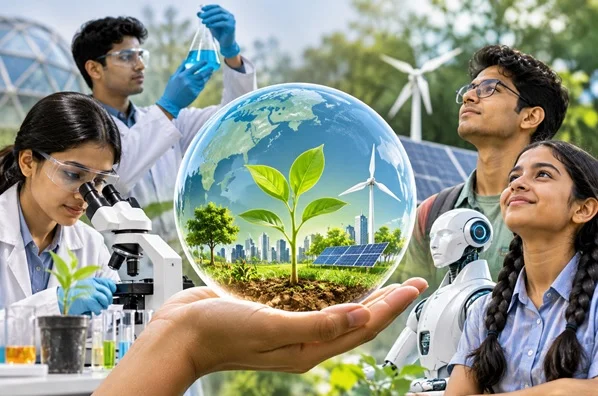
The first International Day of Engagement in Science for Sustainable Development is being observed on 27 November 2026.
Key Facts
|
Particular
|
Details
|
|
Observance
|
International Day of Engagement in Science for Sustainable Development
|
|
Date
|
27 November
|
|
First observance
|
2026
|
|
Proclaimed by
|
UNESCO General Conference
|
|
Year of proclamation
|
2025
|
|
Main objective
|
Promote public engagement in science
|
|
Related initiative
|
International Decade of Sciences for Sustainable Development (2024-2033)
|
|
Focus areas
|
Scientific literacy, citizen science, research and innovation
|
Background and History
- The initiative emerged from the recognition that scientific knowledge must become a shared resource rather than remain confined to specialised institutions.
- Ukraine proposed the establishment of this International Day. On 14 April 2025, the UNESCO Executive Board supported the proposal to designate 27 November as the annual observance.
- Subsequently, during its 43rd session in Samarkand, Uzbekistan, in November 2025, the UNESCO General Conference adopted the resolution proclaiming the International Day of Engagement in Science for Sustainable Development.
- The date, 27 November, also has special significance for Ukraine. It marks the birthday of renowned Ukrainian scientist Borys Paton and the founding day of the National Academy of Sciences of Ukraine.
Objectives of the International Day
- Promoting Science as a Common Good: Science should benefit all sections of society rather than remain restricted to wealthy nations, research institutions or specialised communities.
- Encouraging Public Participation: People should be encouraged to participate in scientific discussions, research projects and innovation activities that affect their daily lives.
- Strengthening Science Education: The day promotes scientific education, particularly among children and young people, to develop curiosity, creativity and problem-solving abilities.
- Bridging the Gap Between Science and Society: It seeks to strengthen communication between scientists, governments, educational institutions and ordinary citizens.
- Supporting Inclusive Scientific Development: Women, rural communities, economically weaker sections and underrepresented groups should receive equal opportunities to participate in scientific research and innovation.
- Relationship with Sustainable Development Goals (SDGs): Science and technology play an important role in achieving the 17 Sustainable Development Goals (SDGs) adopted by the United Nations in 2015.
International Decade of Sciences for Sustainable Development (2024-2033)
- The International Day is closely connected with the International Decade of Sciences for Sustainable Development (2024–2033), led by UNESCO.
- The decade recognises the importance of basic sciences, applied sciences and interdisciplinary research in addressing global challenges.
- Its broader objectives include:
- Strengthening international scientific cooperation.
- Promoting scientific education and research.
- Encouraging innovation for sustainable development.
- Improving the accessibility of scientific knowledge.
- Supporting evidence-based policymaking.
- Connecting scientific research with real-world problems.
- The decade also encourages governments, universities, research institutions and civil society organisations to work together to make science more accessible and useful.
Why is Public Engagement in Science Important?
- Tackling Climate Change: Public participation in environmental research, climate awareness campaigns and citizen-led conservation projects can strengthen climate action.
- Improving Public Health: Scientific awareness helps people understand vaccination, disease prevention, sanitation, nutrition and emerging health threats.
- Promoting Innovation: When students and citizens are encouraged to experiment and solve local problems, they can develop innovative solutions.
- Combating Misinformation: Scientific literacy enables people to distinguish evidence-based information from rumours, pseudoscience and misleading claims.
- Encouraging Democratic Decision-Making: Public understanding of scientific issues helps citizens participate more effectively in discussions concerning energy, health, environment and emerging technologies.
India's Role in Promoting Scientific Engagement
- INSPIRE-MANAK: The Innovation in Science Pursuit for Inspired Research (INSPIRE) programme includes INSPIRE-MANAK, which encourages school students to develop innovative ideas and technological solutions. It aims to identify young students with scientific and innovative potential.
- Atal Tinkering Labs (ATL): Launched under the Atal Innovation Mission of NITI Aayog, Atal Tinkering Labs encourage students to develop problem-solving and innovation skills. Students receive opportunities to work with robotics, electronics, sensors and other emerging technologies.
- CSIR-JIGYASA Programme: The Council of Scientific and Industrial Research (CSIR) launched the JIGYASA programme in 2017 in collaboration with Kendriya Vidyalaya Sangathan. Its objective is to connect school students with scientists and scientific research institutions. Activities include:
- Visits to CSIR laboratories.
- Interaction with scientists.
- Hands-on experiments.
- Scientific workshops.
- Student competitions and research activities.
- Vigyan Jyoti Programme: The Department of Science and Technology launched the Vigyan Jyoti initiative in December 2019. It encourages meritorious girls studying in Classes 9–12 to pursue education and careers in Science, Technology, Engineering and Mathematics (STEM). The programme promotes gender equality in scientific fields through science camps, mentorship, laboratory visits and interactions with women scientists.
- Vigyan Dhara Scheme: The Vigyan Dhara scheme came into effect on 16 January 2025. It integrates three major umbrella schemes of the Department of Science and Technology, focusing on:
- Science and technology institutional and human capacity building.
- Research and development.
- Innovation, technology development and deployment.
Major Challenges in Scientific Engagement
- Digital Divide: Unequal access to digital devices and scientific resources.
- Lack of Scientific Awareness: Limited understanding of scientific concepts among sections of society.
- Gender Inequality: Underrepresentation of women in several STEM fields
- Inadequate Research Funding: Limited resources for research and innovation.
- Urban-Rural Gap: Unequal availability of laboratories and scientific institutions.
- Scientific Misinformation: Spread of pseudoscience and unverified information.
- Language Barriers: Limited availability of scientific resources in regional languages.
Prelims MCQ
Q. With reference to the International Day of Engagement in Science for Sustainable Development, consider the following statements:
- It is observed on 27 November.
- It was proclaimed by UNESCO in 2025.
- It is associated with the International Decade of Sciences for Sustainable Development (2024–2033).
Which of the statements given above are correct?
A. 1 only
B. 1 and 2 only
C. 2 and 3 only
D. 1, 2 and 3
Mains Practice Question
Q. "Scientific research and innovation alone cannot ensure sustainable development without active public participation." Discuss.
|
FAQs
When is the International Day of Engagement in Science for Sustainable Development observed?
27 November.
Which organisation proclaimed this International Day?
UNESCO's General Conference proclaimed it in 2025.
When was it celebrated for the first time?
27 November 2026.
What is the main objective of this day?
To encourage public participation in science and promote scientific knowledge for sustainable development.
Which international initiative is associated with this day?
The International Decade of Sciences for Sustainable Development (2024-2033).
|