


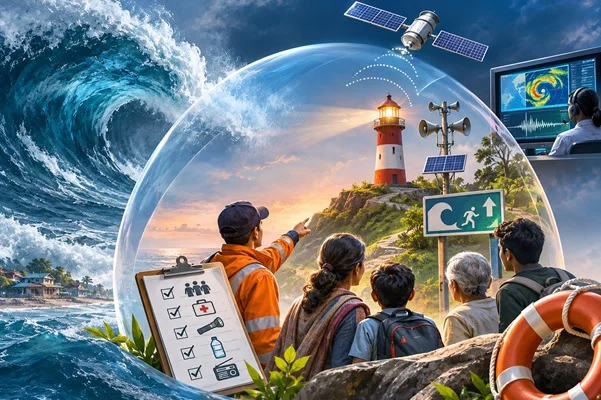
World Tsunami Awareness Day 2026 will be observed on 5 November 2026 across the world.
|
Particulars |
Details |
|
Day |
World Tsunami Awareness Day |
|
Date |
5 November |
|
First observed |
2016 |
|
Established by |
United Nations General Assembly |
|
Resolution |
A/RES/70/203 |
|
Theme 2026 |
Be Tsunami Ready: Resilience Starts With You |
|
Main objective |
Promote tsunami awareness and preparedness |
|
Lead UN body |
United Nations Office for Disaster Risk Reduction (UNDRR) |
|
Global scientific coordination |
UNESCO-IOC |
|
Cause |
Explanation |
|
Undersea earthquakes |
Sudden movement of tectonic plates displaces the ocean floor and pushes large amounts of water. |
|
Volcanic eruptions |
Underwater or coastal volcanic eruptions can displace seawater. |
|
Submarine landslides |
Large underwater masses of soil and rocks suddenly move, generating waves. |
|
Meteorite impacts |
A large object striking the ocean can displace enormous volumes of water. |
|
Basis |
Normal Ocean Waves |
Tsunami |
|
Main cause |
Wind |
Earthquakes, landslides, volcanic activity |
|
Wavelength |
Relatively short |
Extremely long |
|
Speed |
Generally lower |
Can exceed 800 km/h in deep oceans |
|
Energy |
Mostly concentrated near the surface |
Involves movement of the entire water column |
|
Impact |
Usually limited to surface activity |
Can cause extensive coastal flooding |
|
Number of waves |
Usually individual or continuous wind-driven waves |
A series of waves |
|
Warning sign |
What it indicates |
|
Strong or prolonged earthquake |
Possible undersea tectonic activity |
|
Sudden rise or withdrawal of seawater |
Possible tsunami approaching the coast |
|
Loud roaring sound from the ocean |
Possible approaching tsunami waves |
|
Unusual behaviour of the sea |
Potential coastal hazard |
|
Area |
Impact |
|
Human life |
Large-scale deaths, injuries and displacement |
|
Infrastructure |
Destruction of houses, roads, bridges, ports and communication networks |
|
Economy |
Damage to fisheries, tourism, agriculture and coastal industries |
|
Environment |
Coastal erosion, saltwater intrusion and destruction of marine ecosystems |
|
Agriculture |
Salinization of agricultural land and contamination of freshwater sources |
|
Public health |
Risk of waterborne diseases, sanitation problems and psychological trauma |
|
Year |
Location |
Significance |
|
1960 |
Chile |
The Great Chilean Earthquake generated a trans-Pacific tsunami. |
|
2004 |
Indian Ocean |
One of the deadliest tsunamis in recorded history, affecting several countries. |
|
2011 |
Japan |
The Tohoku earthquake triggered a devastating tsunami and the Fukushima nuclear accident. |
|
Region |
Tsunami vulnerability |
|
Andaman and Nicobar Islands |
Located close to the seismically active Sunda subduction zone. |
|
Tamil Nadu |
Exposed to tsunami waves originating from the eastern Indian Ocean. |
|
Andhra Pradesh |
Vulnerable due to its long Bay of Bengal coastline. |
|
Odisha |
Coastal settlements are exposed to multiple ocean-related hazards. |
|
Kerala |
Vulnerable to tsunami waves originating in the Indian Ocean. |
|
Pondicherry |
Its coastal location creates exposure to tsunami-related hazards. |
|
Component |
Function |
|
Seismic stations |
Detect earthquakes and determine their magnitude and location. |
|
Bottom Pressure Recorders (BPRs) |
Detect changes in water pressure at the ocean floor. |
|
Tsunami buoys |
Transmit ocean measurements to monitoring centres. |
|
Tide gauges |
Measure changes in sea level along coastlines. |
|
Numerical models |
Estimate tsunami propagation and potential coastal impact. |
|
Warning centre |
Analyses data and issues tsunami advisories to relevant authorities. |
|
Initiative |
Organisation |
Objective |
|
World Tsunami Awareness Day |
UN General Assembly |
Promote global tsunami awareness and preparedness. |
|
Sendai Framework for Disaster Risk Reduction (2015–2030) |
United Nations |
Reduce disaster risks and losses through prevention, preparedness and resilience. |
|
Tsunami Ready Programme |
UNESCO-IOC |
Strengthen community-level tsunami preparedness. |
|
Early Warnings for All (EW4All) |
United Nations |
Ensure that everyone is protected by early warning systems. |
|
Indian Ocean Tsunami Warning and Mitigation System (IOTWMS) |
UNESCO-IOC |
Coordinate tsunami warning and mitigation across the Indian Ocean. |
Prelims MCQQ. Consider the following statements regarding tsunamis:
Which of the statements given above are correct? (a) 1 and 2 only (b) 1, 2 and 3 only (c) 2 and 4 only (d) All four Mains Practice QuestionQ. Discuss the role of early warning systems and disaster resilience in reducing tsunami-related risks, with special reference to India. |
When is World Tsunami Awareness Day observed?5 November every year. What is the theme of World Tsunami Awareness Day 2026?Be Tsunami Ready: Resilience Starts With You. Which organisation coordinates global tsunami warning systems?UNESCO's Intergovernmental Oceanographic Commission (IOC). Where is India's Tsunami Early Warning Centre located?INCOIS, Hyderabad. Which disaster led India to establish its tsunami early warning system?The Indian Ocean Tsunami of 26 December 2004. |




