
- UPSC Exam
- State PCS
- One Day Exam
- Current Affairs
- PT Quiz
- Downlaods
- About Coaching
- Blog
- Videos

| Prelims: (Science & Technology + CA) Mains: (GS 3 – Science and Technology, Space Research, Indigenous Innovation) |
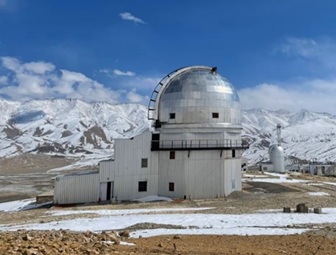
The Union Budget has approved the establishment of two new telescopes in Ladakh—one to study the Sun and another to explore the origins of the universe—along with the upgradation of an existing telescope. Ladakh, already a major astronomy hub and home to India’s first Dark Sky Reserve at Hanle, is set to play a transformative role in Indian and global astronomy.
India’s space and astronomical research ecosystem has expanded steadily over the past two decades, marked by landmark achievements such as Chandrayaan, Gaganyaan, and Aditya-L1. However, ground-based observational astronomy remains equally crucial for:
Ladakh’s unique geography—high altitude, dry climate, low atmospheric turbulence, and minimal light pollution—makes it one of the world’s best locations for optical and infrared astronomy. The designation of Hanle as India’s first Dark Sky Reserve further institutionalises conservation of night-sky conditions.
The Budget’s approval of three major telescope projects signals a strategic push to:
The NLST is a 2-metre aperture solar telescope planned in the Merak region near Pangong Tso in Ladakh. It will operate in the visible and near-infrared wavelengths, enabling high-resolution, ground-based observations of the Sun.
The NLST will enable detailed studies of:
These studies are critical for:
Once operational (expected within 5–6 years), NLST will become India’s third ground-based solar observatory, joining:
It will also complement ISRO’s Aditya-L1 mission (launched in 2023), creating a robust, integrated heliophysics research ecosystem combining space-based and ground-based observations.
The NLOT will be a 13.7-metre aperture segmented-mirror telescope built in Hanle, Ladakh. Its primary mirror will consist of 90 hexagonal segments, functioning together as a single giant mirror to capture extremely faint cosmic light with high precision.
Once completed (within the next decade), NLOT will rank among the largest optical–infrared telescopes in the world.
Ladakh’s:
minimise atmospheric distortion and absorption, enabling sharper and more accurate astronomical observations compared to many global sites.
NLOT will enable frontier research in:
Its optical–infrared capability is essential for observing distant, faint, and redshifted cosmic objects, making it a cornerstone for deep-sky cosmology.
India’s participation in the Thirty Meter Telescope (TMT) project has built strong expertise in segmented-mirror technology. TMT’s 30-metre mirror uses 494 hexagonal segments, and India contributes by:
This experience will significantly ease the design, construction, and precision alignment challenges involved in building NLOT.
Upgraded Himalayan Chandra Telescope: Strengthening India’s Transient Astronomy
The 2-metre HCT, established over 25 years ago in Ladakh, has been a pioneer in Indian observational astronomy. It has contributed significantly to:
The approved upgrade will transform HCT into a 3.7-metre segmented-mirror telescope, operating in the optical–infrared wavelengths. This will:
The upgraded HCT will work in synergy with major international projects such as:
By coordinating observations, HCT will help identify and study cosmic events detected via gravitational waves and radio signals, enabling multi-messenger astronomy.
NLST and NLOT will be among the most powerful facilities at this longitude and region, offering observational windows not fully covered by existing global telescopes.
These telescopes will generate high-quality, original data in:
This will significantly enhance India’s contribution to global scientific knowledge.
Unlike international telescopes where access is competitive and limited, these indigenous facilities will provide assured and preferential observation time to Indian scientists, boosting domestic research output and training.
Building and operating these telescopes will:
Together, NLST and NLOT position India as a leader in astronomy in the Global South, contributing critical insights to the international scientific community and shaping future collaborative research.
FAQs1. Why is Ladakh chosen for major astronomical observatories ? Ladakh offers high altitude, dry climate, low atmospheric turbulence, and minimal light pollution, making it ideal for optical and infrared astronomy. 2. What is the main purpose of the National Large Solar Telescope (NLST) ? NLST will study solar activity, magnetism, and space weather, helping protect satellites, communication systems, and space missions. 3. How significant is the National Large Optical–Near Infrared Telescope (NLOT) ? With a 13.7-metre segmented mirror, NLOT will be among the world’s largest telescopes, enabling deep-space and cosmological research. 4. What role will the upgraded Himalayan Chandra Telescope play ? The upgraded 3.7-metre HCT will enhance India’s capability in transient and multi-messenger astronomy, working with facilities like LIGO-India and SKA. 5. How do these telescopes strengthen India’s global scientific standing ? They position India as a leading astronomy hub in the Global South, enhance indigenous scientific capability, and contribute significantly to global astronomical research. |



Our support team will be happy to assist you!

 Contact Us
  New Batch : 9555124124/ 7428085757
  Tech Support : 9555124124/ 7428085757