
- UPSC Exam
- State PCS
- One Day Exam
- Current Affairs
- PT Quiz
- Downlaods
- About Coaching
- Blog
- Videos

| Prelims: (International Relations + CA) Mains: (GS 2 – Bilateral Relations; GS 3 – Mineral Resources & Energy Security; GS 3 – Indigenisation of Technology & Supply Chain Resilience; GS 3 – Industrial Policy & Advanced Manufacturing) |
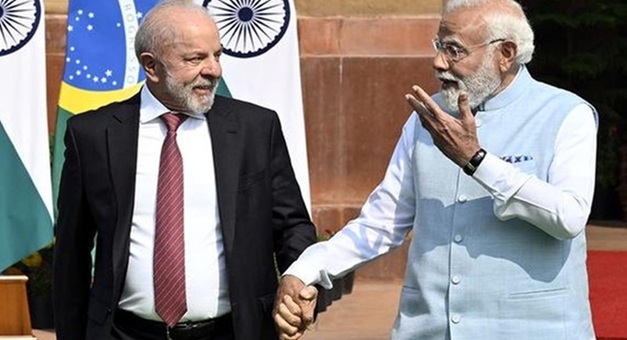
India and Brazil signed a Memorandum of Understanding (MoU) on rare earths and critical minerals during the visit of President Luiz Inácio Lula da Silva to India in February 2026.
The agreement aims to deepen cooperation across the entire mineral value chain — including exploration, mining, processing, refining, and recycling — to secure reliable access to strategic resources essential for advanced manufacturing, clean energy, electronics, and defence sectors.
The Global Critical Minerals Race
Critical minerals such as lithium, cobalt, nickel, graphite, and rare earth elements are indispensable for:
The concentration of supply chains in a few countries has created strategic vulnerabilities. As geopolitical tensions intensify, nations are prioritising supply chain diversification and resource diplomacy.
India has adopted a multi-pronged approach to strengthen its position across the critical mineral value chain.
1. National Critical Mineral Mission
In January 2025, the Union Cabinet approved the National Critical Mineral Mission (2024–25 to 2030–31) to accelerate domestic exploration, beneficiation, processing, and recovery from end-of-life products.
2. Identification of Critical Minerals
In July 2023, India released a list of 30 critical minerals essential for strategic and industrial sectors.
3. Legal and Regulatory Reforms
The Mines and Minerals (Development and Regulation) Amendment Act, 2023 empowered the Centre to auction blocks for critical and strategic minerals. Multiple auction rounds have since been conducted.
4. Overseas Resource Diplomacy
Through Khanij Bidesh India Ltd. (KABIL), India is pursuing overseas acquisitions and partnerships in countries such as Argentina and Chile to diversify sourcing.
5. Trade and Cost Rationalisation
Customs duties on certain critical minerals and recyclable scrap have been reduced to enhance domestic processing capacity.
6. Boosting Advanced Manufacturing
India aims to begin domestic production of rare-earth permanent magnets by end-2026 to reduce import dependence in sectors such as EVs and defence.
1. Access to Untapped Mineral Wealth
Brazil holds significant reserves of rare earths, lithium, bauxite, manganese, and other strategic minerals. Only about 30% of its potential reserves have been explored. The MoU opens pathways for Indian participation in exploration and downstream processing.
2. Supply Chain Diversification
By expanding partnerships beyond traditional suppliers, India reduces over-dependence on a limited number of countries, enhancing resilience against export controls or geopolitical shocks.
3. Enhanced Bargaining Power
Diversification improves India’s leverage in global mineral markets, strengthening its negotiating position on pricing and long-term contracts.
4. Boost to Domestic Manufacturing
Reliable mineral supply encourages private-sector investment in downstream industries such as battery manufacturing, electronics, and renewable energy components.
5. Standards and Sustainability Alignment
Harmonising sourcing and environmental standards may help Indian firms access global markets that demand traceable and responsible mineral supply chains.
India joined Pax Silica on February 20, 2026 — a US-led initiative aimed at securing the “silicon stack,” covering raw materials, manufacturing equipment, advanced computing, and AI hardware.
The India–Brazil MoU complements Pax Silica by strengthening upstream access to critical raw materials essential for semiconductor ecosystems.
However:
1. Value Addition Beyond Raw Exports
Brazil can move beyond exporting unprocessed ores and expand refining, processing, and recycling capacity.
2. Attracting Investment
Indian investment and long-term procurement commitments enhance project viability and financing prospects .
3. Diversified Strategic Partnerships
Partnership with India strengthens Brazil’s position in global supply chain negotiations and reduces reliance on traditional buyers.
4. Industrial Development
The agreement supports Brazil’s objective of strengthening its domestic mineral value chain and promoting industrial upgrading.
1. Strategic Resource Security
Ensures stable access to minerals vital for energy transition, defence, and digital transformation.
2. South–South Cooperation
The MoU reflects growing cooperation between emerging economies in reshaping global supply chains.
3. Energy Transition Enablement
Critical minerals are foundational for renewable energy systems and electric mobility.
4. Industrial Competitiveness
Secured supply chains enhance manufacturing competitiveness and reduce production uncertainties.
5. Geopolitical Signalling
The agreement signals India’s proactive mineral diplomacy amid intensifying global competition.
FAQs1. What is the objective of the India–Brazil Critical Minerals MoU ? To cooperate across exploration, mining, processing, refining, and recycling of rare earths and critical minerals. 2. Why are critical minerals important for India ? They are essential for electric vehicles, renewable energy, semiconductors, defence systems, and advanced electronics. 3. How does the MoU enhance India’s strategic position ? It diversifies supply sources, strengthens bargaining power, and improves long-term supply security. 4. Is Brazil part of the Pax Silica initiative ? No. The MoU is a bilateral arrangement, though it complements broader supply chain security initiatives. 5. How does this agreement benefit Brazil ? It attracts investment, supports value addition, diversifies partnerships, and enhances strategic leverage in global markets. |



Our support team will be happy to assist you!

 Contact Us
  New Batch : 9555124124/ 7428085757
  Tech Support : 9555124124/ 7428085757