
- UPSC Exam
- State PCS
- One Day Exam
- Current Affairs
- PT Quiz
- Downlaods
- About Coaching
- Blog
- Videos

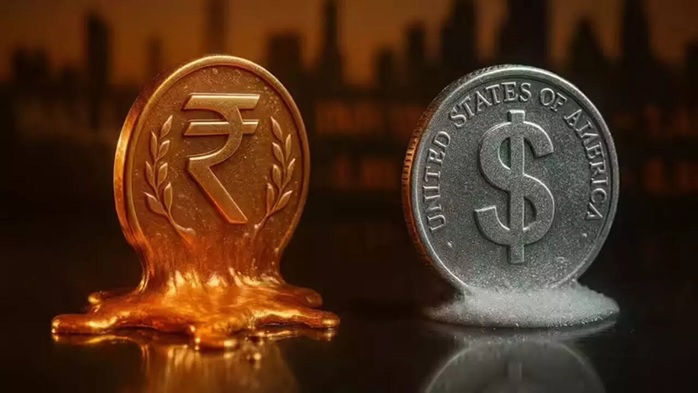
The value of a currency depends mainly on demand and supply.
If more people, companies, and countries want dollars, then the demand for dollars rises. When demand rises, the dollar becomes stronger. Similarly, if demand for the Indian Rupee falls, then the rupee weakens.
India imports many essential items such as:
Almost all international trade for these goods happens in US Dollars. So whenever India buys these products, it needs dollars to make payments.
Now imagine oil prices suddenly rise globally. India will then need even more dollars to buy the same quantity of oil. This increases demand for dollars in India’s foreign exchange market. As demand for dollars rises, the rupee loses value.
In simple words:
That is why the exchange rate changes from ₹80 per dollar to ₹90 or even ₹96 per dollar over time.
The US Dollar is considered the world’s reserve currency. Most global trade, oil transactions, international loans, and foreign reserves are based on dollars.
Whenever there is:
Investors across the world prefer keeping their money in dollars because they see the US economy as safer and more stable.
Another major reason is the policy of the US Federal Reserve. Recently, America kept interest rates high to control inflation. High interest rates mean investors earn better returns by investing in the US economy. As a result, global investors shifted money from emerging markets like India toward America.
This increased global demand for dollars and strengthened the US currency further.
India imports nearly 85–90% of its crude oil requirement. Since oil is purchased in dollars, higher oil prices directly increase demand for dollars.
When global oil prices rise above $100 per barrel, India needs billions of extra dollars for imports. This weakens the rupee.
India imports more goods than it exports. This creates a trade deficit.
When more money goes out of the country than comes in:
This situation is called the Current Account Deficit (CAD).
Recently, foreign investors withdrew nearly $23 billion from Indian markets.
When investors leave India:
This sudden increase in dollar demand weakens the rupee even more.
Wars, supply chain disruptions, and geopolitical tensions create uncertainty in world markets.
In such situations:
The weakening rupee affects the stock market in multiple ways.
When the dollar becomes stronger and US markets offer better returns, foreign investors move money out of India. This causes:
Industries depending on imported goods face rising costs.
Examples include:
Their profits decline because imports become more expensive.
A weaker rupee increases the cost of:
This eventually increases inflation in the economy.
Interestingly, some industries gain from a weak rupee.
These include:
Because they earn in dollars while paying expenses in rupees.
India is one of the world’s largest consumers of gold. Every year, India imports huge amounts of gold from abroad.
Gold imports require payment in dollars. This increases demand for dollars and weakens the rupee further.
To reduce unnecessary dollar outflow, the government tightened rules on gold imports and increased restrictions. The main objective was:
At the same time, the Reserve Bank of India (RBI) increased liquidity in financial markets.
This was done because:
RBI injected money so banks could continue lending to businesses and consumers.
The RBI also sometimes sells dollars from its forex reserves to stabilize the rupee and reduce panic in currency markets.
So RBI’s strategy works on two levels:
The weakening rupee is definitely a challenge, but it does not mean the Indian economy is collapsing.
India still has several strengths:
However, continuous dependence on imports, especially crude oil, remains a major weakness for the rupee.
In the long run, the real solution lies in:
A stronger economy ultimately creates a stronger currency.



Our support team will be happy to assist you!

 Contact Us
  New Batch : 9555124124/ 7428085757
  Tech Support : 9555124124/ 7428085757