Is Himachal's Ghepan Lake becoming a major threat? Sissu village faces the threat of glacial flooding.
Why in the news ?
Sissoo village, located in the Lahaul-Spiti district of Himachal Pradesh, is currently in the news due to a serious environmental threat.
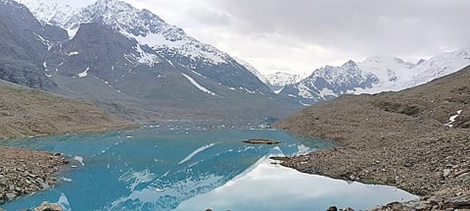
Ghepan Lake, located above the village, is continuously increasing in size, leading scientists to fear a Glacial Lake Outburst Flood (GLOF).
If this happens, Sissoo, along with several surrounding villages, could suffer significant damage, as could agricultural land and vital infrastructure.
Sissu Becomes a Tourism Hub After the Atal Tunnel
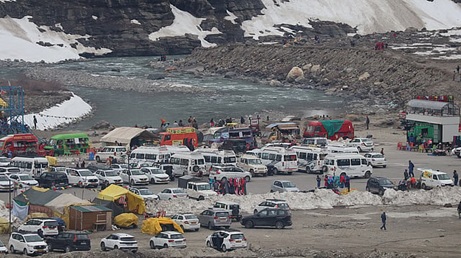
Sissu village, located on the banks of the Chandra River, has become one of Himachal Pradesh's major tourist destinations following the opening of the Atal Tunnel.
The opening of the Atal Tunnel in October 2020 has seen an unprecedented increase in tourist arrivals. Approximately 2,000 vehicles arrive in Sissu daily, while this number reaches 5,000 during the tourist season.
Boating, ziplining, homestays, and adventure activities have boosted the local economy. However, a major natural hazard is also emerging amid growing tourism.
What is Ghepan Lake ?
Ghepan Lake, also known as Ghepang Ghat Glacial Lake, is located about 11 kilometers from Sissu village and at an altitude of 4,068 meters above sea level.
The lake is located near the Ghepan Glacier and is named after Ghepan, the revered deity of the Lahaul region. It also holds religious and cultural significance for the local people.
Why are scientists worried ?
The National Disaster Management Authority (NDMA) has classified Ghepan Lake as a "highly vulnerable" glacial lake. Scientists believe that if the lake's natural dam were to breach, the resulting flood could prove devastating for Sissoo village.
According to a report by the National Remote Sensing Centre (NRSC), Sissoo would be the first and most affected village in the event of a lake burst.
Floods could reach in just 21 minutes
According to scientific estimates, if the lake's dam breaks, floodwaters could reach Sissoo village in just 21 minutes. During this time, the water speed could reach approximately 43 kilometers per hour and its depth could reach 20 meters.
Large boulders, rocks, and a large amount of debris will also flow with the floodwaters, which could further increase the damage.
The lake's size has tripled in three decades
According to data from the National Remote Sensing Center, the area of Ghepan Lake, which was 36.49 hectares in 1989, has increased to 101.30 hectares by 2022.
This means that the lake has nearly tripled in size in the last three decades. This is considered a clear indication of rapid glacier melt and climate change.
The Ghepan Glacier is rapidly shrinking
Scientific studies have shown that the Ghepan Glacier is continuously retreating. Since 1962, it has shrunk by approximately 2.76 kilometers.
Between 2015 and 2023, it is projected to lose approximately 0.90 meters of water-equivalent ice per year. Experts attribute this to rising temperatures and an increase in rainfall rather than snowfall.
What is a GLOF ?
A glacial lake outburst flood (GLOF) occurs when the natural dam of a glacial lake suddenly breaks. This dam is typically made of rocks, sand, and debris deposited by glaciers.
Heavy rainfall, landslides, avalanches, or large pieces of glacier falling into the lake can cause this dam to break and cause a sudden, devastating flood.
How big could the potential damage be ?
Experts estimate that if Ghepan Lake bursts, approximately 34 settlements could be affected. Additionally, 204 hectares of agricultural land, 57 bridges, and 106 kilometers of road could be damaged.
The Manali-Leh National Highway, the Atal Tunnel, and tourism-related infrastructure could also be at risk. Scientists believe its impact could be felt as far as Jammu and Kashmir via the Chenab River.
Warning System Remains Inadequate
Although several scientific institutions are monitoring Ghepan Lake, a full-fledged early warning system has not yet been established.
A siren network, real-time warning system, and clear evacuation routes remain lacking. A pilot warning system is currently being tested, but it has yet to be fully implemented.
Are tourism and construction activities also responsible ?
Experts do not directly blame tourism, but they believe that increasing human activities increase environmental pressure. Dust from vehicles settles on the snow surface, reducing its reflective capacity and causing it to absorb more heat. This can accelerate the melting of glaciers.
The Growing Climate Crisis in the Himalayas
The issue of Ghepan Lake is not limited to Himachal Pradesh. The area of glaciers in the Hindu Kush Himalayan region has decreased by approximately 12 percent between 1990 and 2020.
The total area of glacial lakes in India is also increasing rapidly. Himachal Pradesh had 805 glacial lakes in 2016, which increased to 1,619 by 2022. This situation is posing a serious challenge to the Himalayan ecosystem.
Growing Concerns Among Locals
The people of Sissoo and surrounding villages are well aware of this danger. Many villagers worry about their rehabilitation and livelihoods if a major disaster strikes in the future.
Some locals believe that the lake has existed for years and the likelihood of immediate danger is low. Despite this, people's concerns increase during every heavy rainfall.
Conclusion
The ever-increasing size of Ghepan Lake and the rapidly melting glaciers highlight the serious impacts of climate change in the Himalayas. If effective warning systems, scientific monitoring, and disaster management measures are not strengthened in time, this lake could trigger a major natural disaster in the future.
Coordinated efforts between the government, scientific institutions, and local communities are needed to protect Sissoo and surrounding areas.






 Contact Us
  New Batch : 9555124124/ 7428085757
  Tech Support : 9555124124/ 7428085757