
- UPSC Exam
- State PCS
- One Day Exam
- Current Affairs
- PT Quiz
- Downlaods
- About Coaching
- Blog
- Videos

| Prelims: (International Relations + CA) Mains: (GS 2 – India & World Affairs; GS 3 – Security & Energy Security; GS 3 – Internal Security & Diaspora; GS 2 – International Institutions & Diplomacy) |
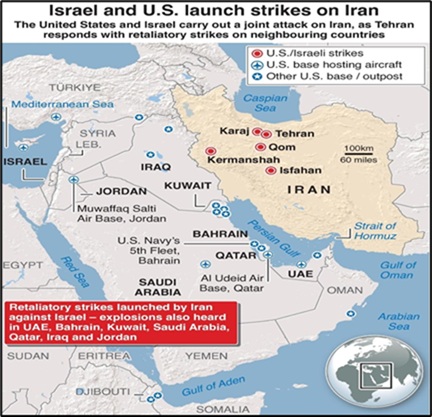
On February 28, 2026, Israel conducted a daylight strike on Tehran, calling it a pre-emptive operation against Iran’s nuclear infrastructure. US President Donald Trump confirmed American involvement, and the US Department of Defense named the operation Operation Epic Fury.
Iran retaliated with missile strikes on Israeli territory and expanded attacks to US military facilities across Qatar, Bahrain, Jordan, Kuwait, and the UAE, transforming a bilateral confrontation into a broader regional crisis.
The rivalry between Israel and Iran has evolved from ideological hostility to proxy confrontations across Syria, Lebanon, and Gaza. Israel perceives Iran’s nuclear programme as an existential threat, while Iran positions itself as a counterweight to Israeli and US influence in West Asia.
The 2015 nuclear agreement (JCPOA) sought to restrict Iran’s uranium enrichment in exchange for sanctions relief. However, the US withdrawal in 2018 reignited tensions. Subsequent indirect talks, including recent Geneva negotiations mediated by Oman, failed to yield a breakthrough.
Iran insists on its sovereign right to enrich uranium for peaceful purposes. The US and Israel argue that enrichment levels approach weapons-grade capability.
The strike was framed as preventive, aiming to degrade Iran’s nuclear infrastructure before it crossed a perceived red line.
The scale and daylight execution marked a departure from covert operations historically associated with Israel–Iran tensions.
Iran launched missiles toward northern Israel; Israeli air defence systems intercepted incoming projectiles.
Subsequently, Iran expanded retaliation by targeting US-linked facilities:
This widened the theatre of conflict beyond bilateral confrontation.
The strikes mark a transition from indirect proxy warfare to overt state-to-state military engagement.
The involvement of Gulf states hosting US bases increases the probability of a multi-country conflict.
Threats to disrupt the Strait of Hormuz — through which nearly one-fifth of global oil trade passes — could destabilise global energy markets.
The breakdown of diplomatic talks weakens multilateral non-proliferation frameworks and increases the likelihood of accelerated nuclearisation.
India has significant exposure:
Airspace closures and disruptions necessitate contingency evacuation planning.
Nearly 60% of India’s crude imports originate from West Asia. Disruption of maritime routes could trigger price spikes, inflationary pressure, and current account strain.
FAQs1. Why did Israel and the US strike Tehran ? They described it as a pre-emptive action aimed at halting Iran’s alleged progress toward nuclear weapons capability. 2. How did Iran respond ? Iran launched missiles at Israel and expanded attacks to US military facilities in several Gulf countries. 3. Why is the Strait of Hormuz important in this crisis ? It is a critical oil transit chokepoint; disruption could trigger global energy shocks. 4. How does the escalation affect India ? India faces risks to its diaspora safety, energy security, and diplomatic balancing between strategic partners. |


Our support team will be happy to assist you!

 Contact Us
  New Batch : 9555124124/ 7428085757
  Tech Support : 9555124124/ 7428085757