Why in the news ?
- In April 2026, India announced the resumption of the Kailash Mansarovar Yatra for June-August.
- Nepal lodged a formal protest, calling it a violation of its sovereignty.
- The issue has again highlighted the trilateral sensitivities between India, Nepal, and China.

Background - Lipulekh Dispute :
- The Lipulekh Pass is a strategic pass located at the tri-junction of India, Nepal, and China.
- It is an important route for trade and the Kailash Mansarovar pilgrimage.
- Historical Basis
- Nepal claims that Limpiyadhura, Kalapani, and Lipulekh fall within its territory based on the Sugauli Treaty of 1816.
- The root cause of the dispute is differing interpretations of the source of the Mahakali River.
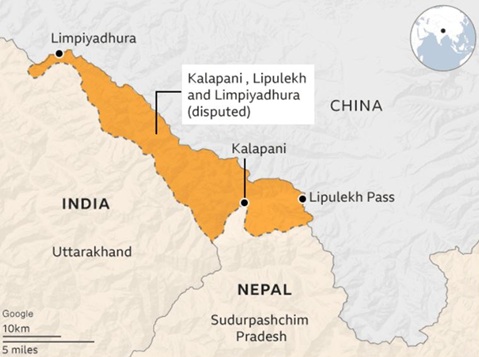
India's Position
- India has been using this route for pilgrimage since 1954.
- India considers Nepal's claims historically inconsistent.
China's Role
- China has maintained a relatively silent stance while maintaining trade cooperation with India.
- Recent cooperation has given the dispute a trilateral dimension.
Stakeholder Positions
Nepal
- Claims territorial sovereignty based on historical treaties and maps.
- Demands trilateral talks (India-Nepal-China).
- Expects a halt to activities in the disputed area.
India
- Emphasis on traditional use and religious significance.
- Supports resolving the border dispute within a bilateral framework.
- Calls Nepal's claims "artificial enlargement."
- Importance to India
- Geopolitical : Maintaining influence in Nepal
- Security : Control over Himalayan passes
- Cultural : Continuation of the Kailash Mansarovar Yatra
China
- A balanced and cautious approach while maintaining commercial interests.
Historical development of the dispute
- 1954 : India begins using the route as a travel route
- 2020 : India builds a road, Nepal releases a new map
- 2025 : Nepal protests India-China trade
- 2026 : Announcement of travel resumption sparks tensions
Key Issues and Challenges
Border Ambiguity
- The primary cause of the border dispute between India and Nepal is the disputed interpretation of the exact source of the Kali River in the Sugauli Treaty, leading to ambiguity in the demarcation.
- Domestic Politics and Nationalism
- The border issue has become a highly sensitive and nationalistic topic in Nepal's domestic politics, often used by political parties to garner public support.
Strategic Sensitivity
- Tri-junctions like Kalapani and Lipulekh are of immense strategic importance to India, as any activity there has a direct and profound impact on the security situation of India-China relations.
- Bilateral vs. Trilateral Approach
- Nepal : Nepal has been supporting trilateral talks (between China, India, and Nepal) to resolve border disputes or territorial issues.
- India : In contrast, India has always insisted on resolving these issues through bilateral solutions by directly negotiating with the concerned country.
- Cultural impact: Kailash Mansarovar is a center of faith for Hindus, Buddhists, and Jains. Disruption to the pilgrimage weakens centuries-old cultural and religious bridges.
Way Forward
- Activating the border dialogue mechanism
- Intensifying meetings of India-Nepal Joint Committees
- Evidence-based solutions
- Use of historical maps, satellite data, and joint surveys
- Confidence Building Measures (CBMs)
- Temporary arrangements for pilgrimage even while the dispute continues
- Diplomatic restraint
- Avoiding inflammatory rhetoric
- Limited trilateral coordination
- Balanced dialogue with China as needed
Conclusion
The Lipulekh dispute reflects the complex geopolitics of the Himalayan region, where history, geography, and nationalism are intertwined. The Kailash Mansarovar Yatra may be the immediate trigger, but the underlying issue is the unresolved border dispute. Dialogue, mutual respect, and balanced diplomacy are the most effective paths to maintaining India-Nepal relations and regional stability.






 Contact Us
  New Batch : 9555124124/ 7428085757
  Tech Support : 9555124124/ 7428085757