- UPSC Exam
- State PCS
- One Day Exam
- Current Affairs
- PT Quiz
- Downlaods
- About Coaching
- Blog
- Videos

|
Prelims: Indian Economy - Capital Market, NSE/BSE, SEBI, ESG & Sustainable Finance (Current Affairs) Mains: GS Paper III - Indian Economy (Capital Markets, Financial Markets, Sustainable Finance & Ethical Investing) |
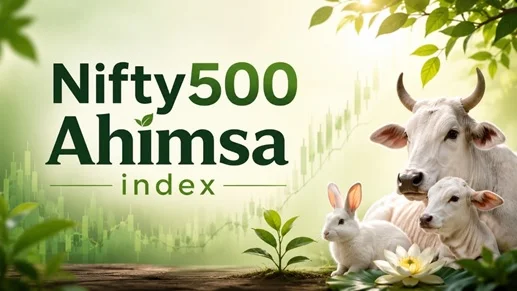
The Nifty 500 Ahimsa Index is a thematic equity index developed by NSE Indices in collaboration with the Ahimsagain Foundation. It selects companies from the Nifty 500 universe whose operations align with the principle of "Ahimsa" (non-violence) by avoiding activities that directly contribute to animal cruelty.
The index provides investors with an opportunity to invest in businesses that follow ethical practices towards animals, making it India's first animal welfare-focused investment benchmark.
|
ESG Investing |
Ahimsa Investing |
|
Focuses on Environmental, Social and Governance factors |
Focuses primarily on animal welfare and non-violence |
|
Global framework |
Based on the Indian philosophy of Ahimsa |
|
Emphasises carbon emissions, labour standards and governance |
Screens businesses based on animal cruelty-free practices |
|
Widely adopted globally |
India's first values-based ethical investment framework |
|
Nifty 500 Ahimsa Index |
BSE Saatvik 100 Index |
|
Focuses mainly on animal welfare |
Covers animal welfare along with addictive, toxic and socially harmful products |
|
Based on Ahimsa Investment Movement framework |
Broader ethical investment framework |
|
Developed by NSE Indices and Ahimsagain Foundation |
Developed by BSE |
|
Launched on 10 July 2026 |
Launched on 17 June 2026 |
ESG (Environmental, Social and Governance) is an internationally accepted framework used to evaluate a company's sustainability and ethical performance.
|
Q. With reference to the Nifty 500 Ahimsa Index, consider the following statements:
Which of the statements given above is/are correct?
Mains QuestionQ. "The emergence of ethical investment indices reflects a shift in capital markets from profit-centric investing to value-based investing." Discuss with reference to the launch of the Nifty 500 Ahimsa Index. |
Q1. What is the Nifty 500 Ahimsa Index?Answer: The Nifty 500 Ahimsa Index is India's first thematic stock market index that tracks companies following animal cruelty-free business practices. It was launched by the National Stock Exchange (NSE) on 10 July 2026. Q2. Why was the Nifty 500 Ahimsa Index launched?Answer: The index aims to promote ethical and values-based investing by enabling investors to invest in companies that adhere to the principle of Ahimsa (non-violence) and avoid activities that harm animals. Q3. How are companies selected for the Ahimsa Index?Answer: Companies are assessed using the Ahimsa Investment Movement (AIM) Framework, which classifies firms into Green, Orange, and Red bands. Only Green Band companies are included in the index. Q4. How is the Ahimsa Index different from ESG investing?Answer: While ESG (Environmental, Social and Governance) investing evaluates companies on environmental, social, and governance parameters, the Ahimsa Index specifically focuses on animal welfare and non-violence, reflecting Indian ethical values. |
Rajasthan Chief Minister Bhajan Lal Sharma has launched the Mukhyamantri Yuva Suyog Platform, a new digital initiative aimed at connecting young people with sports, skill development, employment opportunities, volunteering, and community engagement. The platform has been launched on a pilot basis in Bagru Assembly Constituency and Baran district.

With the integration of the MY Bharat Portal, the Mukhyamantri Yuva Suyog Platform has the potential to become a comprehensive youth engagement ecosystem in Rajasthan. By combining sports, skills, employment, entrepreneurship, and community participation, the initiative aims to empower young people and contribute to the State's long-term social and economic development.
Q1. What is the Mukhyamantri Yuva Suyog Platform?Answer: The Mukhyamantri Yuva Suyog Platform is a Rajasthan Government initiative designed to connect young people with sports, skill development, employment opportunities, volunteering, and community engagement through a unified digital platform. Q2. Who launched the Mukhyamantri Yuva Suyog Platform?Answer: The platform was launched by Rajasthan Chief Minister Bhajan Lal Sharma on a pilot basis in Bagru Assembly Constituency and Baran district. Q3. What are the objectives of the Mukhyamantri Yuva Suyog Platform?Answer: The platform aims to promote grassroots sports, skill development, employment, youth leadership, volunteerism, and active participation of young people in community and governance initiatives. Q4. How is the Mukhyamantri Yuva Suyog Platform linked to MY Bharat?Answer: The platform is inspired by the Government of India's MY Bharat Programme and will be integrated with the MY Bharat Portal to provide broader opportunities for Rajasthan's youth. Q5. What are the key features of the Mukhyamantri Yuva Suyog Platform?Answer: Key features include sports competitions from the ward and panchayat level, online registration, digital mapping of sports infrastructure, Yuva Suyog Clubs, volunteer activities, and the 'Suyog Charcha' dialogue platform. Q6. Why is the Mukhyamantri Yuva Suyog Platform significant?Answer: The initiative is expected to identify sports talent at the grassroots level, improve youth employability, encourage community participation, strengthen skill development, and create greater opportunities for youth empowerment across Rajasthan. |
| Keywords: FCRA Bill 2026, FCRA Amendment Bill 2026, Designated Authority, NGO Assets, PIB Fact Check, Foreign Contribution Regulation Act, FCRA Rules 2026, NGO Foreign Funding, FCRA UPSC, FCRA Amendment Explained, Ministry of Home Affairs, NGO Registration India, FCRA Current Affairs, GS Paper 2, UPSC Prelims Mains. |
The Foreign Contribution (Regulation) Amendment Bill, 2026 is back in focus during the Monsoon Session of Parliament after the Press Information Bureau (PIB) issued a clarification addressing concerns raised by minority institutions, especially Christian organizations. The clarification came after objections to the proposed Designated Authority, which would manage assets created from foreign contributions when an NGO's FCRA registration is suspended, cancelled, or not renewed.

The Foreign Contribution (Regulation) Act (FCRA), 2010 is a law enacted to regulate the acceptance and utilization of foreign contributions by individuals, associations and NGOs.
It seeks to ensure that foreign funds do not adversely affect:
Administered by: Ministry of Home Affairs (MHA)
The 1976 law was replaced by the Foreign Contribution (Regulation) Act, 2010.
Major reforms included:
The FCRA Amendment Act, 2020 introduced stricter regulations.
The proposed Bill introduces a Designated Authority to manage assets created from foreign contributions after lawful cessation of FCRA registration.
|
Year |
Development |
|---|---|
|
1976 |
First FCRA enacted |
|
2010 |
New FCRA Act replaces 1976 law |
|
2020 |
Major amendments tightening regulation |
|
2026 |
Designated Authority proposed |
According to the Government:
The Bill proposes appointment of a Designated Authority having powers similar to a Civil Court.
It can:
However, only assets created using foreign contributions are covered.
|
Myth |
Fact |
|---|---|
|
Government can seize all NGO assets. |
Only foreign-funded assets are covered after lawful cessation. |
|
Churches and religious institutions can be taken over. |
Religious character remains protected by law. |
|
Cancellation means wrongdoing. |
Many cancellations occur due to procedural lapses. |
|
No legal remedy exists. |
Appeals can be filed before District Judge and higher courts. |
The PIB clarified that:
The Government argues that:
|
Particular |
Data |
|---|---|
|
Active FCRA NGOs (2024-25) |
Around 16,200 |
|
Foreign Contribution |
₹22,963 Crore |
|
Christian NGOs Share |
Less than 15% |
| Sector | Examples of Permitted Activities |
| Education | Schools, colleges, vocational training, scholarship support, educational research, libraries, adult literacy programmes |
| Healthcare | Hospitals, clinics, mobile health units, maternal and child healthcare, community health education, disability support |
| Rural Development | Watershed development, livelihood support, agricultural extension, sanitation, clean water access, housing |
| Social Welfare | Support for persons with disabilities, elderly care, child welfare, women's empowerment, rehabilitation programmes |
| Environment | Conservation initiatives, afforestation, clean energy, pollution control, wildlife protection, environmental research |
| Culture and Heritage | Preservation of cultural heritage, folk arts, indigenous knowledge, traditional crafts, museums and archives |
| Relief and Rehabilitation | Disaster relief, emergency response, post-disaster rehabilitation, resettlement support |
| Faith-Based Welfare | Maintenance of places of worship, religious education, moral instruction, meditation programmes, preservation of faith traditions |
| Scientific Research | Research institutions, laboratories, academic collaborations, publication and knowledge dissemination |
Prelims MCQQ. Consider the following statements regarding the FCRA Amendment Bill, 2026:
Which of the statements given above is/are correct? A. 1 only B. 1 and 2 only C. 2 and 3 only D. 1, 2 and 3 UPSC Mains Question"The regulation of foreign contributions must strike a balance between national security, transparency, and the autonomy of civil society organizations." Discuss in the context of the Foreign Contribution (Regulation) Amendment Bill, 2026. |
1. What is the FCRA Amendment Bill, 2026?It proposes a Designated Authority to manage assets created from foreign contributions after suspension, cancellation, or non-renewal of an NGO's FCRA registration. 2. What is the role of the Designated Authority?It can temporarily manage, transfer, or dispose of foreign-funded assets, subject to judicial review. 3. Why is the Bill controversial?Some NGOs and minority organizations fear increased government control over NGO assets and possible impact on institutional autonomy, though the government says religious character and legal safeguards remain protected. 4. Why is FCRA important for India?It regulates foreign funding to ensure that external financial support does not undermine India's sovereignty, security, democratic institutions, or public interest, while enabling legitimate developmental and charitable activities. |

Our support team will be happy to assist you!

 Contact Us
  New Batch : 9555124124/ 7428085757
  Tech Support : 9555124124/ 7428085757