New
GS Foundation (P+M) - Delhi : 19th Jan. 2026, 11:30 AM New Year offer UPTO 75% + 10% Off | Valid till 03 Jan 26 GS Foundation (P+M) - Prayagraj : 09th Jan. 2026, 11:00 AM New Year offer UPTO 75% + 10% Off | Valid till 03 Jan 26 GS Foundation (P+M) - Delhi : 19th Jan. 2026, 11:30 AM GS Foundation (P+M) - Prayagraj : 09th Jan. 2026, 11:00 AM

Current Affairs for 24 December 2025

Kuttanad Wetlands Face Soil Toxicity Risk

Prelims: (Agriculture + CA)
Mains: (GS 1 – Geography; GS 3 – Agriculture, Environmental Degradation, Sustainable Farming)

Why in News ?

Recent soil tests in the Kuttanad paddy fields of Kerala—part of the Kuttanad Wetland Agricultural System—have revealed elevated aluminium concentrations, raising concerns over soil health, crop productivity, and the long-term sustainability of this globally recognised farming system.

Background & Context

Kuttanad represents one of India’s most ecologically sensitive and unique agricultural landscapes, where farming is carried out below sea level. The region is highly vulnerable to changes in soil chemistry, water management, and climate variability.

Increasing soil acidity—often linked to intensive cultivation, fertiliser use, altered hydrology, and saline intrusion—can mobilise aluminium in soils, posing a serious threat to paddy cultivation. The recent findings have therefore drawn attention to the fragility of wetland agro-ecosystems and the need for sustainable soil management practices.

Kuttanad Wetland Agricultural System: Key Features

Unique Agricultural Landscape

  • Only agricultural system in India where rice is cultivated below mean sea level
  • Located in Kerala, spanning parts of Alappuzha, Kottayam, and Pathanamthitta districts
  • Protected by an extensive network of bunds and water channels

Mosaic Structure of the Kuttanad System

The system comprises a complex, interlinked landscape divided into three major components:

  1. Wetlands
    • Paddy cultivation
    • Inland fishing activities
  2. Garden Lands
    • Coconut plantations
    • Tuber crops and food crops
  3. Water Bodies
    • Inland fisheries
    • Shell and aquatic resource harvesting

This integration supports both livelihood security and ecological balance.

Global Recognition: GIAHS Status

  • Recognised as the Kuttanad Below Sea-Level Farming System
  • Listed under the Globally Important Agricultural Heritage Systems (GIAHS) programme of the Food and Agriculture Organization (FAO)
  • Recognition highlights:
    • Traditional knowledge systems
    • Sustainable land and water management
    • Biodiversity conservation

Aluminium Toxicity: Impact on Soil and Plants

Soil Chemistry

  • Aluminium becomes highly soluble and toxic when:
    • Soil pH falls below 5
  • Acidic conditions accelerate aluminium release into soil solution

Impact on Crops

  • Damages plant root systems
  • Inhibits absorption of essential nutrients:
    • Phosphorus
    • Calcium
    • Potassium
    • Magnesium
  • Leads to:
    • Stunted growth
    • Reduced yields
    • Increased crop stress

In a wetland system like Kuttanad, such toxicity can significantly undermine food security and farmer livelihoods.

Broader Environmental Concerns

  • Rising soil acidity may be linked to:
    • Excessive fertiliser use
    • Changes in water flow and drainage
    • Salinity intrusion due to sea-level rise
  • Highlights the vulnerability of below-sea-level farming to climate change
  • Calls for integrated soil, water, and nutrient management strategies

Globally Important Agricultural Heritage Systems (GIAHS): Key Facts

  • FAO initiative launched at the World Summit for Sustainable Development (2002)
  • Objective:
    • Balance conservation, sustainable adaptation, and socioeconomic development
  • Recognises agricultural systems of:
    • Outstanding biodiversity
    • Cultural and ecological value

India’s GIAHS Sites

  • Koraput Region (Odisha):
    • Traditional subsistence paddy cultivation on highland slopes
  • Kuttanad System (Kerala):
    • Unique below-sea-level wetland farming
  • Saffron Park of Kashmir:
    • Traditional agro-pastoral saffron cultivation system

Significance for India

  • Protecting Kuttanad is vital for:
    • Wetland conservation
    • Climate-resilient agriculture
    • Preservation of indigenous farming knowledge
  • Ensuring soil health is essential to maintain:
    • GIAHS status
    • Long-term agricultural sustainability

FAQs

Q1. What is unique about the Kuttanad agricultural system ?

It is the only system in India where rice is cultivated below sea level.

Q2. Why is aluminium toxic to crops ?

In acidic soils, aluminium damages roots and blocks nutrient absorption.

Q3. What is GIAHS ?

A FAO programme recognising traditional agricultural systems of global importance.

Q4. Why is soil acidity a concern in Kuttanad ?

It increases aluminium toxicity, reduces yields, and threatens wetland sustainability.

Q5. How is Kuttanad relevant for UPSC exams ?

It links geography, environment, agriculture, climate change, and sustainable development.

Parliamentary Privileges: Scope and Limits

Prelims: (Polity + CA)
Mains: (GS 2 – Indian Constitution, Parliament, Separation of Powers, Judicial Review)

Why in News ?

The Lok Sabha Speaker is examining a breach of parliamentary privilege notice over alleged disruptive conduct during the debate on the Viksit Bharat – Guarantee For Rozgar and Ajeevika Mission (Gramin) Bill, 2025, raising questions on contempt of the House and legislative discipline.
Background & Context

Parliamentary privileges are derived from the British parliamentary tradition and are meant to safeguard the independence, dignity, and effective functioning of legislatures. In India, these privileges are constitutionally recognised but not codified, leading to frequent debates on their scope, misuse, and conflict with democratic accountability.

What are Parliamentary Privileges ?

Parliamentary privileges are special rights, immunities, and exemptions enjoyed by:

  • Each House of Parliament
  • Parliamentary committees
  • Members of Parliament

Objective: To ensure free debate, uninhibited decision-making, and protection from external interference.

Types of Parliamentary Privileges

Individual Privileges

  • Freedom of speech in Parliament (Article 105)
  • Immunity from legal proceedings for speeches and votes
  • Freedom from arrest in civil cases during parliamentary sessions and related periods

Collective Privileges

  • Right to regulate internal proceedings
  • Power to punish for breach of privilege and contempt
  • Right to publish proceedings and conduct secret sittings

Sources of Parliamentary Privileges

  • Constitutional: Articles 105, 122, 194, 212
  • Legal: Article 105(3), Code of Civil Procedure, 1908
  • Conventions: British parliamentary practices
  • Rules & Procedure: Lok Sabha and Rajya Sabha rules
  • Judicial Interpretation: Supreme Court rulings

Breach of Privilege and Contempt of House

  • Breach of Privilege: Violation of a specific parliamentary right
  • Contempt of House: Any act that obstructs parliamentary functioning or lowers its authority

All breaches amount to contempt, but contempt can occur without a specific breach.

Procedure for Privilege Complaints

  1. Written notice to Speaker/Chairman
  2. Consent of Presiding Officer
  3. Leave of the House (supported by at least 25 members)
  4. Inquiry by the House or Committee of Privileges
  5. Punishment: reprimand, suspension, expulsion, or imprisonment till prorogation

Key Judicial Pronouncements

  • Searchlight Case (1958): Privileges can override freedom of press
  • PV Narasimha Rao Case (1998): Legislative immunity (now overturned)
  • Sita Soren Case (2024): Bribery is not protected by parliamentary privilege

Key Issues & Concerns

  • Scope for political misuse
  • Conflict with Fundamental Rights
  • Lack of codification and transparency
  • Erosion of public trust

Way Forward

  • A broad statutory framework defining core privileges
  • Transparent and fair procedures
  • Stronger ethics oversight
  • Harmonious balance between privileges and Fundamental Rights

FAQs

Q1. What are parliamentary privileges ?

Special rights and immunities that protect Parliament and MPs in performing legislative functions.

Q2. Which constitutional articles deal with parliamentary privileges ?

Articles 105, 122, 194, and 212.

Q3. What is the difference between breach of privilege and contempt of the House ?

Breach involves violation of a specific privilege; contempt is broader and includes any act obstructing parliamentary functioning.

Q4. Can MPs claim immunity for criminal acts ?

No. As clarified by the Supreme Court (2024), criminal acts like bribery are not protected.

Q5. Why is reform of parliamentary privileges needed ?

To prevent misuse, enhance transparency, and align privileges with constitutional values.

Export Growth and Regional Imbalance in India

Prelims: (Economy + CA)
Mains: (GS 3 – Economic Development, Regional Disparities, Industrial Policy, Employment)

Why in News ?

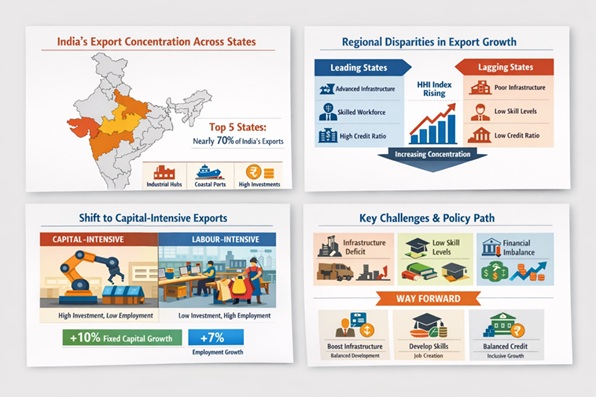
A recent analysis of RBI’s State-wise export data reveals that India’s export growth is increasingly concentrated in a few States, exposing deepening regional imbalances and questioning the assumption that export expansion automatically leads to broad-based industrialisation and employment generation.
Background & Context

At the national level, India’s export performance appears resilient, even amid a weakening rupee and global trade slowdown. However, a disaggregated, State-level analysis presents a contrasting picture. Export-led growth has become geographically skewed, benefiting already industrialised and coastal States, while large parts of the hinterland remain marginal participants. This pattern challenges traditional development models that viewed exports as a catalyst for industrialisation, job creation, and regional convergence.

Overview of India’s Export Performance

  • Aggregate export figures suggest robustness and diversification.
  • State-wise data from the RBI Handbook of Statistics on Indian States (2024–25) shows:
    • Export growth is unevenly distributed.
    • A small group of States accounts for a disproportionate share of total exports.
  • This raises concerns about the quality and inclusiveness of export-led growth.

Concentration of Exports Among a Few States

  • Five States dominate India’s export landscape:
    • Maharashtra
    • Gujarat
    • Tamil Nadu
    • Karnataka
    • Uttar Pradesh
  • Together, they contribute nearly 70% of India’s total exports.
  • Half a decade ago, their share stood at around 65%, indicating rising concentration.

Measuring Concentration

  • The Herfindahl–Hirschman Index (HHI) of exports has increased.
  • HHI is used by anti-trust authorities to assess market concentration:
    • Calculated by squaring the market share of each participant and summing the values.
  • Rising HHI signals divergence, not convergence, in regional export performance.

Structural Reasons Behind Regional Divergence

Changing Nature of Global Trade

  • The era of labour-intensive, low-skill manufacturing as a development ladder is narrowing.
  • Global merchandise trade growth has slowed.
  • Capital increasingly flows to regions with high economic complexity, not merely cheap labour.

Agglomeration Advantages in Export-Leading States

  • Export-dominant States possess:
    • Dense industrial clusters
    • Advanced logistics and ports
    • Skilled labour pools
    • Strong supplier networks
    • Financial depth
  • These factors reinforce spatial clustering, making relocation to lagging regions costly.

Structural Deficits in Hinterland States

  • Persistent shortages of:
    • Infrastructure
    • Human capital
    • Institutional capacity
  • These constraints limit entry into complex global value chains, trapping hinterland States in low-export equilibria.

Shift from Labour-Intensive to Capital-Intensive Exports

  • Export growth is becoming capital-intensive rather than job-rich.
  • Annual Survey of Industries (2022–23) data shows:
    • Fixed capital investment grew by over 10%
    • Employment growth lagged at about 7%
  • Rising fixed capital per worker indicates capital deepening.
  • Exports increasingly generate value without proportionate employment creation, weakening the traditional agriculture-to-manufacturing labour absorption pathway.

Employment Outcomes and Labour Market Trends

  • Periodic Labour Force Survey (PLFS) findings:
    • Manufacturing employment share stagnates at 11.6–12%, despite record exports.
    • This suggests a decline in employment elasticity of exports.
  • Export-linked jobs are concentrated in:
    • Electronics hubs in Tamil Nadu
    • Industrial clusters in Noida and western India
  • Wage share in Net Value Added has declined, indicating productivity gains accrue more to capital than labour.

Financial and Institutional Constraints in Hinterland States

  • Export-leading States often have Credit–Deposit (CD) ratios above 90%, allowing:
    • Local recycling of savings into industry
  • Lagging States such as Bihar and eastern Uttar Pradesh:
    • CD ratios below 50%
    • Capital flows out to already developed regions
  • This creates a vicious cycle of underdevelopment:
    • Capital flight
    • Weak industrial capacity
    • Continued exclusion from export growth

Rethinking Exports as a Development Metric

The emerging evidence suggests a structural shift:

  • Exports are increasingly an outcome of prior development, not its cause
  • States do not export their way into prosperity; they export because they already possess:
    • Industrial depth
    • Institutional strength
    • Human capital

Relying solely on export growth as a proxy for development risks overlooking:

  • Employment generation
  • Regional equity
  • Wage growth
  • Human capital outcomes

Policy Implications and Way Forward

  • Complement export promotion with:
    • Infrastructure investment in lagging regions
    • Skill development aligned with complex manufacturing
    • Financial deepening in hinterland States
  • Focus on:
    • Employment-intensive sectors
    • Regional industrial policy
    • Balanced credit allocation
  • Shift evaluation metrics from export volumes to inclusive development outcomes.

FAQs

Q1. What does the concentration of exports across States indicate ?

It reflects growing regional inequality and uneven industrial development.

Q2. Which States dominate India’s export basket ?

Maharashtra, Gujarat, Tamil Nadu, Karnataka, and Uttar Pradesh.

Q3. What is the Herfindahl–Hirschman Index (HHI) ?

A measure of concentration calculated by summing the squared market shares of participants.

Q4. Why is export growth no longer generating sufficient jobs ?

Because exports are increasingly capital-intensive, with rising capital per worker.

Q5. What is the key policy takeaway from this trend ?

Exports should be treated as an outcome of development, not a standalone development strategy.

IMF Emergency Aid via Rapid Financing Instrument

Prelims: (Economy + Disaster Management + CA)
Mains: (GS 2 – International Organisations; GS 3 – Disaster Management)

Why in News ?

The International Monetary Fund (IMF) has approved USD 206 million in emergency financing for Sri Lanka under its Rapid Financing Instrument (RFI) to address urgent balance of payments needs arising from the catastrophic Cyclone Ditwah.

Background & Context

Sri Lanka has faced recurrent economic and climatic shocks in recent years, severely straining its public finances, foreign exchange reserves, and balance of payments. Natural disasters such as cyclones exacerbate these vulnerabilities by disrupting economic activity, damaging infrastructure, and increasing import dependence for relief and reconstruction.

In this context, IMF emergency financing instruments play a critical role in providing swift liquidity support to affected countries without the delays associated with full-fledged adjustment programmes.

Rapid Financing Instrument (RFI): Overview

The Rapid Financing Instrument is an IMF facility designed to provide quick financial assistance to member countries facing urgent balance of payments needs.

  • Available to all IMF member countries
  • Intended for situations requiring rapid disbursement
  • Operates under the General Resources Account (GRA)

Objectives of the Rapid Financing Instrument

  • Address immediate foreign exchange shortages
  • Support countries affected by:
    • Natural disasters
    • Exogenous shocks
    • Domestic instability
    • Fragility and crises
  • Prevent escalation into deeper macroeconomic crises

Types of Rapid Financing Instrument

1. Regular Window

  • For urgent balance of payments needs caused by:
    • Domestic instability
    • Exogenous economic shocks
    • Fragility or emergencies
  • Access Limits:
    • Up to 50% of quota per year
    • Up to 100% of quota on a cumulative basis

2. Large Natural Disaster Window

  • Applicable when:
    • Damage from a natural disaster equals or exceeds 20% of GDP
    • Designed for severe disaster-related shocks
  • Access Limits:
    • Up to 80% of quota per year
    • Up to 133.33% of quota on a cumulative basis

Conditionality under the RFI

  • No ex-post program-based conditionality
  • No requirement for:
    • Structural reform benchmarks
    • Periodic programme reviews
    • Prior actions may apply in certain cases
  • Recipient country must commit to:
    • Policies aimed at resolving underlying balance of payments problems
    • Transparency and appropriate use of funds

Significance of RFI Support for Sri Lanka

  • Provides immediate liquidity for disaster response and recovery
  • Helps stabilise foreign exchange reserves
  • Prevents further macroeconomic and external sector stress
  • Complements longer-term economic reform and recovery efforts

Broader Implications

  • Highlights IMF’s role as a global financial safety net
  • Demonstrates the importance of climate-resilient financing mechanisms
  • Reflects growing linkage between:
    • Climate disasters
    • External sector vulnerability
    • Global financial stability

Relevance for India and the Region

  • South Asia is highly vulnerable to climate-induced disasters
  • IMF emergency instruments may become increasingly relevant
  • Stability in neighbouring economies is vital for:
    • Regional trade
    • Financial stability
    • Humanitarian cooperation

FAQs

Q1. What is the Rapid Financing Instrument (RFI) ?

An IMF facility that provides quick financial assistance to member countries facing urgent balance of payments needs.

Q2. Under which IMF account does the RFI operate ?

The General Resources Account (GRA).

Q3. What triggered IMF assistance to Sri Lanka under the RFI ?

Urgent balance of payments needs arising from Cyclone Ditwah.

Q4. Does RFI financing involve strict conditionality ?

No. It involves no ex-post program-based conditionality, though prior actions may apply.

Q5. How does the Large Natural Disaster Window differ from the Regular Window ?

It offers higher access limits when disaster-related damage exceeds 20% of GDP.

Anjadip: Indigenous ASW Shallow Water Craft

Prelims: (Defence + CA)
Mains: (GS 3 – Defence Technology, Indigenisation, Internal Security)

Why in News ?

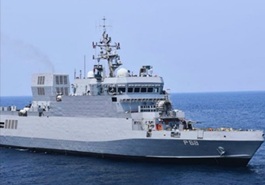
The Indian Navy has received ‘Anjadip’, an Anti-Submarine Warfare Shallow Water Craft (ASW-SWC), at Chennai. It is the third vessel in the series of eight such ships being inducted to strengthen India’s coastal and littoral defence capabilities.
Background & Context

India’s long coastline, dense maritime traffic, and increasing underwater threats in the Indian Ocean Region (IOR) have necessitated the development of specialised platforms for shallow-water anti-submarine operations. Conventional large warships are less effective in coastal waters due to depth constraints and manoeuvrability issues.

To address this gap, the Indian Navy conceptualised the ASW Shallow Water Craft programme under the broader vision of Atmanirbhar Bharat in defence, aiming to enhance indigenous shipbuilding, reduce import dependence, and improve maritime domain awareness close to the coast.

Anjadip Ship: Key Details

  • Type: Anti-Submarine Warfare Shallow Water Craft (ASW-SWC)
  • Series: Third of eight ships
  • Builder:
    • Garden Reach Shipbuilders and Engineers (GRSE), Kolkata
    • Built under Public–Private Partnership (PPP) with L&T Shipyard, Kattupalli
  • Design & Classification:
    • Indigenously designed
    • Constructed as per Indian Register of Shipping (IRS) rules

Legacy and Nomenclature

  • Named after Anjadip Island, located off the coast of Karwar, Karnataka
  • Symbolic reincarnation of the earlier INS Anjadip:
    • A Petya-class corvette
    • Decommissioned in 2003
  • Reflects continuity of naval heritage and tradition

Technical Features of Anjadip

Performance and Propulsion

  • Maximum speed: ~25 knots
  • Propulsion:
    • Waterjet propulsion system
    • Largest Indian naval warship class to be propelled by waterjets
  • Enhanced manoeuvrability in shallow and confined waters

Combat and Sensor Systems

  • Lightweight Torpedoes (state-of-the-art)
  • Indigenously designed Anti-Submarine Rockets
  • Shallow-water SONAR systems for submarine detection
  • Optimised for operations in littoral and coastal zones

Strategic Significance

  • Strengthens:
    • Anti-submarine warfare capability
    • Coastal surveillance
    • Mine-laying operations
  • Enhances India’s ability to counter:
    • Enemy submarines
    • Asymmetric maritime threats in shallow waters
  • Acts as a force multiplier for coastal security architecture

Contribution to Indigenous Defence Ecosystem

  • Demonstrates maturity of India’s domestic shipbuilding industry
  • Reinforces:
    • Make in India and Atmanirbhar Bharat
    • Public–Private Partnership model in defence manufacturing
  • Reduces reliance on foreign platforms and systems

Relevance for India’s Maritime Security

  • Supports protection of:
    • Ports and harbours
    • Offshore infrastructure
    • Sea lines of communication (SLOCs)
  • Complements larger surface combatants and submarines
  • Enhances India’s preparedness in the Indian Ocean Region

FAQs

Q1. What is Anjadip ?

Anjadip is an Anti-Submarine Warfare Shallow Water Craft inducted into the Indian Navy.

Q2. Who built the Anjadip ship ?

It was built by GRSE, Kolkata, under a PPP model with L&T Shipyard, Kattupalli.

Q3. Why are ASW Shallow Water Crafts important ?

They are specifically designed to detect and neutralise submarines in shallow coastal waters.

Q4. What propulsion system does Anjadip use ?

It uses waterjet propulsion, offering better manoeuvrability in shallow waters.

Q5. How does Anjadip support Atmanirbhar Bharat ?

It is indigenously designed and built, reducing import dependence and strengthening India’s defence manufacturing ecosystem.

« »
  • SUN
  • MON
  • TUE
  • WED
  • THU
  • FRI
  • SAT
Have any Query?

Our support team will be happy to assist you!

OR