- UPSC Exam
- State PCS
- One Day Exam
- Current Affairs
- PT Quiz
- Downlaods
- About Coaching
- Blog
- Videos

| Prelims: Governance + CA Mains: GS Paper 2 – Government Policies & Interventions; Social Justice; Welfare Schemes |
The Government of India is strengthening the Nasha Mukt Bharat Abhiyaan (NMBA) through technological upgrades and expanded outreach, reflecting renewed focus on tackling substance abuse as a major social and public health challenge.
Thus, NMBA is evolving from a government scheme into a mass participatory movement (Jan Andolan) aimed at achieving a drug-free society.
Substance abuse has emerged as a significant socio-economic and public health issue in India, affecting individuals across age groups and regions.
Thus, NMBA represents a holistic and coordinated response to address the complex challenge of substance abuse in India.
Tackles substance abuse, which has far-reaching health and social consequences
Focuses on prevention, reducing long-term healthcare costs and burdens
Encourages community participation and collective responsibility
Reduces productivity losses and contributes to overall economic development
Organised trafficking and cross-border smuggling continue to sustain drug availability
Addiction is often stigmatised, discouraging individuals from seeking help
Limited availability of quality de-addiction centres in certain regions
Difficulty in reaching remote populations reduces programme effectiveness
Multiple agencies involved can lead to implementation challenges
Integrate substance abuse awareness into school and college curricula
Increase availability and accessibility of rehabilitation centres
Promote grassroots participation for sustained impact
Use digital tools for monitoring, awareness, and service delivery
Improve coordination among agencies to reduce drug supply
FAQsQ1. When was Nasha Mukt Bharat Abhiyaan launched ? It was launched on 15 August 2020. Q2. What is its primary objective ? To reduce drug demand through awareness, prevention, treatment, and rehabilitation. Q3. Who are the target groups ? Youth, women, children, and vulnerable populations. Q4. What is its key approach ? A multi-pronged strategy involving prevention, treatment, and community participation. Q5. What is the latest development ? Expansion of the programme nationwide and introduction of digital tools for monitoring and outreach. |
FAQsQ1. When was Nasha Mukt Bharat Abhiyaan launched ? It was launched on 15 August 2020. Q2. What is its primary objective ? To reduce drug demand through awareness, prevention, treatment, and rehabilitation. Q3. Who are the target groups ? Youth, women, children, and vulnerable populations. Q4. What is its key approach ? A multi-pronged strategy involving prevention, treatment, and community participation. Q5. What is the latest development ? Expansion of the programme nationwide and introduction of digital tools for monitoring and outreach. |
| Prelims: Polity + CA Mains: GS Paper 2 – Parliament; Constitutional Provisions; Political Ethics; Governance |
The announcement by Raghav Chadha and several Rajya Sabha MPs of their “merger” with the Bharatiya Janata Party has triggered a major constitutional debate regarding the interpretation of the Anti-Defection Law.
Thus, the episode has become a critical test case for interpreting the scope, intent, and limitations of the Anti-Defection Law in India.
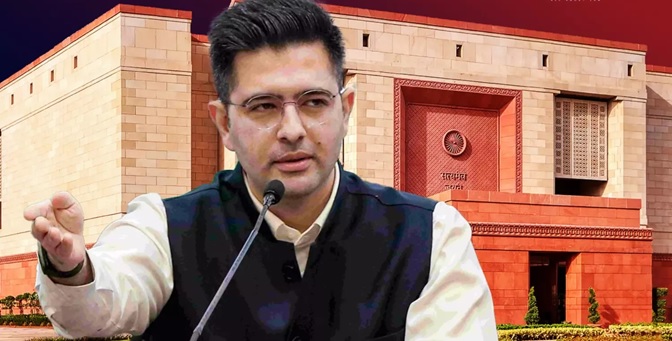
The Anti-Defection Law is contained in the Tenth Schedule of the Constitution, introduced by the 52nd Constitutional Amendment Act, 1985, to curb the growing trend of political defections.
The case exposes how legal provisions may be used strategically, raising questions about the ability of the law to achieve its original objective
It raises fundamental questions about whether loyalty lies with the political party as an institution or the legislative group within Parliament
Large-scale defections, even if legally protected, may undermine the mandate given by voters, affecting democratic legitimacy
The outcome of this case will shape how future defections are structured and interpreted under constitutional law
The two-thirds rule may be used as a legal shield to legitimise defections rather than facilitate genuine ideological realignments
Lack of clarity in defining “merger” creates scope for conflicting interpretations
Absence of timelines allows political uncertainty and manipulation
Raises questions about political morality and accountability in democratic governance
Constitutional or legislative clarification is required to define whether merger must involve the original political party
The Supreme Court should provide clear guidelines to ensure uniform application of the law
Introduce strict timelines for deciding defection cases to prevent prolonged uncertainty
Encourage transparency and accountability in political decision-making
Reform the law to ensure both party discipline and democratic independence of legislators
PrelimsQ. With reference to the Anti-Defection Law, consider the following statements:
Which of the statements given above is/are correct ? Mains“The merger clause under the Anti-Defection Law has become a tool for legitimising defections rather than preventing them.” Critically examine. |
FAQsQ1. What is the main issue in this case ? Whether the merger of MPs alone qualifies as a valid merger under the Anti-Defection Law. Q2. What is the two-thirds rule ? It allows exemption from disqualification if two-thirds of legislators agree to merge. Q3. Why is this controversial ? Because the original political party has not merged, raising legal doubts. Q4. Who decides the outcome ? The Chairman of the Rajya Sabha, subject to judicial review. Q5. What is the key takeaway ? Ambiguities in the law allow strategic political manoeuvres. |
| Prelims: Economy + CA Mains: GS Paper 3 – Banking; Financial Regulation; Digital Economy |
The Reserve Bank of India (RBI) has cancelled the banking licence of Paytm Payments Bank Limited, marking one of the most stringent regulatory actions in India’s evolving digital banking ecosystem.
Thus, the episode represents a critical moment in India’s fintech evolution, where rapid innovation is being balanced with strict regulatory enforcement.
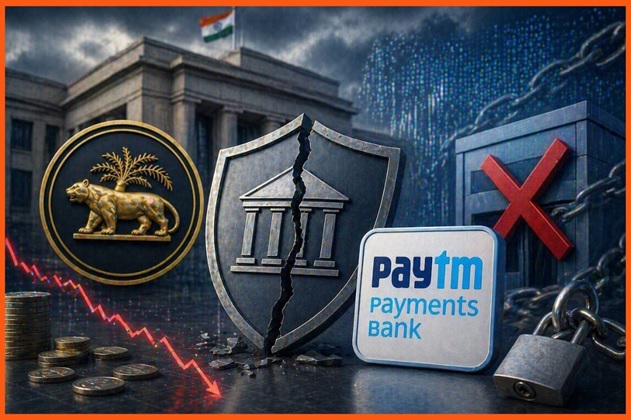
Payments Banks are a specialised category of banks introduced to promote financial inclusion, digital payments, and last-mile banking access, particularly for underserved sections of society.
The objective behind Payments Banks was to leverage technology to expand financial inclusion while maintaining systemic stability.
PrelimsQ. Payments Banks in India are allowed to: Mains“Strict regulatory enforcement is essential for maintaining trust in India’s digital banking ecosystem.” Discuss in the context of the Paytm Payments Bank case. |
FAQsQ1. Why was the licence cancelled ? Due to repeated regulatory violations and risks to depositors. Q2. What happens to customers’ money ? It remains safe and will be repaid. Q3. Can Paytm still operate ? Yes, its non-banking services continue. Q4. What is the key lesson ? Compliance is critical in banking. Q5. What is the broader impact ? Stronger regulation of fintech sector. |

Our support team will be happy to assist you!

 Contact Us
  New Batch : 9555124124/ 7428085757
  Tech Support : 9555124124/ 7428085757