Prelims: Economy + CA
Mains: GS Paper 3 – Banking; Financial Regulation; Digital Economy |
Why in News ?
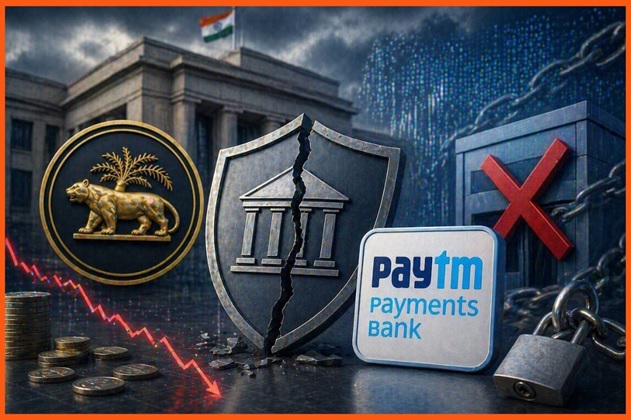
The Reserve Bank of India (RBI) has cancelled the banking licence of Paytm Payments Bank Limited, marking one of the most stringent regulatory actions in India’s evolving digital banking ecosystem.
- The licence cancellation has been undertaken under provisions of the Banking Regulation Act, 1949, which empowers the central bank to revoke licences if operations are found to be detrimental to public interest or depositor safety
- The RBI has also initiated legal proceedings for winding up the bank, indicating that the regulator has lost confidence in the institution’s ability to function within the prescribed regulatory framework
- This action comes after years of progressive regulatory intervention, including restrictions on onboarding new customers, limitations on deposits, and close supervisory monitoring
- The decision reflects a broader regulatory philosophy that prioritises:
- Financial stability
- Protection of depositors’ funds
- Integrity and transparency in digital financial services
Thus, the episode represents a critical moment in India’s fintech evolution, where rapid innovation is being balanced with strict regulatory enforcement.
What are Payments Banks ?
Payments Banks are a specialised category of banks introduced to promote financial inclusion, digital payments, and last-mile banking access, particularly for underserved sections of society.
- They are permitted to:
- Accept demand deposits up to a specified limit per customer
- Facilitate payments and remittance services
- Provide basic banking services such as savings accounts
- However, they are restricted from:
- Lending activities or credit creation
- Issuing credit cards or undertaking complex financial intermediation
- Their business model is therefore:
- Low-risk
- Transaction-oriented
- Dependent on high volume, low-margin operations
The objective behind Payments Banks was to leverage technology to expand financial inclusion while maintaining systemic stability.
Key Reasons for Licence Cancellation
1. Persistent and Repeated Regulatory Non-Compliance
- The RBI identified a consistent pattern of non-adherence to regulatory norms and licensing conditions, despite multiple warnings and supervisory interventions over several years
- Instead of isolated lapses, the violations were:
- Systemic in nature
- Recurrent over time
- This reflects:
- Weak compliance culture within the institution
- Inadequate internal monitoring and audit mechanisms
- The failure to implement corrective actions even after regulatory directions indicates a breakdown of institutional accountability, which is unacceptable in the banking sector
2. Serious Deficiencies in KYC (Know Your Customer) Processes
- The bank was found to have significant lapses in verifying customer identities, a cornerstone requirement for financial institutions
- Issues included:
- Multiple accounts linked to the same identity documents
- Inadequate due diligence in customer onboarding
- Such lapses increase the risk of:
- Money laundering
- Fraudulent transactions
- Use of the banking system for illegal activities
- Given that Payments Banks deal with high transaction volumes, weak KYC norms can pose systemic risks beyond the institution itself, affecting the broader financial ecosystem
3. Operations Conducted in a Manner Prejudicial to Depositors’ Interests
- The RBI concluded that the bank’s functioning was detrimental to the interests of depositors, which is one of the most serious grounds for licence cancellation
- Depositor protection is the primary responsibility of any banking regulator, and any risk to public funds necessitates decisive action
- Concerns included:
- Operational inefficiencies
- Weak risk management frameworks
- Such conditions undermine:
- Trust in the banking system
- Confidence of small depositors, who are the primary customers of Payments Banks
4. Governance Failures and Weak Institutional Controls
- The regulator flagged deficiencies in:
- Corporate governance practices
- Board-level oversight
- Internal control systems
- Effective governance is essential in financial institutions because:
- It ensures compliance
- It maintains transparency and accountability
- Weak governance structures lead to:
- Poor decision-making
- Inability to respond to regulatory concerns
- The case highlights how governance failures can translate into systemic regulatory violations
5. Violation of Licensing Conditions and Operational Guidelines
- Payments Banks operate under a tightly regulated framework with clearly defined operational boundaries
- The bank was found to have:
- Breached multiple licence conditions
- Failed to adhere to regulatory caps and norms
- These violations undermine the very purpose of:
- Creating a specialised, low-risk banking category
- As violations accumulated over time, the RBI escalated its response from:
- Advisory measures → Restrictions → Licence cancellation
6. Long History of Regulatory Action Without Adequate Compliance
- The cancellation is not a sudden action but the result of a gradual escalation over several years
- Regulatory actions included:
- Imposition of operational restrictions
- Prohibition on onboarding new customers
- Limits on deposits and services
- Despite these measures:
- Compliance improvements remained inadequate
- This demonstrates that regulatory patience has limits, especially when systemic risks persist
What Happens After Licence Cancellation ?
1. Complete Cessation of Banking Operations
- The bank is no longer authorised to:
- Accept deposits
- Conduct payment banking activities
- It effectively ceases to function as a regulated banking entity
2. Initiation of Winding-Up Proceedings
- The RBI will approach the appropriate judicial authority to:
- Initiate formal winding-up of the bank
- This ensures:
- Orderly resolution
- Protection of stakeholder interests
3. Safeguarding Depositors’ Funds
- The RBI has indicated that:
- The bank holds sufficient funds to meet depositor liabilities
- Customers are required to:
- Withdraw or transfer their balances within the stipulated timeframe
- This step is crucial to:
- Maintain public confidence in the financial system
4. Limited Impact on Parent Company’s Non-Banking Services
- The parent company continues to operate:
- Digital payment services
- UPI-based transactions through partner banks
- However, the incident may affect:
- Brand perception
- User trust
Significance of RBI’s Action
1. Reinforcement of Regulatory Credibility
- Demonstrates that the RBI is:
- Proactive
- Willing to take strict action when required
- Strengthens:
- Credibility of the regulator
2. Protection of Financial Stability
- Prevents:
- Escalation of risks within the financial system
- Ensures:
3. Strong Signal to Fintech Sector
- Sends a clear message that:
- Innovation must be accompanied by compliance
- Encourages:
- Responsible business practices
4. Emphasis on Governance and Risk Management
- Highlights the importance of:
- Strong internal controls
- Ethical management
5. Setting a Regulatory Precedent
- Establishes a benchmark for:
- Future regulatory enforcement
- Reinforces the principle that:
- No entity is “too big to regulate”
Impact on India’s Banking and Fintech Sector
1. Heightened Regulatory Scrutiny
- Fintech companies will face:
- More rigorous compliance checks
- Increased focus on:
2. Short-Term Disruptions for Customers
- Customers may experience:
- Operational inconvenience
- Need to shift accounts
3. Long-Term Strengthening of Financial Ecosystem
- Improves:
- Transparency
- Accountability
- Leads to:
- More resilient financial institutions
4. Reorientation of Business Models
- Companies may shift toward:
- Focus on:
Challenges Highlighted
1. Regulating Rapidly Evolving Fintech Sector
- Innovation often outpaces:
2. Balancing Innovation and Regulation
- Excessive regulation may:
- Weak regulation may:
3. Low Financial Literacy
- Many users lack awareness about:
Way Forward
1. Strengthening Compliance Infrastructure
- Institutions must invest in:
- Robust compliance systems
2. Enhancing Regulatory Coordination
- Improve synergy between:
- Regulators
- Financial institutions
3. Promoting Responsible Innovation
4. Improving Financial Literacy
5. Continuous Supervisory Monitoring
- Regulators must:
- Anticipate emerging risks
Practice Questions
Prelims
Q. Payments Banks in India are allowed to:
(a) Provide loans
(b) Accept deposits with limits and provide payment services
(c) Issue credit cards
(d) Invest in equity markets
Mains
“Strict regulatory enforcement is essential for maintaining trust in India’s digital banking ecosystem.” Discuss in the context of the Paytm Payments Bank case.
|
FAQs
Q1. Why was the licence cancelled ?
Due to repeated regulatory violations and risks to depositors.
Q2. What happens to customers’ money ?
It remains safe and will be repaid.
Q3. Can Paytm still operate ?
Yes, its non-banking services continue.
Q4. What is the key lesson ?
Compliance is critical in banking.
Q5. What is the broader impact ?
Stronger regulation of fintech sector.
|






 Contact Us
  New Batch : 9555124124/ 7428085757
  Tech Support : 9555124124/ 7428085757