Why in News
China developed an AI-powered electrochemical technology to convert nitrate-rich wastewater into ammonia (NH3) for fertiliser production.
AI-Driven Catalyst Innovation
- The process uses an AI-optimised Dual-Atom Catalyst (DAC) containing two adjacent active metal atoms.
- The catalyst improves reaction selectivity and nitrate-to-ammonia conversion efficiency.
- The technology converts nitrates from agricultural runoff and industrial effluents into ammonia.
Energy-Efficient Ammonia Production
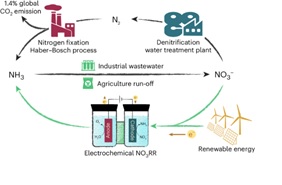
- The technology uses electrochemical reduction to convert nitrates into ammonia at room temperature.
- It is nearly three times more efficient than earlier nitrate-to-ammonia conversion methods.
- Unlike the Haber-Bosch Process, it does not require high temperature and pressure conditions.
- The Haber-Bosch Process produces ammonia from nitrogen and hydrogen and is highly energy-intensive.
- Ammonia is the main raw material for nitrogen fertilisers such as urea and ammonium compounds.






 Contact Us
  New Batch : 9555124124/ 7428085757
  Tech Support : 9555124124/ 7428085757