Why in News ?
The Government of India has banned sugar exports until September 30, 2026. The decision has been driven mainly by two major concerns :
- Rising geopolitical uncertainty linked to Iran and the wider West Asia crisis
- The possible emergence of El Niño, which may affect India’s future agricultural production
Although India currently has adequate sugar availability, the government has adopted a precautionary approach to ensure food security, control inflation, and maintain supply stability. Only limited exports under special quota commitments to the European Union and the United States will continue.
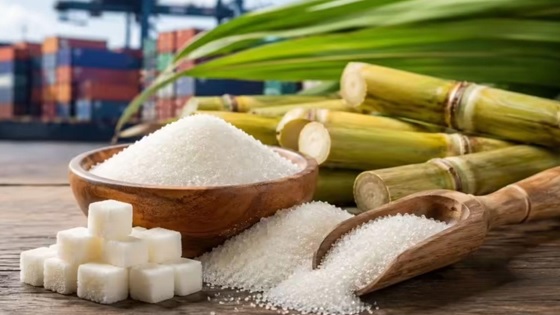
Sugar Industry in India
India is the world’s second-largest sugar producer after Brazil and also the largest consumer of sugar globally. The industry supports millions of farmers, labourers, transport workers, and mill employees, making it one of India’s most important agro-based industries.
Factors Responsible for the Location of Sugar Industry
1. Raw Material Availability
Sugarcane is the primary raw material for sugar production. Since sugarcane is bulky, highly perishable, and loses sucrose content rapidly after harvesting, sugar mills are generally located close to cane-growing regions.
2. Climate
Sugarcane grows best in tropical and subtropical climatic conditions with :
- High temperatures
- Adequate rainfall or irrigation
- Long growing season
This naturally concentrates sugar production in fertile plains and coastal belts.
3. Labour Availability
The sugar industry is labour-intensive in both cultivation and processing stages. Availability of agricultural and industrial labour plays an important role in determining mill locations.
4. Transport Facilities
Efficient road and rail connectivity are essential for Rapid transportation of sugarcane to mills and Distribution of processed sugar to markets Delay in transportation directly affects sugar recovery and quality.
5. Water and Power Supply
Sugar mills require large quantities of water for Washing sugarcane ,Crushing and refining processes Reliable electricity and fuel supply are also necessary for continuous mill operations.
6. Market and Government Policy
India’s large population ensures strong domestic demand for sugar. The government heavily regulates the sector through :
- Fair and Remunerative Price (FRP) for sugarcane
- Export controls
- Monthly release mechanisms
- Ethanol blending policies
Geographical Distribution of Sugar Industry in India
North India Belt
The northern belt includes:Uttar Pradesh ,Bihar ,Punjab ,Haryana ,Uttarakhand .
Key Features
- Uttar Pradesh has the highest number of sugar mills
- Located mainly in the fertile Ganga-Yamuna plains
- Crushing season is shorter (November–April)
- Lower sugar recovery and yield per hectare
South India Belt
The southern belt includes:Maharashtra ,Karnataka ,Tamil Nadu ,Andhra Pradesh .
Key Features
- Higher sucrose content in sugarcane
- Longer crushing season
- Better irrigation facilities
- More modern and cooperative-run mills
- Greater productivity and efficiency
India’s Sugar Supply Position Remains Comfortable, But Stocks Are Tightening
India is expected to produce around 279 lakh tonnes (lt) of sugar during the 2025–26 sugar season.
Supply Position
- Opening stock : Over 50 lakh tonnes
- Total availability : 329 lakh tonnes
- Domestic consumption : About 280 lakh tonnes
Initially, the government allowed :
- 15 lakh tonnes of exports in November 2025
- Additional 5 lakh tonnes in February 2026
Thus, total permitted exports reached 20 lakh tonnes.
However, only about 6 lakh tonnes have already been exported Another 0.5 lakh tonnes are in transit at ports
Therefore, total exports are expected to remain around 6.5 lakh tonnes.
Expected Closing Stocks
- After accounting for:Domestic consumption: 280 lakh tonnes ,Exports: 6.5 lakh tonnes
- India’s closing stock on September 30, 2026 is expected to fall to around 42.5 lakh tonnes.
- Although this would be the lowest level since 2016–17, it still equals nearly 1.8 months of domestic consumption, which is considered sufficient until the next crushing season begins around November.
Why the Government Took No Chances on Sugar Exports
1. El Niño Threat to Future Sugar Production
- The biggest concern is the possible development of El Niño conditions.
- El Niño refers to abnormal warming in the Pacific Ocean, which often leads to:Weak monsoon rainfall in India ,Higher temperatures ,Water shortages .
- Climate models suggest a weak-to-moderate El Niño may emerge by mid-2026 and could continue into 2027.
- This may not affect the current sugar crop significantly, but it could damage the next planting cycle meant for the 2027–28 sugar season.
2. Fertiliser Supply Risks Due to West Asia Crisis
- Sugarcane is a water- and fertiliser-intensive crop.
- Ongoing tensions in West Asia, especially involving Iran, may disrupt:Fertiliser imports ,Shipping routes ,Energy markets This could increase production costs and reduce future sugarcane yields.
3. Concerns Over Actual Sugar Stocks
Sugar mills are required to submit monthly stock declarations to the government through P-II forms.
However, policymakers reportedly fear that :
- Some mills may not physically hold the stock quantities they officially report
- Any mismatch between declared and actual stocks may create unexpected shortages
To avoid supply uncertainty, the government preferred a complete export restriction.
4. Inflation Management
- The government wants to prevent any future shortage that could:-Increase sugar prices ,Add pressure on food inflation ,Worsen broader inflation concerns related to fuel and fertilisers Maintaining stable domestic supplies has therefore become a policy priority.
5. Sugar Exports Were Already Economically Weak
- Indian sugar exports had already become commercially unattractive.
Domestic vs Export Prices
- Maharashtra ex-factory prices : ₹38–38.5/kg
- Uttar Pradesh ex-factory prices : ₹40–40.5/kg
- Export price of Indian white sugar : Around ₹41/kg
After including:Bagging ,Transportation ,Port handling costs Export profitability became lower than domestic sales.
Thus, the ban mainly shuts an already narrow export window.
India’s Sugar Export Ban to Hit Major Overseas Buyers
India is the world’s second-largest sugar exporter after Brazil.
Sugar exports increased sharply after 2020 and peaked at:₹45,132 crore in 2022 However, exports declined steadily afterward :
- ₹30,688 crore in 2023
- ₹18,906 crore in 2024
- ₹18,586 crore in 2025
This showed weakening export momentum even before the latest ban.
Majority of Export Trade Affected
- The exemption granted to the United States and European Union provides limited relief because these markets account for only a small share of India’s exports.
- Nearly 90% of India’s sugar exports go to other regions.
- Major Importers of Indian Sugar -Somalia ,Sudan ,Djibouti ,Yemen UAE ,Bangladesh ,Kenya ,Sri Lanka ,Iran .
- African countries account for a particularly large share of India’s sugar exports.
- The export ban is therefore expected to :
- Disrupt trade flows
- Affect importing nations dependent on Indian sugar
- Increase global dependence on Brazilian sugar exports






 Contact Us
  New Batch : 9555124124/ 7428085757
  Tech Support : 9555124124/ 7428085757