Prelims: Carbon allotropes; covalent bonding; hybridisation; crystal structures
Mains: GS Paper III – Science and Technology, materials science and emerging technologies
Keywords: Diamondiyne, carbon allotrope, sp and sp³ hybridisation, diyne linkage, diamond topology, liquid–liquid interface |
Why in News?
- Researchers reported the synthesis of diamondiyne, a new three-dimensional carbon allotrope, in Angewandte Chemie International Edition.
- The material was proposed decades ago, but its synthesis was difficult because the required carbon building block is unstable.
- The researchers produced thin carbon films containing diamondiyne crystallites using a reaction at the boundary between two liquids.
What is Diamondiyne
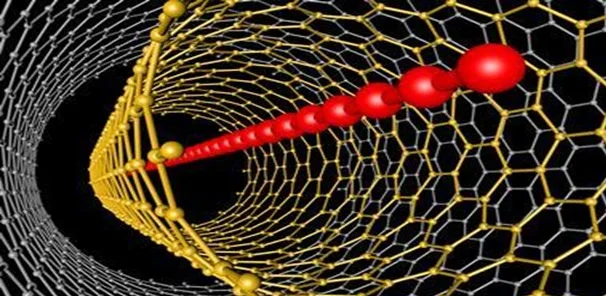
- Diamondiyne is a carbon-only material with a three-dimensional, diamond-like network.
- The study describes it as a “carbo-mer” of diamond: diyne units are inserted into the diamond-topology network, expanding it and creating a more open structure.
- The name’s “yne” refers to the carbon–carbon triple bonds in these units.
Key Features and Structure
- Three-dimensional network: Its carbon atoms form a covalently connected network extending in all three dimensions.
- Mixed hybridisation: The ideal structural model combines sp-hybridised carbon atoms in triple-bonded diyne groups with sp³-hybridised carbon atoms connected through single bonds.
- Expanded diamond topology: Inserting diyne groups preserves the overall diamond-like network while making its repeating structure more open and porous.
- Ideal model: The proposed ideal structure has face-centred cubic symmetry and an 8:1 ratio of sp to sp³ carbon atoms.
How Was It Synthesised?
- The team used a liquid–liquid interface—the boundary between an organic liquid and an aqueous liquid—as the site for a cascade reaction. A protected carbon-based precursor was gradually converted into a reactive building block, which then coupled to form the carbon network. Copper fluoride helped remove the protective groups and catalyse the coupling reaction.
- Keeping the precursor concentration low helped control the reaction and encouraged the material to grow at the interface. The method produced continuous thin films whose thickness could be adjusted by changing the reaction time. The reported films contained diamondiyne crystallites alongside amorphous carbon.
Significance
- Expands the family of carbon materials: Diamondiyne adds a new three-dimensional structure to the known forms of carbon.
- Demonstrates a synthesis strategy: The work shows how careful control of reaction speed and concentration can help form ordered networks using strong, largely irreversible carbon–carbon bonds.
- Opens a research pathway: Its more open structure may motivate research into possible material uses. However, the study does not demonstrate a practical application or establish performance in devices.
Challenges
- Crystallinity and scale: The reported material consists of crystallites within thin carbon films, rather than a large, uniform bulk crystal.
- Low reported yield: The study estimates reaction yield at up to about 1% and notes that it has not yet been optimised.
- Structural control: The researchers observed variation between crystallites and evidence of interpenetrating networks, so the precise structure may differ across the film.
- Unproven uses: The material’s potential applications remain unknown; further research must measure its properties and test it in specific uses.
Way Forward
- Researchers can work to improve yield, control crystallite size and structure, and produce more uniform films.
- Further studies should measure electrical, mechanical, thermal and chemical properties, then test whether diamondiyne offers useful performance in a particular application.
Conclusion
Diamondiyne is a newly synthesised carbon allotrope that combines a diamond-like three-dimensional network with triple-bonded diyne units. Its synthesis marks a significant step in carbon-materials research, while its practical value will depend on improving production and establishing its properties through further testing.
Prelims MCQ
With reference to diamondiyne, consider the following statements:
- It is a carbon allotrope with a three-dimensional network.
- Its ideal model combines sp- and sp³-hybridised carbon atoms.
- Researchers produced it as a large, uniform bulk crystal.
Which of the statements given above is/are correct?
A. 1 and 2 only
B. 2 and 3 only
C. 1 and 3 only
D. 1, 2 and 3
Mains Question
Explain how diamondiyne differs structurally from diamond. What challenges must be addressed before it can be considered for practical applications?
|
FAQs
1. What is diamondiyne?
Diamondiyne is a newly synthesised, three-dimensional carbon allotrope with an expanded diamond-like network.
2. What does “diyne” mean in its name?
A diyne group contains two carbon–carbon triple bonds. These groups help expand the diamond-topology network.
3. How does its structure differ from diamond?
Diamond has a network of sp³-hybridised carbon atoms. Diamondiyne’s ideal model combines sp and sp³ carbon, with diyne units making the network more open.
4. How was diamondiyne made?
Researchers formed it through a cascade reaction at the interface between two liquids, producing thin carbon films containing diamondiyne crystallites.
5. Does diamondiyne already have a confirmed industrial use?
No. The study reports its synthesis and structural evidence; practical applications have not yet been demonstrated.
|






 Contact Us
 New Batch : 9555124124/ 7428085757
 Tech Support : 9555124124/ 7428085757
