Prelims : Governance + CA
Mains : GS Paper 2 – Government Policies & Interventions; GS Paper 3 – Cyber Security |
Why in News ?
The e-SafeHER Initiative has been recently launched as a nationwide cybersecurity awareness programme aimed at empowering rural women to safely participate in India’s rapidly expanding digital ecosystem.
The initiative comes at a time when digital penetration in rural India is increasing rapidly, but awareness regarding cyber risks and safe digital practices remains limited, especially among women.
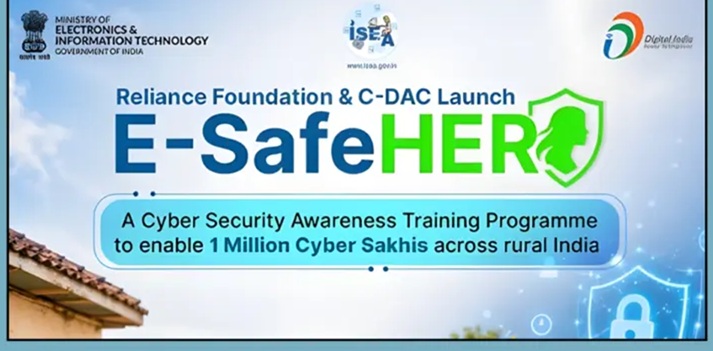
What is the e-SafeHER Initiative?
The e-SafeHER initiative is a large-scale cybersecurity awareness and training programme designed to promote safe digital inclusion among women in rural India.
It focuses on :
- Bridging the gap between digital access and digital safety, ensuring that women are not only connected but also protected in the digital ecosystem.
- Building a gender-responsive and community-led model, where women themselves become agents of awareness and change.
- Empowering women to confidently use digital platforms for financial transactions, livelihoods, and access to government services.
Institutional Framework
The initiative is implemented through a collaborative, multi-stakeholder approach involving government, technical institutions, and private organisations.
- It is anchored under the Ministry of Electronics and Information Technology through its Information Security Education and Awareness (ISEA) Programme, which provides the policy and knowledge framework for cybersecurity awareness.
- The Centre for Development of Advanced Computing is responsible for:
- Developing training content and modules
- Ensuring localisation and multilingual adaptation
- Continuously upgrading cybersecurity knowledge frameworks
- The Reliance Foundation plays a key role in:
- Grassroots-level implementation
- Mobilising communities and outreach
- Leveraging existing women empowerment platforms
This integrated framework ensures both technical robustness and effective last-mile delivery.
Objectives of the Initiative
The programme aims to achieve multiple interconnected objectives :
- Training one million rural women over a period of three years, thereby creating a large network of digitally aware and empowered individuals.
- Developing “Cyber Sakhis”, who are trained women acting as community leaders to spread awareness about safe digital practices.
- Enhancing cybersecurity awareness, particularly in areas such as digital payments, online fraud prevention, and data protection.
- Promoting confidence in digital participation, enabling women to actively engage in the digital economy without fear of cyber threats.
Key Features of the e-SafeHER Initiative
1. Community-Based and Peer-Led Model
- The initiative adopts a bottom-up, community-driven approach, where trained women (Cyber Sakhis) educate others in their communities.
- This ensures :
- Greater trust and acceptance among participants
- Cultural and contextual relevance of training
- Sustainable and scalable awareness mechanisms
2. Focus on Self-Help Groups (SHGs)
- The programme leverages existing networks of women’s Self-Help Groups for implementation.
- This enables :
- Efficient outreach in rural and remote areas
- Integration with ongoing livelihood and empowerment initiatives
- Faster dissemination of knowledge at the grassroots level
3. Structured Training Modules and Content
- The initiative provides comprehensive and structured cybersecurity training, including :
- Safe use of digital payments and banking platforms
- Awareness about phishing, frauds, and cyber threats
- Best practices for protecting personal data and privacy
- Training content is :
- Localised in regional languages
- Delivered through audio-visual tools
- Designed for easy understanding
4. Phased Implementation Strategy
- The initiative follows a phased rollout approach, ensuring effective scaling :
- Initial implementation in states such as Madhya Pradesh and Odisha
- Gradual expansion to other regions across India
- Target of reaching one million women by 2029
- This phased strategy allows continuous learning and improvement.
5. Integration with Existing Digital and Social Programmes
- Instead of creating parallel systems, the initiative integrates with :
- Existing digital literacy programmes
- Women empowerment schemes
- This ensures :
- Cost-effectiveness
- Sustainability
- Wider reach
6. Focus on Behavioural Outcomes
- The programme is designed to produce measurable behavioural changes, such as :
- Increased awareness of cyber risks
- Improved confidence in digital transactions
- Adoption of safe online practices
- This outcome-oriented approach ensures real impact rather than just training delivery.
Significance of the Initiative
1. Promoting Safe Digital Inclusion
- While digital access is expanding rapidly, safety remains a concern.
- The initiative ensures that women are not just digitally connected but also digitally secure.
2. Empowering Rural Women
- By equipping women with cybersecurity skills, the initiative :
- Enhances their participation in the digital economy
- Improves access to financial services and government schemes
- Strengthens their socio-economic position
3. Strengthening Cybersecurity at the Grassroots
- Cyber threats are increasingly affecting rural populations.
- The initiative builds last-mile cybersecurity awareness, reducing vulnerability to fraud and scams.
4. Supporting Digital India Mission
- The programme complements broader government initiatives aimed at :
- Digital governance
- Financial inclusion
- E-commerce and digital livelihoods
5. Creating a Scalable and Replicable Model
- The community-based approach makes the initiative :
- Scalable across regions
- Adaptable to different socio-economic contexts
- Replicable for other digital awareness programmes
Challenges and Concerns
1. Digital Literacy Gaps
- Many rural women have limited exposure to digital technologies, which may slow training effectiveness.
2. Infrastructure Constraints
- Poor internet connectivity and lack of devices in rural areas can hinder implementation.
3. Sustainability of Awareness
- Ensuring long-term behavioural change requires continuous engagement and follow-up.
4. Cyber Threat Evolution
- Rapidly evolving cyber threats require constant updating of training content and strategies.
Way Forward
1. Strengthening Digital Infrastructure
- Improve internet connectivity and access to devices in rural areas.
2. Continuous Capacity Building
- Regular training updates and refresher programmes for Cyber Sakhis.
3. Public-Private Partnerships
- Expand collaboration with private sector and NGOs for wider outreach.
4. Integration with Education and Skill Development
- Incorporate cybersecurity awareness into broader digital literacy and skill programmes.
Practice Questions
Prelims
Q. The e-SafeHER initiative is associated with :
(a) Financial inclusion of women
(b) Cybersecurity awareness among rural women
(c) Digital payments infrastructure
(d) Skill development in manufacturing
Mains
“Digital inclusion without digital safety can expose vulnerable populations to new risks.” Examine in the context of the e-SafeHER initiative.
FAQs
Q1. What is e-SafeHER ?
A cybersecurity awareness programme for rural women.
Q2. What is its main objective ?
To enable safe participation in the digital ecosystem.
Q3. What are Cyber Sakhis ?
Trained women who spread cybersecurity awareness in communities.
Q4. Which ministry is involved?
Ministry of Electronics and Information Technology.
Q5. Why is it important ?
It ensures safe and inclusive digital growth.
|






 Contact Us
  New Batch : 9555124124/ 7428085757
  Tech Support : 9555124124/ 7428085757