Context
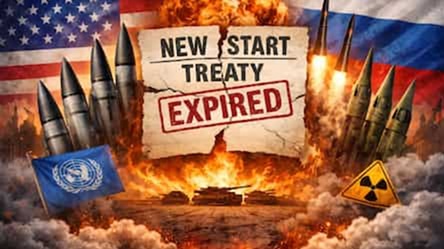
The formal expiration of the New START Treaty on February 5, 2026, marks a significant turning point in the history of global security. The end of the legal obligations that had limited nuclear weapons between the United States and Russia for the past five decades has raised the threat of a new nuclear race.
The Cold War and Early Arms Control Initiatives (1960-1970)
- In the late 1960s, when the Soviet Union equaled its intercontinental ballistic missile (ICBM) power with that of the United States, fears of global instability arose. To reduce this tension, the Strategic Arms Limitation Talks (SALT) were initiated.
- SALT I (1969-1972): This led to the Anti-Ballistic Missile (ABM) Treaty, which limited missile defense systems to prevent any country from acquiring a first-strike capability.
- SALT II (1979): This treaty capped the number of nuclear delivery vehicles (bombers and missiles) at 2,250. However, the US never ratified it due to the Soviet invasion of Afghanistan.
Post-Cold War Era: Reduction and Reduction (1991-2009)
- With the collapse of the Soviet Union, the focus shifted to "reduction," rather than simply limiting, the number of weapons.
- START I (1991): This was a landmark treaty that mandated a limit to 6,000 nuclear warheads and 1,600 missiles. It included strict on-site inspections. It expired in 2009.
- START II (1993): Its goal was to reduce the number of weapons to 3,500, but Russia also withdrew from the ABM Treaty in 2002 after the US withdrew from the treaty.
- SORT (2002): Seen as a "temporary bridge," it aimed to keep deployed warheads between 1,700 and 2,200.
New START: The Final Pillar of Nuclear Stability (2011-2026)
In 2010, President Obama (USA) and Dmitry Anatolyevich Medvedev (Russia) signed this treaty, which came into effect in 2011.
Key Terms of the Treaty
- Weapons Limitation: Tactical nuclear warheads were limited to 1,550 and delivery systems to 800.
- Strict Monitoring: Ground inspections were conducted 18 times per year and continuous data sharing was provided to ensure compliance.
- Extension: In 2021, President Joe Biden extended it for five years, making it valid until February 5, 2026.
The Treaty's End: Future Challenges and Risks
- Now that the treaty has expired, the global security landscape is fraught with the following threats:
- Uncontrolled Arsenals: There are now no legal restrictions on the US (approximately 5,277 warheads) and Russia (approximately 5,449 warheads) from expanding their nuclear capabilities.
- Lack of Transparency: The cessation of regular inspections and data sharing will increase suspicion between the two countries, potentially escalating even minor disputes into major nuclear conflicts.
- Setback to Nuclear Non-Proliferation: The breakdown of the Treaty just before the 2026 Nuclear Non-Proliferation Treaty (NPT) review could provoke other countries to abandon restraint.
- Strategic Competition: There are now signs of an open and uncontrolled strategic rivalry emerging between Russia, the US, and China.
Conclusion
Experts are clear in their warnings: without arms control, the world is more insecure than ever before. Although new agreements remain possible in the future, the current lack of mutual trust and lack of legal boundaries point to an uncertain nuclear age.






 Contact Us
  New Batch : 9555124124/ 7428085757
  Tech Support : 9555124124/ 7428085757