Prelims: (Economy + CA)
Mains: (GS 3 – Science & Technology, Innovation, Economic Development) |
Why in News ?
Emerging research in marine and space biotechnology is drawing global attention for its potential to harness life forms from extreme environments such as deep oceans and outer space to generate new biological knowledge, advanced materials, and sustainable manufacturing processes.
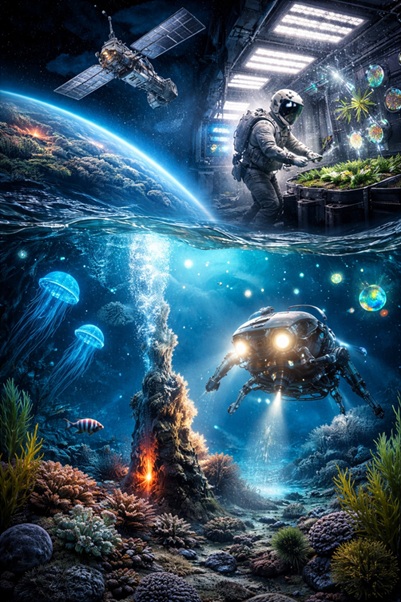
Understanding Marine and Space Biotechnology
- Marine biotechnology focuses on microorganisms, algae, invertebrates, and other marine life adapted to high pressure, salinity, low light, and extreme temperatures.
- These organisms are studied to develop bioactive compounds, enzymes, biomaterials, food ingredients, pharmaceuticals, and biostimulants.
- Space biotechnology examines how biological systems—microbes, plants, animals, and human cells—respond to microgravity, radiation, and confined environments.
- Insights from space biology support innovations in healthcare, materials science, life-support systems, and long-duration space missions.
Why Marine and Space Biotechnology Matters for India ?
- India has an extensive coastline of over 11,000 km and an Exclusive Economic Zone (EEZ) exceeding two million sq km, offering access to vast marine biodiversity.
- Despite this, India’s share in global marine biotechnology outputs remains low, indicating significant untapped potential.
- Marine biomanufacturing can generate new sources of food, energy, chemicals, and biomaterials, while reducing pressure on land, freshwater, and agriculture.
- Space biotechnology is critical for India’s expanding space ambitions, enabling safe food production, human health management, and biological manufacturing in extreme environments.
- Together, these domains can help position India as a future-ready leader in sustainable biomanufacturing.
India’s Current Position in Marine and Space Biotechnology
- India’s marine biomass production, including seaweed, is limited to around 70,000 tonnes annually, leading to continued imports of agar, carrageenan, and alginates used in food, pharmaceuticals, cosmetics, and medical products.
- Policy initiatives such as the Blue Economy agenda, Deep Ocean Mission, and BioE3 aim to build integrated marine biomanufacturing ecosystems.
- A small group of private firms—such as Sea6 Energy and ClimateCrew—along with research institutions like ICAR–Central Marine Fisheries Research Institute, are exploring scale-up pathways.
- In space biotechnology, the Indian Space Research Organisation (ISRO) is advancing research on microgravity biology involving microbes, algae, and life-support systems.
- However, private-sector participation remains limited, reflecting the nascent stage of the ecosystem.
Global Advances in Marine and Space Biotechnology
- The European Union is investing heavily in marine bioprospecting, algae-based biomaterials, and bioactive compounds, supported by shared research infrastructure such as the European Marine Biological Resource Centre.
- China has rapidly scaled seaweed aquaculture and marine bioprocessing to strengthen its bioeconomy and industrial biotechnology base.
- In space biotechnology, the United States leads through NASA and the International Space Station, where experiments on microbes, protein crystallisation, stem cells, and life-support systems advance drug discovery, regenerative medicine, and long-duration human spaceflight.
The Way Forward for Marine and Space Biotechnology
- Marine and space biotechnology represent largely untapped strategic frontiers where early movers can secure long-term technological and economic advantages.
- The principal risk lies in slow, fragmented research and development efforts.
- India needs a dedicated national roadmap with clear priorities, timelines, and outcomes to coordinate research institutions, industry, and government agencies.
- Focused investment, public–private partnerships, and international collaboration can accelerate innovation and translation into commercial applications.
FAQs
1. What is marine biotechnology ?
It involves using marine organisms to develop bioactive compounds, enzymes, biomaterials, and food products.
2. What does space biotechnology study ?
It examines how biological systems respond to microgravity and radiation in space environments.
3. Why is marine biotechnology important for India ?
India’s vast coastline and EEZ offer immense but underutilised biological resources.
4. Which Indian initiatives support marine and space biotechnology ?
Blue Economy agenda, Deep Ocean Mission, BioE3, and ISRO’s space biology programmes.
5. What is the main challenge for India in these fields ?
Fragmented R&D and limited scale-up of research into commercial applications.
|






 Contact Us
  New Batch : 9555124124/ 7428085757
  Tech Support : 9555124124/ 7428085757