Prelims: (Polity & Governance + CA)
Mains: (GS 2 – Governance, Accountability, Public Policy; GS 3 – Economy, Fiscal Management) |
Why in News ?
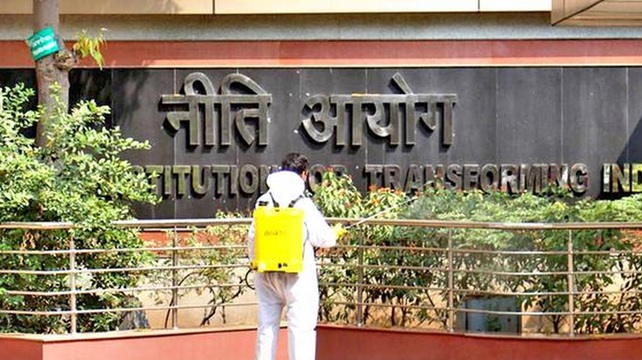
A Parliamentary Standing Committee has flagged poor financial planning and underutilisation of funds by the NITI Aayog and the Ministry of Planning.
The Committee criticised the persistent gap between budgetary allocations and actual expenditure, raising concerns over fiscal discipline, efficiency, and governance outcomes.
Background and Context
Evolution of Planning in India
India’s planning framework underwent a major shift with the replacement of the Planning Commission by the NITI Aayog in 2015.
This transition marked a move from:
- Centralised planning → Cooperative federalism
- Resource allocation → Policy advisory role
Role of NITI Aayog
The NITI Aayog functions as the government’s premier policy think tank, with key roles:
- Designing long-term development strategies
- Promoting cooperative and competitive federalism
- Monitoring and evaluating government schemes
- Facilitating innovation and sustainable development
Unlike the Planning Commission, it does not allocate funds, but plays a crucial role in shaping policy priorities and resource utilisation.
Parliamentary Committee’s Key Observations
1. Persistent Underutilisation of Funds
The Committee observed a consistent pattern of low expenditure despite high allocations:
- 2023–24:
- Budget Estimate: ~₹824 crore
- Actual Expenditure: ~₹290 crore (~35%)
- 2024–25:
- Budget Estimate: ~₹837 crore
- Actual Expenditure: ~₹282 crore (~34%)
Implication:
- Indicates structural inefficiencies in planning and execution
- Funds remain idle instead of being productively utilised
2. Rising Allocations Despite Low Spending
- Ministry sought ~₹1,203 crore for 2026–27
- ~22% increase despite poor utilisation
Concern:
- Reflects inflated budgeting and weak financial discipline
3. Weak Implementation and Planning Gaps
- Significant gap between planned and actual expenditure
- Delays in scheme execution and approvals
Outcome:
- Poor translation of policy into ground-level results
4. Skewed Expenditure Pattern
- Excessive spending concentrated in the last quarter (Q4)
Issues:
- “March rush” to exhaust funds
- Compromises quality and efficiency of spending
5. Violation of Fiscal Norms
- Government guidelines require even distribution of expenditure
- Last-quarter spending may lead to:
- Inefficient resource use
- Reduced accountability
- Suboptimal outcomes
Recommendations by the Committee
1. Realistic Budgeting
- Align allocations with actual needs and capacity
- Avoid inflated demands
2. Strengthening Monitoring Mechanisms
- Regular internal reviews and audits
- Ensure timely administrative approvals
3. Improving Fund Utilisation
- Avoid idle funds and delays
- Enhance coordination between planning and execution
4. Better Expenditure Management
- Ensure balanced spending across quarters
- Prevent last-minute rush of expenditure
Significance of the Issue
1. Impact on Development Outcomes
- Underutilisation delays:
- Infrastructure projects
- Social welfare schemes
- Leads to inefficient service delivery
2. Fiscal Responsibility and Accountability
- Persistent gaps undermine:
- Transparency in public finance
- Credibility of budgeting process
3. Governance Challenges
- Reflects deeper issues in:
- Administrative capacity
- Policy implementation
4. Relevance for Cooperative Federalism
- Inefficiencies at central level affect:
- State-level planning and coordination
- Overall development outcomes
Way Forward
- Strengthen public financial management systems
- Use data-driven planning and real-time monitoring
- Improve institutional coordination
- Promote outcome-based budgeting
- Enhance accountability mechanisms
FAQs
1. What is NITI Aayog ?
It is India’s policy think tank, responsible for strategic planning and promoting cooperative federalism.
2. Why did the Parliamentary Committee criticise NITI Aayog ?
Due to persistent underutilisation of funds and poor financial planning.
3. What is the issue with last-quarter spending ?
It leads to inefficient expenditure and reduced accountability, often called the “March rush”.
4. Does NITI Aayog allocate funds like the Planning Commission ?
No, it does not allocate funds but provides policy guidance and evaluation.
5. Why is efficient fund utilisation important ?
It ensures timely implementation of schemes, better governance, and optimal use of public resources.
|






 Contact Us
  New Batch : 9555124124/ 7428085757
  Tech Support : 9555124124/ 7428085757