Why in News ?
A study published in PLoS Biology on 7 May 2026 has developed an advanced DNA-based genetic mapping system (“DNA maps”) that can identify the geographic origin and trafficking routes of illegally traded pangolins, while also revealing international trafficking corridors including networks linked to northeastern India around Arunachal Pradesh and Assam feeding routes towards Yunnan in China.
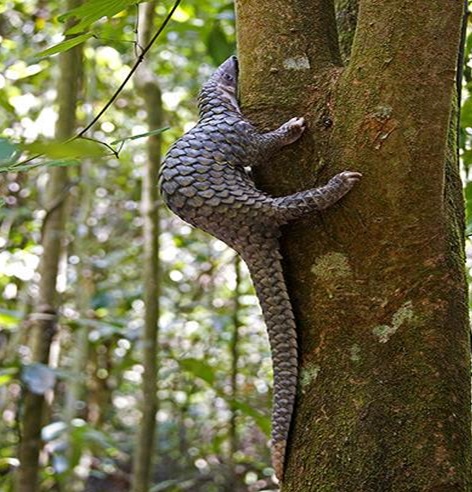
How Scientists Used DNA Mapping to Trace Pangolin Trafficking
- Pangolins are among the most trafficked mammals in the world, but conservation agencies have long faced difficulties in identifying where trafficked pangolins are originally poached because scales seized from smugglers often contain degraded DNA, making conventional genetic analysis difficult and preventing authorities from tracing seized material back to its source populations.
- To overcome this challenge, researchers adopted a new population genomics approach in which they focused only on 671 specific locations of the pangolin genome that differ between populations and can therefore act as geographic markers for identifying the origin of trafficked animals.
- The researchers also used 122 museum specimens to fill historical and geographical gaps from regions where pangolins have become rare or locally extinct, and combined these with hundreds of modern samples to create an extensive geo-referenced genetic database covering the distribution of all eight pangolin species.
- This resulted in the creation of an unprecedented “genetic map”, which can now help state agencies and wildlife authorities accurately determine the source location of seized pangolins and their body parts.
Major Findings of the Study
The study challenged the traditional assumption that domestic pangolin trade and international trafficking operate independently, revealing instead that the same source areas frequently supply both local markets and international smuggling networks.
Researchers found that pangolins involved in domestic trade are transported an average distance of around 454 km from their original habitat, indicating the existence of organised local supply chains before the animals enter international trafficking routes.
The study further identified three major international trafficking hotspots:
|
Species
|
Major Trafficking Hub
|
|
White-bellied Pangolin
|
Southwestern Cameroon
|
|
Sunda Pangolin
|
Southwestern Borneo
|
|
Chinese Pangolin
|
Myanmar region
|
Researchers also observed that traffickers often collect scales from multiple nearby pangolin populations and consolidate them before exporting them internationally, mainly towards consumer markets in China and Vietnam.
India-linked Pangolin Trafficking Network
- The research identified evidence suggesting that northeastern India, particularly areas around Arunachal Pradesh and Assam and possibly Bhutan, may be contributing to trafficking routes supplying Yunnan Province in China, while Yunnan itself may further serve as a source region for Guangdong, indicating the existence of interconnected regional wildlife trafficking corridors across Asia.
- This finding is particularly significant because it highlights India’s importance not only as a habitat region for pangolins but also as a potential transit and supply zone within broader transnational wildlife trade networks.
Importance of the DNA-Based Genetic Map
- The newly developed genetic database may significantly strengthen wildlife conservation and law enforcement efforts because it enables authorities to identify poaching hotspots, trace confiscated wildlife products back to their source populations, provide scientific evidence for prosecution, improve anti-trafficking operations, and disrupt illegal supply chains at their origin rather than only intercepting shipments after trafficking has occurred.
- Considering that global authorities recorded more than 1.4 lakh wildlife seizures between 2015 and 2021, this technology may provide the missing evidence needed to target illegal wildlife trade networks effectively.
About Pangolins
The pangolin is one of the world's most unique and mysterious creatures. It is the only mammal with hard scales made of keratin—the same keratin that makes up our nails and hair.
Physical Features and Behavior
- Unique protective armor: When threatened, the pangolin curls up like a ball. Its armor is so strong that even a lion or leopard cannot chew it.
- Diet: It has no teeth. It feeds on ants and insects with its long, sticky tongue. An adult pangolin can consume approximately 70 million insects a year, which is why it is also known as a "natural pest controller."
- Temperament: It is a shy and nocturnal creature that prefers to live alone.
Species Diversity
- There are eight species of pangolins globally, of which four species occur in Africa and four species occur in Asia.
African Pangolin Species
- White-bellied Pangolin
- Black-bellied Pangolin
- Giant Ground Pangolin
- Temminck’s Ground Pangolin
Asian Pangolin Species
- Indian Pangolin
- Chinese Pangolin
- Sunda Pangolin
- Philippine Pangolin
Habitat and Distribution
- Pangolins inhabit tropical forests, grasslands, agricultural landscapes and areas close to human settlements, while the Indian pangolin is widely distributed across India, Nepal, Sri Lanka and Bangladesh.
- The species plays an important ecological role because it feeds primarily on ants and termites, thereby helping in natural pest control, soil aeration and maintenance of ecosystem balance.
Threats Faced by Pangolins
- Pangolins face severe threats due to illegal wildlife trade, habitat destruction and increasing human activities, while their scales continue to be used in traditional medicine systems in parts of Asia and their meat is consumed as a delicacy in some regions.
- Simultaneously, deforestation, agricultural expansion, infrastructure development and habitat fragmentation have accelerated population decline across their distribution range.
Conservation Status
- The Indian Pangolin is listed as Endangered on the IUCN Red List, whereas the Chinese Pangolin is categorised as Critically Endangered due to rapid population decline.
- In India, both species receive the highest level of legal protection under Schedule I of the Wildlife (Protection) Act, 1972.
- At the international level, all eight pangolin species are included in Appendix I of CITES, which prohibits international commercial trade in these species.






 Contact Us
  New Batch : 9555124124/ 7428085757
  Tech Support : 9555124124/ 7428085757