Why in News ?
- Recently, Iran-linked media platforms floated the idea of imposing charges and “protection payments” on operators of undersea cables passing through the Strait of Hormuz.
- The remarks have drawn global attention to the invisible but highly critical infrastructure that supports modern internet connectivity and the global digital economy.
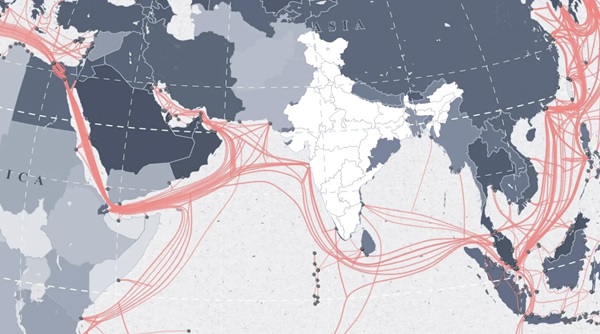
- Today, a large share of international internet traffic travels through submarine fibre-optic cables laid beneath the oceans. India, along with several countries in West Asia and Europe, depends significantly on cable systems that pass through the Hormuz region.
- Therefore, any geopolitical tension, conflict, cyberattack, or disruption affecting these routes could impact not only internet services but also cloud platforms, banking systems, stock markets, military communications, and international trade.
What are Undersea (Submarine) Cables ?
- Undersea or submarine cables are fibre-optic communication lines laid on the ocean floor that serve as the backbone of global digital connectivity. They are often called the “invisible highways” of the digital world because most internet traffic, video calls, cloud computing, financial transactions, and international communications rely on them.
- These cables are installed by specialised cable-laying vessels hundreds of metres below the sea surface. Inside them are extremely thin fibre-optic strands that transmit data through light signals at very high speed across continents. To protect them from deep-sea pressure, ship anchors, fishing activities, and physical damage, they are covered with multiple layers of plastic, steel, and copper protection.
- The United Nations General Assembly (UNGA) recognised submarine cables as “critical communication infrastructure” in 2010. Today, nearly 95–99% of international data traffic is transmitted through these cables, while satellites play only a supplementary role.
Role of Undersea Cables in the Global Internet System
- The modern digital economy functions largely because of submarine cable networks. Whenever a user in India accesses a server in Europe or America, joins an international video call, uses cloud storage, or conducts cross-border banking transactions, the data generally travels through undersea cables.
- Compared with satellite communication, submarine cables provide:
- Higher bandwidth capacity
- Lower latency
- Faster transmission speed
- Greater cost efficiency
- This makes them essential for global financial markets, digital payments, social media platforms, e-commerce systems, and cloud infrastructure.
- If a cable network is disrupted, internet traffic is rerouted through alternative routes. However, this creates congestion and overload on other networks, leading to slower internet speeds, delays in cloud services, and degraded performance.
- Thus, undersea cables are not merely communication assets but strategic infrastructure supporting the global economy.
Why is the Strait of Hormuz Important ?
- The Strait of Hormuz is one of the world’s most important strategic maritime corridors connecting the Persian Gulf to the Arabian Sea. While it is globally known as an energy chokepoint for oil and gas transportation, it has also become a major hub for digital connectivity.
- Several critical cable systems connecting India, West Asia, and Europe pass through this region, including:
- FALCON cable operated by Tata Communications
- Tata-TGN Gulf
- Gulf Bridge International (GBI)
- These systems support connectivity for countries such as:India ,United Arab Emirates ,Qatar ,Saudi Arabia ,Oman Because multiple critical cable systems converge here, Hormuz is increasingly described as a “digital chokepoint.” Any disruption in this area could affect international communication networks and global digital operations.
Growing Threats to Undersea Cable Networks
1. Geopolitical Intervention and Strategic Leverage
- Iran’s recent comments indicate that undersea cables are increasingly becoming geopolitical assets rather than merely technical infrastructure.
- Reports referring to licensing fees and “protection payments” suggest the possibility of using digital infrastructure as a strategic and economic instrument during geopolitical tensions.
- Technology companies such as:
have been mentioned in discussions concerning digital infrastructure control and strategic dependence.
2. Hybrid Warfare and Gray-Zone Conflict
- Modern conflicts increasingly extend beyond conventional warfare. Digital infrastructure, communication networks, and cyber systems have become important targets in what is often called gray-zone warfare.
- Disrupting submarine cables can weaken a country’s economy, communication systems, and digital operations without direct military engagement. Consequently, undersea cables have emerged as sensitive assets in geopolitical competition.
3. Cyber Threats and Espionage Risks
- Submarine cable systems are also vulnerable to surveillance and cyber operations.
- Potential threats include:
- Wiretapping and data interception
- Monitoring international communications
- Cyberattacks on network management systems
- Intelligence gathering through digital channels
Access to cable traffic could expose financial transactions, government communications, strategic information, and commercial data.
Potential Impact on India
1. Slower Internet and Disruption in Digital Services
India depends significantly on international connectivity routes passing through West Asia. If cable systems in the Hormuz region are disrupted, traffic would need to be diverted through alternate routes.
Although the internet may not completely fail, users could experience:
- Reduced internet speed
- Video buffering
- Disrupted video conferencing
- Gaming lag
- Delay in cloud-based applications
The impact would be more visible in sectors dependent on international data transfer.
2. Impact on Cloud Services and Data Infrastructure
India’s businesses, startups, financial institutions, and public services increasingly rely on global cloud infrastructure such as:
- Amazon Web Services (AWS)
- Microsoft Azure
- Google Cloud
Disruptions in submarine cables may increase server response times, slow cloud access, and temporarily affect digital platforms.
This could impact e-commerce, online education, payment systems, digital governance, and enterprise services.
3. Effects on Financial Markets and Banking Systems
- India’s financial ecosystem relies heavily on high-speed international connectivity.
- Stock exchanges, algorithmic trading systems, international banking networks, and payment infrastructure require uninterrupted data transmission.
- Any delay or instability in connectivity could affect:
- Stock trading operations
- Banking transactions
- Payment processing systems
- International financial communication
Even short disruptions may have wider economic implications.
4. Risks to India’s IT and Outsourcing Industry
India’s IT-BPM and outsourcing industry serves clients across the world and depends on uninterrupted digital connectivity.
Disruptions in cable systems may affect:
- Real-time client communication
- Server access
- Data exchange
- Global service delivery
This could impact operational efficiency and India’s digital services economy.
5. Strategic and National Security Concerns
- Digital networks have become integral to national security.
- Military communications, intelligence-sharing mechanisms, and strategic information systems increasingly rely on global connectivity.
- In a conflict scenario, disruption of undersea cable infrastructure may affect defence coordination, surveillance systems, and strategic communication networks.
- Therefore, submarine cable security is no longer only an economic issue but also a national security concern.
Why are Digital Chokepoints Becoming Geopolitical Risks ?
- Global internet traffic, cloud systems, and financial networks are increasingly concentrated around a limited number of strategic maritime routes.
- Regions such as:
- Strait of Hormuz
- Red Sea
- Strait of Malacca
- host multiple submarine cable systems and have emerged as digital chokepoints.
- Any conflict, cyberattack, sabotage, or maritime disruption in these areas could affect global digital infrastructure.
- As a result, countries increasingly view digital networks, data systems, and cable infrastructure as strategic national assets linked to economic power and security.
Conclusion
- Iran’s recent remarks have highlighted an important reality: the internet is not merely a virtual cloud but depends on physical infrastructure spread across oceans.
- Submarine cables form the backbone of global communications, cloud services, digital trade, and financial systems. For India, which is rapidly expanding its digital economy, strengthening digital resilience has become essential.
- India may need to accelerate investments in:
- Alternative cable routes
- Satellite backup systems
- Data localisation
- Secure digital infrastructure
- Strategic protection of communication networks
- Strengthening these capabilities would help India maintain digital stability amid future geopolitical disruptions.






 Contact Us
  New Batch : 9555124124/ 7428085757
  Tech Support : 9555124124/ 7428085757