| (UPSC GS-1, GS-3: Food Security, Agriculture, Environment, Climate Change) |
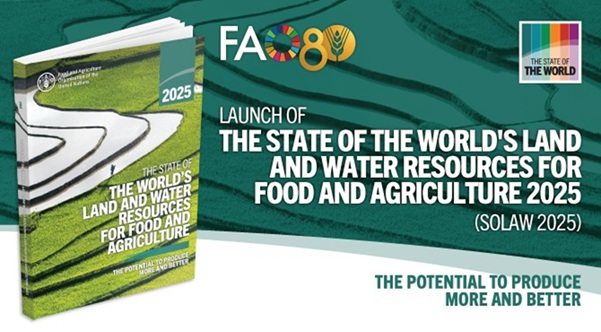
The Food and Agriculture Organization (FAO) of the United Nations releases the SOLAW Report every two years. SOLAW 2025 focuses on unlocking the hidden and untapped potential of land, soil, and water resources to ensure:
- Higher agricultural productivity,
- Food security,
- Climate resilience, and
- Conservation of ecosystem services.
The report highlights increasing pressure on land–water systems, degradation, pollution, and worsening supply–demand imbalances.
Key Highlights of the Report
1. Rising Global Demand & Stress on Agriculture
- By 2050, global population growth will require: → 50% more food, feed, and fibre compared to 2012.
- Freshwater demand is expected to rise by 25%.
Why it matters:
Major stress on agricultural resources is emerging from population growth, rapid urbanization, and climate change.
2. Little to No Scope for Agricultural Land Expansion
The report clearly states that:
- Agricultural land expansion is practically over globally.
- The only viable option now is to increase production from limited land and water resources.
3. Land & Water Degradation – A Serious Global Threat
Land Degradation
- More than 60% of global degradation directly affects agricultural land.
- Over-exploitation reduces soil fertility, weakens carbon storage, and destabilizes ecosystems.
Water Resource Crisis
- Agriculture uses over 70% of global freshwater.
- Overdependence on irrigation and declining groundwater levels intensify stress.
Intensive Agriculture Impacts
- Excessive fertilizers, pesticides, monocropping → Soil pollution, biodiversity loss, and water contamination.
Solutions & Opportunities: Sustainable Agricultural Intensification
SOLAW 2025 explains productivity enhancement across three pillars:
A. Enhancing Land Productivity
1. Reducing the Yield Gap
- Narrowing the gap between actual and potential yields through:
- Improved seeds
- Better fertilizer management
- Modern irrigation
2. Climate-resilient Crop Varieties
- Drought-tolerant, heat-resistant, and saline-resistant crops suited to local climates.
3. Sustainable Crop Management
- Integrated Nutrient Management (INM)
- Integrated Pest Management (IPM)
- Nutrient recycling
B. Improving Productivity in Rainfed Agriculture
Rainfed farming covers a major share of global cropland but remains low in productivity.
Key Strategies
- Conservation Agriculture
- Minimum tillage
- Crop residue retention
- Crop rotation
- Drought-resistant technologies
- Soil moisture conservation
- Micro-irrigation
- Crop diversification
- Community-based innovation
- Example: Gorakhpur, India – “Effective Microorganism Management” significantly increased farmers’ incomes.
C. Integrated Production Systems
FAO promotes multifunctional agricultural systems, including:
- Agroforestry
- Rotational grazing
- Improved forage crops
- Rice–fish integrated farming
Benefits:
- Diversified income
- Improved land productivity
- Reduced climate risks
Institutional Capacity Strengthening
1. Agricultural Extension Services
Modern extension systems provide localized, practical solutions to farmers.
2. FAO’s Farmer Field Schools (FFS)
- Hands-on training through field experiments.
- Example – Andhra Pradesh:
- FFS facilitated Community-managed Natural Farming, improving soil health and farmer livelihoods.
Global Significance of SOLAW 2025
1. SDG Alignment
Supports:
- SDG 2 – Zero Hunger
- SDG 6 – Clean Water & Sanitation
- SDG 15 – Life on Land
2. Climate Resilience
- Sustainable land–water management reduces climate-induced agricultural risks.
3. Geo-political Relevance
Land and water resources are emerging as major points of global conflict. Better governance ensures stability.
4. Economic Impact
- Land degradation may cause up to 10% loss in global GDP.
- Water scarcity threatens international agricultural trade.
Policy Recommendations (as per SOLAW 2025)
1. Restoring Land & Soil Health
- Enhancing soil organic carbon
- Promoting regenerative agriculture
- Combating land degradation
2. Water Management Reforms
- Improving Water-use Efficiency (WUE)
- Expanding micro-irrigation (drip, sprinkler)
- Groundwater recharge strategies
3. Reducing Chemical Usage
- Promoting organic alternatives
- Scaling up IPM and INM
4. Crop Diversification & Climate-resilient Crops
- Millets, pulses, legumes
- Multi-tier and diversified farming systems
5. Farmer Capacity Development
- Expanding the Farmer Field School model
- Creating digital knowledge platforms for farmers






 Contact Us
  New Batch : 9555124124/ 7428085757
  Tech Support : 9555124124/ 7428085757