Prelims: (Environment & Ecology + CA)
Mains: (GS 2 – Governance; GS 3 – Environment, Biodiversity) |
Why in News ?
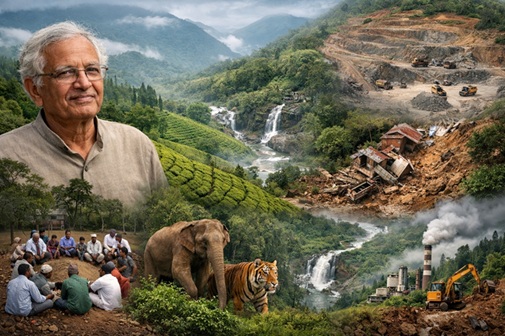
Eminent ecologist Madhav Gadgil passed away at the age of 83 in Pune, reviving national attention on his most influential contribution—the Western Ghats Ecology Expert Panel (WGEEP) report.
Though never fully implemented, the report’s warnings against unregulated development in the Western Ghats continue to gain relevance, particularly after recurring landslides, floods, and ecological disasters in the region. The renewed debate highlights the enduring tension between environmental protection, livelihoods, and federal politics.
Background: The Western Ghats and India’s Ecological Security
The Western Ghats, stretching over 1,600 km from Gujarat to Tamil Nadu, are among the world’s eight “hottest” biodiversity hotspots.
Ecological Significance
- Acts as the water tower of peninsular India
- Origin of major rivers such as:
- Godavari
- Krishna
- Cauvery
- Periyar
- Netravathi
- High degree of endemism, with species found nowhere else
- Plays a crucial role in:
- Monsoon regulation
- Climate resilience
- Flood moderation
Despite this, the region has faced growing pressure from mining, dams, roads, tourism, quarrying, and urban expansion, intensifying ecological fragility.
Why the Western Ghats Ecology Expert Panel (WGEEP) Was Set Up
In March 2010, the Union Ministry of Environment and Forests constituted the WGEEP, chaired by Madhav Gadgil.
Triggers for Its Formation
- Rising concerns over climate change impacts
- Unregulated infrastructure expansion
- Ecological degradation highlighted by civil society movements
- A 2010 meeting of the Save Western Ghats movement in the Nilgiris, attended by then Environment Minister Jairam Ramesh
Mandate of the Panel
- Assess the ecological status of the Western Ghats
- Identify Ecologically Sensitive Areas (ESAs)
- Recommend zoning regulations
- Propose governance mechanisms for sustainable and participatory development
Core Recommendations of the Gadgil Panel
Entire Western Ghats as an Ecologically Sensitive Area
- Designated the full 1,29,037 sq km Western Ghats landscape as an ESA
- Recognised cumulative and interconnected ecological vulnerability
Three-Tier Sensitivity Zoning
- Classified the region into:
- ESZ 1 (Most Sensitive)
- ESZ 2
- ESZ 3 (Least Sensitive)
- Regulatory intensity increased with ecological fragility
Restrictions on High-Impact Activities
- Ban on:
- Genetically Modified (GM) crops
- New Special Economic Zones (SEZs)
- New hill stations
- No new mining licences
- Phase-out of existing mines in ESZ 1 and 2 within five years
- Complete ban on quarrying in ESZ 1
Limits on Infrastructure Expansion
- Avoidance of new:
- Exceptions only for essential public needs, to minimise habitat fragmentation
Creation of a Statutory Western Ghats Ecology Authority (WGEA)
- A 24-member authority under the Environment Protection Act
- Composition included:
- Ecologists and domain experts
- Representatives from key ministries
- Multi-state coordination for uniform governance
Emphasis on Decentralised Governance
- Strong role for Gram Sabhas
- Shift from exclusionary conservation to community-led ecological stewardship
Political Opposition and the Gadgil Report Backlash
Delay and Secrecy
- Draft submitted in March 2011, final report in August 2011
- Initially withheld from the public
- Released only in May 2012 after:
- RTI applications
- Intervention by the Chief Information Commissioner
- Judicial proceedings
State-Level Resistance
- Kerala and Maharashtra emerged as the strongest critics
- Concerns raised:
- Threats to agriculture and plantation economies (Idukki, Wayanad)
- Livelihood insecurity
- Over-centralisation of environmental authority
- The Catholic Church and local political groups warned of displacement and economic disruption
- Maharashtra opposed WGEA, calling it a “parallel governance structure”
The Kasturirangan Panel: A Diluted Alternative
In response to widespread opposition, the Centre constituted a High-Level Working Group (2012) under K. Kasturirangan, former ISRO chief.
Key Features of the 2013 Kasturirangan Report
- Reduced ESA coverage to 56,825 sq km
- Focused mainly on natural landscapes, excluding most cultural and agricultural areas
- Supported restrictions on:
- Mining
- Polluting industries
- Thermal power plants
- Large townships
- Identified specific villages instead of entire regions
- Released state-wise ESA lists, making implementation administratively easier
Continuing Policy Deadlock
- The Centre has issued six draft ESA notifications, the latest in August 2024
- Persistent disagreements with States
- A committee headed by former DGF Sanjay Kumar is still finalising boundaries
- Implementation remains stalled despite increasing climate-induced disasters
Outlook and Contemporary Relevance
Recurring landslides, floods, and extreme rainfall events have repeatedly validated the ecological warnings of the Gadgil report.
As climate change intensifies, the debate is no longer about whether regulation is needed, but how to balance:
- Environmental protection
- Federal autonomy
- Livelihood security
- Developmental aspirations
The Gadgil Report increasingly serves as a moral and scientific benchmark, even when politically inconvenient.
FAQs
1. Why is the Gadgil Report considered controversial ?
Because it proposed strict environmental regulations across the entire Western Ghats, raising fears of economic disruption and loss of State control.
2. How does the Gadgil Report differ from the Kasturirangan Report ?
The Gadgil report adopted a holistic, ecosystem-based approach, while the Kasturirangan report narrowed ESAs to specific villages and natural landscapes.
3. What role did Gram Sabhas play in the Gadgil vision ?
Gram Sabhas were central to decision-making, ensuring decentralised and participatory environmental governance.
4. Why has implementation of ESA notifications been delayed ?
Persistent opposition from States, livelihood concerns, and disputes over ESA boundaries have stalled consensus.
5. Why is the Gadgil Report still relevant today ?
Increasing climate disasters in the Western Ghats underline the costs of ignoring ecological limits and unregulated development.
|




 Contact Us
  New Batch : 9555124124/ 7428085757
  Tech Support : 9555124124/ 7428085757