
- UPSC Exam
- State PCS
- One Day Exam
- Current Affairs
- PT Quiz
- Downlaods
- About Coaching
- Blog
- Videos

| Prelims: Global Hunger Index, Undernourishment, Child Stunting, Child Wasting, Under-five Mortality, Sustainable Development Goal 2. Mains: GS Paper II Poverty, Hunger, Health and Welfare; GS Paper III Food Security, Agricultural Sustainability and Climate Resilience. Keywords: Global Hunger Index 2026, India GHI Rank 2026, India Hunger Score, Global Hunger Rankings, Child Malnutrition, Food Security, Zero Hunger. |
The index combines four indicators after standardising their values:
|
Indicator |
What it measures |
Weight |
|
Undernourishment |
Population with insufficient calorie intake |
One-third |
|
Child stunting |
Under-five children with low height for age |
One-sixth |
|
Child wasting |
Under-five children with low weight for height |
One-sixth |
|
Child mortality |
Deaths before the fifth birthday |
One-third |
Stunting reflects chronic undernutrition, while wasting reflects acute undernutrition.
|
GHI score |
Classification |
|
≤9.9 |
Low |
|
10.0–19.9 |
Moderate |
|
20.0–34.9 |
Serious |
|
35.0–49.9 |
Alarming |
|
≥50.0 |
Extremely alarming |
India’s score falls within the serious category.
|
Indicator |
Value reported in GHI 2026 |
|
Undernourishment |
9.8% |
|
Child stunting |
29.3% |
|
Child wasting |
19.0% |
|
Under-five mortality |
2.7% |
India’s child stunting rate has declined from 50.0% in 2000 to 29.3%, a reduction of 20.7 percentage points. Nevertheless, the reported wasting rate highlights a continuing nutritional challenge. These indicators have different population bases and should not be added together.
|
Country |
Rank in 2026 |
GHI score |
Category |
|
China |
1–24 collectively |
<5.0 |
Low |
|
Sri Lanka |
53 |
10.2 |
Moderate |
|
Nepal |
72 |
14.5 |
Moderate |
|
Myanmar |
72 |
14.5 |
Moderate |
|
Bangladesh |
84 |
19.2 |
Moderate |
|
India |
100 |
24.1 |
Serious |
|
Pakistan |
106 |
25.5 |
Serious |
|
Afghanistan |
108 |
28.6 |
Serious |
The 24 countries scoring below 5.0 share ranks 1–24; they are not individually ranked within that group.
|
Country |
Rank |
Score |
Category |
|
Somalia |
122 |
47.0 |
Alarming |
|
Democratic Republic of the Congo |
121 |
39.5 |
Alarming |
|
Chad |
120 |
38.0 |
Alarming |
|
Madagascar |
119 |
36.5 |
Alarming |
These are the highest scores among ranked countries. Missing data prevent some crisis-affected countries from receiving numerical rankings.
The historical series recalculated within the 2026 edition shows:
|
Reference year |
India’s GHI score |
|
2000 |
38.1 |
|
2006 |
37.0 |
|
2012 |
28.8 |
|
2018 |
25.8 |
|
2026 |
24.1 |
India’s score declined by 14 points between 2000 and 2026, including 1.7 points since 2018. Comparisons should use this edition’s historical series, rather than directly comparing figures published in separate annual reports.
The following policy implications emerge from India’s indicator profile:
These are policy implications drawn from the findings, rather than a claim that the index establishes the effectiveness of individual government programmes.
The Global Hunger Index 2026 presents India’s nutrition challenge as one of sustained progress alongside persistent gaps. The policy priority should be to translate food access into better nutritional outcomes through coordinated support for households, mothers and children. Rankings can draw attention to the issue; effective action requires local evidence and accountable implementation.
Prelims MCQWhich of the following is NOT a component of the Global Hunger Index? (a) Undernourishment Mains Question“Ensuring food availability is necessary but insufficient for achieving nutritional security.” Discuss in the context of India’s performance in the Global Hunger Index 2026. Suggest measures to improve nutritional outcomes. |
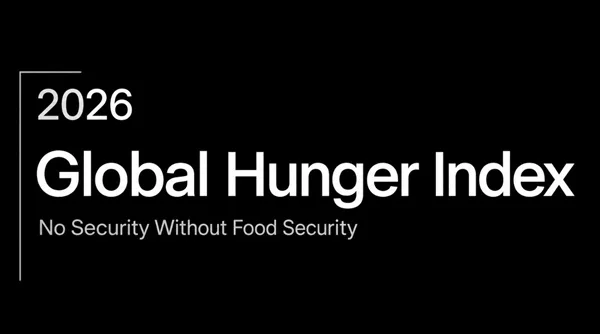
1. What is India’s rank in the Global Hunger Index 2026?India ranks 100th out of 122 countries, with a score of 24.1. 2. Which hunger category does India fall into?India falls into the serious category. 3. Does India’s score mean that 24.1% of its population is hungry?No. 24.1 is a composite index score, not a population percentage. 4. Which country has the highest calculated GHI score in 2026?Somalia, with a score of 47.0, has the highest calculated score among ranked countries. 5. What is the theme of the Global Hunger Index 2026?The theme is “No Security without Food Security.” |


Our support team will be happy to assist you!


 Contact Us
 New Batch : 9555124124/ 7428085757
 Tech Support : 9555124124/ 7428085757
