Prelims: (International Relations + CA)
Mains: (GS 2: International Relations, International Law; GS 3: Strategic Resources, Critical Minerals, Geopolitics) |
Why in News ?
Denmark and Greenland have strongly rejected US President Donald Trump’s assertion that the United States needs Greenland “for defence”, calling any attempt to annex or purchase the island unacceptable and absurd.
The sharp response follows renewed US signalling—including provocative maps and statements—suggesting strategic interest in taking control of the Arctic island, escalating tensions over sovereignty, Arctic security, and international law.
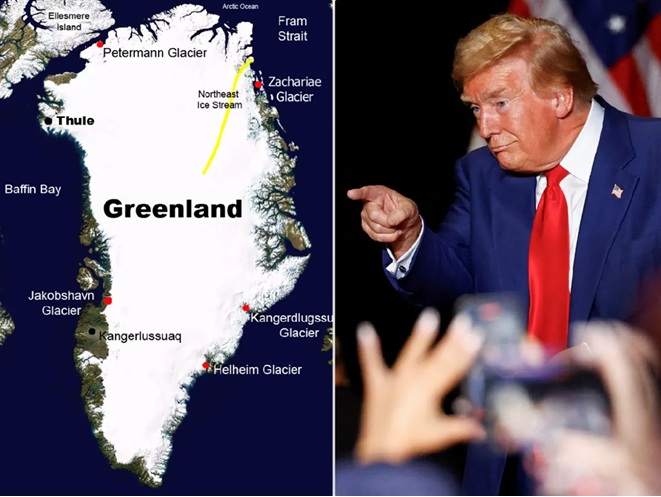
Why the US Wants Greenland: Strategic and Resource Interests
Geostrategic Location
Greenland occupies a critical position between North America, Europe, and the Arctic, making it strategically invaluable.
- The US operates the Pituffik Space Base (earlier Thule Air Base), a cornerstone of:
- Missile early-warning systems
- Space surveillance
- NATO’s northern defence architecture
Its location allows monitoring of potential threats from Russia, China, and North Korea, reinforcing US global defence posture.
Arctic Power Competition
- Melting Arctic ice is opening:
- New shipping routes
- Strategic maritime corridors
- Military operating zones
- As Russia expands Arctic military bases and China declares itself a “near-Arctic state”, Greenland’s importance has surged as a geopolitical asset in emerging Arctic rivalry.
Critical Minerals and Supply Chains
- Greenland possesses substantial rare earth mineral reserves, essential for:
- Electric vehicles
- Defence technologies
- Renewable energy systems
- With China dominating global rare-earth supply chains, the US views Greenland as a strategic alternative.
- However, Greenland’s 2021 ban on uranium mining complicates large-scale mineral extraction, reflecting local environmental and political concerns.
A Longstanding US Interest in Greenland
US interest in Greenland is not new:
- 1867: The US State Department identified Greenland’s strategic value soon after the Alaska purchase.
- World War II: The US established control over Greenland following Nazi occupation of Denmark.
- 1946: President Harry S Truman offered $100 million to Denmark to buy Greenland and even explored territorial exchanges involving Alaska.
- 1951 Defence Agreement: Allowed permanent US military presence in Greenland.
- 2019: Donald Trump publicly proposed purchasing Greenland, framing it as a real-estate deal.
- Denmark rejected the idea.
- Trump cancelled a state visit, triggering diplomatic fallout.
Why Denmark and Greenland Are Wary of Trump ?
Sovereignty and Intervention Fears
- Concerns intensified after Trump’s actions in Venezuela, including the capture of President Nicolás Maduro, raising fears of coercive intervention.
- Greenland, though autonomous, remains part of the Danish Kingdom, making sovereignty issues extremely sensitive.
Alleged Three-Phase Strategy
According to a Danish Broadcasting Corporation (DR) report, the Trump administration allegedly pursued a three-phase approach:
- Charm Offensive – High-profile outreach, including visits by Trump family members
- Direct Pressure – Senior US leaders criticising Denmark’s governance of Greenland
- Influence Operations – Attempts to encourage local secessionist sentiment
Denmark has accused Washington of undermining Greenland’s political stability.
Has the US Bought Territories in the Past ?
Yes, the US has expanded through purchases, but under vastly different historical conditions:
- Louisiana Purchase (1803): Bought from France for $15 million, doubling US territory.
- Alaska Purchase (1867): Acquired from Russia for $7.2 million; became a state in 1959.
- Danish West Indies (1917): Purchased from Denmark; now the US Virgin Islands.
However, modern international law prohibits territorial acquisition by coercion or force, making Greenland fundamentally different.
Strategic and Legal Implications
- Trump’s statements challenge:
- The UN Charter
- Principles of sovereignty and self-determination
- The episode exposes rising Arctic militarisation and great-power competition.
- It risks destabilising NATO unity, as Denmark is a NATO ally.
Way Forward
- Strengthening Arctic governance through multilateral forums
- Respecting international law and sovereignty
- Cooperative resource development instead of coercive geopolitics
- Addressing Arctic security through diplomacy rather than unilateralism
FAQs
Q1. Why is Greenland strategically important ?
Its location enables missile defence, Arctic access, and monitoring of rival powers.
Q2. Does Greenland belong to Denmark ?
Yes, Greenland is an autonomous territory within the Kingdom of Denmark.
Q3. Can the US legally buy Greenland today ?
No. Modern international law rejects territorial acquisition without consent.
Q4. Why are rare earth minerals significant ?
They are critical for defence, electronics, and clean energy technologies.
Q5. What makes this issue globally important ?
It reflects rising Arctic militarisation and challenges to international norms.
|






 Contact Us
  New Batch : 9555124124/ 7428085757
  Tech Support : 9555124124/ 7428085757