
- UPSC Exam
- State PCS
- One Day Exam
- Current Affairs
- PT Quiz
- Downlaods
- About Coaching
- Blog
- Videos

| Prelims: (Economy + CA) Mains: (GS 3 – Infrastructure: Energy; Environment & Disaster Management; GS 1 – Geography: River Systems) |
The under-construction 2,880 MW Dibang Multipurpose Project in Arunachal Pradesh recently achieved a major milestone with the successful daylighting of Diversion Tunnel-3 (DT-3), marking significant progress in river diversion works essential for dam construction.
The project, once completed, will become India’s largest hydropower facility and the highest concrete gravity dam in the country.
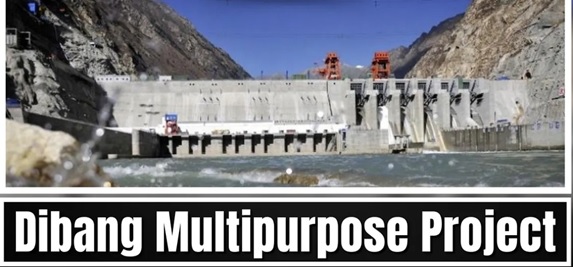
Strategic River Basin : The project is being developed on the Dibang River, a tributary of the Brahmaputra River system, in Arunachal Pradesh.
The Brahmaputra River is one of India’s major river systems, prone to seasonal flooding, especially in Assam and downstream regions.
Project Origin : Conceived as a multipurpose infrastructure initiative, the Dibang project integrates flood control, hydroelectric power generation, and water storage functions.
Developer : The project is being implemented by National Hydroelectric Power Corporation (NHPC), a state-run enterprise specialising in hydropower development.
Regional Significance : Arunachal Pradesh possesses immense hydropower potential due to its mountainous terrain and river gradients, making it central to India’s renewable energy expansion.
Energy Security: At 2,880 MW installed capacity, it will be India’s largest hydropower plant, strengthening renewable energy generation.
Flood Moderation: The project aims to regulate water flow and mitigate downstream flooding in the Brahmaputra basin.
Strategic Infrastructure in the Northeast: Large infrastructure projects enhance connectivity and economic integration of the region.
Energy Storage Capability: Designed as an energy storage project, it supports grid stability amid rising renewable energy penetration.
Climate Transition: Hydropower contributes to India’s non-fossil fuel energy targets and decarbonisation goals.
1. Project Overview
Installed Capacity
The Dibang Multipurpose Project will generate 2,880 MW of electricity, making it India’s largest hydropower facility upon completion.
Multipurpose Objectives
2. Engineering Features
Concrete Gravity Dam : The project involves constructing India’s highest concrete gravity dam.
A gravity dam resists water pressure through its own weight, ensuring structural stability.
Roller Compacted Concrete (RCC) Technique : The dam will be built using Roller Compacted Concrete technology, enabling faster construction and enhanced structural durability.
It is expected to become the highest RCC dam in the world.
3. Diversion Tunnels and Construction Milestones
Purpose of Diversion Tunnels : Before constructing the main dam, the river flow must be diverted through tunnels.
The successful daylighting of Diversion Tunnel-3 (DT-3) marks a critical step in enabling further structural work.
Engineering Importance : River diversion ensures safe construction of the dam foundation and spillway systems.
4. Flood Control and Disaster Mitigation
Brahmaputra Basin Flooding : The Brahmaputra basin is highly flood-prone, especially during monsoon seasons.
Moderation Function : The reservoir will help regulate peak discharge, potentially reducing flood intensity downstream.
Climate Resilience : Increased rainfall variability due to climate change enhances the importance of regulated water storage.
5. Energy Storage and Grid Stability
Balancing Renewable Energy : Hydropower provides peaking power and grid balancing support for intermittent solar and wind generation.
Energy Storage Role : The project is designed to function as an energy storage asset, releasing power during peak demand.
6. Environmental and Social Considerations
Ecological Sensitivity : The Northeast region is ecologically fragile, with rich biodiversity.
Resettlement and Rehabilitation : Large dams require land acquisition and rehabilitation planning, necessitating careful implementation.
Balancing Development and Conservation : The project highlights the broader debate between renewable energy expansion and ecological preservation.
Renewable Energy Expansion: Strengthens India’s clean energy portfolio.
Regional Economic Development: Boosts employment and infrastructure growth in Arunachal Pradesh.
Strategic Water Management: Improves basin-level flood control mechanisms.
Inter-State and Transboundary Sensitivity: Projects in the Brahmaputra basin hold geopolitical relevance due to upstream-downstream dynamics.
Long-Term Infrastructure Asset: Positions India as a leader in large-scale hydropower engineering.
Ensure Environmental Safeguards: Strict compliance with ecological impact mitigation measures.
Strengthen Rehabilitation Policies: Provide fair compensation and livelihood support to affected communities.
Enhance Basin-Level Planning: Integrate flood management with broader Brahmaputra basin strategies.
Adopt Advanced Monitoring Systems: Deploy real-time hydrological monitoring for disaster preparedness.
Promote Sustainable Hydropower Practices: Balance renewable energy expansion with biodiversity conservation.
FAQs1. Where is the Dibang Multipurpose Project located? It is being developed on the Dibang River, a tributary of the Brahmaputra, in Arunachal Pradesh. 2. What is the installed capacity of the project? The project will generate 2,880 MW, making it India’s largest hydropower facility. 3. What is unique about the dam design? It will be India’s highest concrete gravity dam and the highest Roller Compacted Concrete (RCC) dam globally. 4. What are the main objectives of the project? Hydropower generation, flood moderation, energy storage, and water resource management. 5. Why is the project strategically important? It enhances renewable energy capacity, supports grid stability, mitigates flooding, and strengthens infrastructure in the Northeast region. |



Our support team will be happy to assist you!

 Contact Us
  New Batch : 9555124124/ 7428085757
  Tech Support : 9555124124/ 7428085757