Prelims : Internal Security + CA
Mains : GS Paper 3 – Internal Security; Role of Security Forces; Terrorism |
Why in News ?
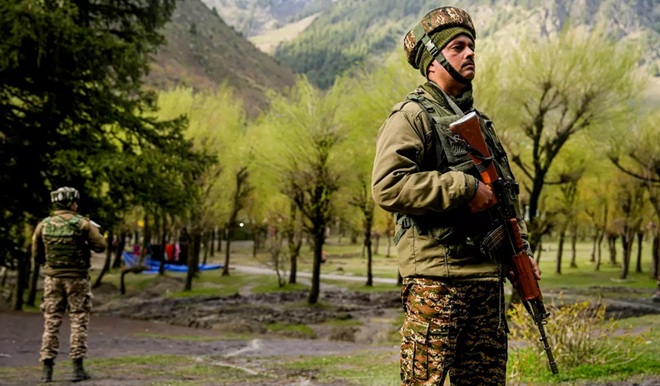
The aftermath of the Pahalgam terror attack (2025) has led to a profound transformation in the security architecture of Jammu & Kashmir (J&K), marking a decisive shift in India’s counter-terrorism approach in the region.
- The attack exposed deep-rooted vulnerabilities in security deployment, particularly in areas that were previously perceived as safe, such as tourist destinations
- It forced security agencies to reassess the nature, intent, and evolving tactics of terrorist organisations, especially their willingness to target civilians and economic lifelines
- In response, India has undertaken a multi-layered restructuring of its counter-terrorism framework, integrating intelligence, technology, force deployment, and civilian security measures
This transformation is widely seen as a strategic recalibration from a reactive security model to a proactive, intelligence-driven, and prevention-oriented approach.
What Happened in the Pahalgam Attack ?
- In April 2025, heavily armed terrorists launched a coordinated attack on tourists in the Pahalgam region, a well-known destination in Jammu & Kashmir
- The attack resulted in :
- Significant loss of civilian lives
- Injuries to several individuals
- Widespread panic and disruption of normal activities
- The incident was particularly alarming because :
- The location was considered relatively secure due to its tourism importance
- Security presence in such areas was comparatively light, based on prior threat perceptions
- The attackers exploited :
- Gaps in surveillance
- Terrain advantages such as forest cover and remote access routes
This incident highlighted a critical mismatch between perceived security and actual threat levels, making it a turning point in security planning.
Why Was the Attack a Strategic Turning Point ?
1. Shift in Terrorist Targeting Strategy
- Traditionally, terrorist groups in J&K focused on :
- Security personnel
- Government institutions
- Political figures
- The Pahalgam attack marked a deliberate shift toward :
- Soft targets such as tourists and civilians, which are more vulnerable and symbolically significant
- This change reflects a broader strategic objective :
- To undermine normalcy in the region
- To create a perception that even safe zones are insecure
- To attract international attention and media coverage
This evolution indicates that terrorism is no longer confined to military confrontation but is increasingly aimed at psychological warfare and economic disruption.
2. Exposure of Critical Security Gaps
- The attack revealed systemic weaknesses such as:
- Inadequate security coverage in remote and tourist-heavy areas
- Insufficient real-time intelligence inputs at the local level
- Lack of coordination between surveillance systems and ground deployment
- It demonstrated that:
- Static deployment strategies are ineffective against mobile and adaptive terror networks
- Threat assessment models need constant updating
This forced a comprehensive re-evaluation of security planning and resource allocation.
3. Economic and Psychological Impact
- Tourism is a key driver of J&K’s economy, providing :
- Employment
- Revenue
- Opportunities for local businesses
- By targeting tourists, the attack aimed to :
- Disrupt economic recovery
- Create fear among visitors
- Damage the region’s image as a safe destination
- Psychologically, such attacks :
- Generate widespread fear
- Erode public confidence in state institutions
Thus, the attack was not just a security incident but a strategic attempt to destabilise both economy and public morale.
Key Structural Shifts in J&K Security Strategy
1. Transition to Proactive and Intelligence-Driven Operations
- Earlier approach:
- Predominantly reactive, responding after incidents occurred
- New approach:
- Focuses on pre-emptive neutralisation of threats before execution
- This involves:
- Real-time intelligence gathering
- Continuous monitoring of suspicious activities
- Swift, targeted operations against identified threats
This shift reflects a move toward anticipatory security rather than reactive defence, significantly enhancing effectiveness.
2. Expansion and Deepening of Security Grid
- Security presence has been significantly increased across :
- Remote villages
- Forest areas
- Mountainous terrains
- Establishment of :
- Forward operating bases
- Temporary camps in previously under-monitored areas
- Increased frequency of :
- Patrols
- Area domination exercises
This ensures that no region remains outside the surveillance and operational reach of security forces, reducing safe havens for militants.
3. Specialisation in Terrain-Specific Warfare
- Terrorists increasingly exploit difficult terrains such as :
- Dense forests
- High-altitude regions
- In response, specialised units have been developed and trained in :
- Jungle warfare
- Mountain combat
- Survival in extreme conditions
- This improves :
- Tactical mobility
- Operational effectiveness
Such adaptation demonstrates a shift toward context-specific counter-terrorism strategies tailored to geographical realities.
4. Integration of Advanced Technology
- Technology is being increasingly used to strengthen security, including :
- Surveillance drones for aerial monitoring
- Sensors and tracking systems
- Digital identification systems for workforce verification
- Data analytics and communication tracking are used to :
- Identify suspicious patterns
- Track terror networks
This represents a transition toward technology-driven policing and intelligence, reducing dependence on manual surveillance alone.
5. Strengthening Intelligence Architecture
- Greater emphasis is placed on :
- Human Intelligence (HUMINT), involving local informants and community networks
- Technical Intelligence (TECHINT), including digital monitoring and signal interception
- Coordination between intelligence agencies has been enhanced to ensure:
- Faster information sharing
- Better decision-making
This improves the ability to detect threats at an early stage and disrupt terror activities proactively.
6. Targeting the Terror Ecosystem
- Focus has expanded beyond militants to include :
- Overground workers (OGWs)
- Financial and logistical support networks
- Measures include :
- Identification and surveillance of suspects
- Disruption of funding channels
- Legal action against collaborators
This approach recognises that terrorism thrives on a support ecosystem, and dismantling it is essential for long-term success.
7. Enhanced Protection of Civilian and Tourist Areas
- Security measures in tourist zones have been strengthened through :
- Regular sanitisation operations
- Increased deployment of personnel
- Monitoring of local workforce and service providers
- This ensures :
- Safety of visitors
- Restoration of confidence in tourism
The focus has shifted toward civilian-centric security, recognising the importance of protecting everyday life.
8. Multi-Dimensional Strategic Response
- Counter-terrorism strategy now integrates :
- Military operations
- Intelligence coordination
- Diplomatic efforts
- Administrative measures
- This holistic approach ensures that terrorism is addressed at :
- Operational level
- Strategic level
- Structural level
Significance of the Security Shift
1. Restoration of Normalcy and Public Confidence
- Strong security measures reassure :
- Local population
- Tourists and investors
- This is essential for :
- Social stability
- Economic revival
2. Enhanced Deterrence Against Terror Groups
- Proactive operations signal :
- Zero tolerance policy
- Increased risk for militants
This discourages :
- Recruitment
- Planning of large-scale attacks
3. Reduction in Frequency and Scale of Attacks
- Improved intelligence and deployment :
- Prevent large-scale incidents
- Limit operational capacity of terrorist groups
4. Strengthening of Internal Security Framework
- Better coordination among :
- Army
- Police
- Central forces
- Leads to :
- Efficient response mechanisms
- Unified command structures
5. Support for Economic Development
- Security stability enables :
- Tourism revival
- Infrastructure projects
- Investment
Challenges Ahead
1. Rise of Hybrid and Decentralised Terrorism
- Use of local recruits and small cells :
- Makes detection difficult
- Reduces reliance on large networks
2. Difficult Geography
- Natural terrain continues to:
- Provide cover to militants
- Complicate operations
3. External Support and Cross-Border Factors
- Continued support from across borders remains a persistent threat
4. Balancing Security and Civil Liberties
- Increased surveillance may :
- Raise privacy concerns
- Lead to allegations of overreach
5. Sustaining Long-Term Vigilance
- Security gains require :
- Continuous monitoring
- Adaptation to evolving threats
Way Forward
1. Strengthening Intelligence Networks
- Expand grassroots intelligence
- Integrate advanced surveillance technologies
2. Continuous Modernisation of Forces
- Invest in :
- Equipment
- Training
- Technology
3. Community Engagement and Trust-Building
- Encourage local participation in :
- Intelligence sharing
- Peace-building initiatives
4. Counter-Radicalisation Efforts
- Address ideological roots of terrorism
- Promote education and awareness
5. Integrated Development Approach
- Combine :
- Security measures
- Economic development
- Political outreach
Practice Questions
Prelims
Q. The recent shift in J&K’s counter-terror strategy emphasises :
(a) Reduction in troop deployment
(b) Reactive response after attacks
(c) Proactive and intelligence-driven operations
(d) Withdrawal from remote areas
Mains
“The Pahalgam attack marked a turning point in India’s counter-terrorism strategy in Jammu & Kashmir.” Critically analyse the nature of this transformation and its implications.
FAQs
Q1. Why was the Pahalgam attack significant ?
It targeted civilians and exposed security gaps.
Q2. What major change followed ?
Shift to proactive and intelligence-based operations.
Q3. What is the biggest challenge now ?
Hybrid and decentralised terrorism.
Q4. How has technology helped ?
Through surveillance, tracking, and data analysis.
Q5. What is the long-term goal ?
Sustainable peace and stability in the region.
|






 Contact Us
  New Batch : 9555124124/ 7428085757
  Tech Support : 9555124124/ 7428085757