Why in News?
- The Council of Scientific and Industrial Research (CSIR), in collaboration with Norway's SINTEF and the Research Council of Norway, organised the India–Norway Dialogue on "Waste to Resource Solutions in the Cement and Construction Sector" on 10 November 2026 at the India Habitat Centre, New Delhi.
- The dialogue focused on developing joint technologies to transform industrial and construction waste into valuable resources, promoting sustainable construction and circular economy practices.
India-Norway Green Strategic Partnership
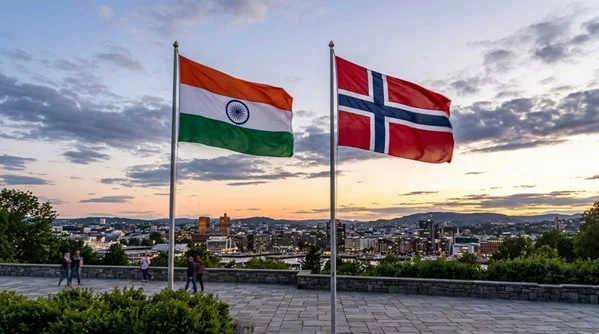
- India and Norway elevated their bilateral relationship to a Green Strategic Partnership on 18 May 2026, during Prime Minister Narendra Modi's official visit to Norway.
- The partnership aims to strengthen cooperation in green technology, clean energy, circular economy, scientific research and sustainable development.
- Both countries are seeking to combine India's industrial and research capabilities with Norway's experience in environmental technologies and resource efficiency.
Key Highlights of the India-Norway Dialogue
1. Joint Research and Technology Development
- CSIR institutes, SINTEF and industry partners discussed technology-oriented collaborative research proposals.
- The focus was on converting industrial residues and construction waste into usable raw materials.
- Participants emphasised scalable technologies, industrial applications and greater resource efficiency.
2. Industrial Waste Utilisation in Construction
The dialogue explored opportunities to reuse industrial by-products in construction and infrastructure development.
|
Waste material
|
Potential application
|
|
Fly Ash
|
Cement, concrete and road construction
|
|
Steel Slag
|
Road aggregates and construction materials
|
|
Red Mud
|
Geopolymers and specialised construction products
|
|
Copper Slag
|
Aggregates and road construction
|
|
Plastic Waste
|
Modified road construction materials
|
|
C&D Waste
|
Recycled aggregates, blocks and construction products
|
These applications depend on material quality, processing standards and environmental safety requirements.
3. Safe Treatment of Hazardous Waste
A technical session examined the environmentally sound treatment of persistent organic pollutants (POPs) and hazardous industrial waste.
- Cement kiln co-processing was discussed as a potential treatment method for suitable hazardous waste.
- Special attention was given to waste contaminated with DDT and polychlorinated biphenyls (PCBs).
- Experts emphasised controlled industrial trials, emission monitoring and regulatory compliance.
4. Construction and Demolition Waste Recycling
Discussions highlighted international best practices involving recycled aggregates, mobile recycling units and advanced processing methods to remove contaminants and impurities.
5. Future Joint Research Projects
India and Norway identified several priorities:
- Development of two to three joint research proposals.
- Pilot-scale demonstrations for hazardous waste treatment.
- Technical guidelines for DDT- and PCB-contaminated waste.
- Development of waste-derived construction materials.
- Stronger industry–academia partnerships.
These are proposed areas of cooperation rather than completed projects.
What is the Circular Economy?
- A circular economy is an economic system that reduces waste and keeps materials and resources in use for as long as possible through reuse, recycling, recovery and resource-efficient production.
- Unlike the traditional linear economy, which follows a take–make–dispose model, the circular economy seeks to minimise resource extraction and environmental pollution.
What is Cement Kiln Co-processing?
- Cement kiln co-processing is a waste management technique in which suitable waste materials are used as alternative fuels or raw materials during cement production.
- The process takes advantage of the high operating temperatures of cement kilns to treat certain organic contaminants under carefully controlled conditions.
What are Persistent Organic Pollutants (POPs)?
- Persistent Organic Pollutants are toxic chemical substances that remain in the environment for long periods, accumulate in living organisms and may travel over long distances through air, water and food chains.
- Important characteristics include environmental persistence, bioaccumulation and the potential for serious health and ecological effects.
Stockholm Convention on Persistent Organic Pollutants
- The Stockholm Convention is an international environmental treaty adopted in 2001 and entered into force in 2004.
- It aims to eliminate or restrict the production, use, release and disposal of specified persistent organic pollutants.
- India is a party to the Convention and implements its commitments through national policies, regulations and action plans.
Challenges
- Technological Limitations: Some industrial residues require advanced treatment before reuse.
- High Processing Costs: Collection, transportation, separation and recycling may involve substantial investments.
- Quality and Standardisation: Recycled materials must satisfy engineering, durability and safety standards.
- Hazardous Contaminants: Improper treatment of toxic waste can cause serious environmental and health risks.
- Limited Market Acceptance: Construction industries may prefer conventional raw materials due to established supply chains.
- Regulatory Compliance: Effective implementation requires monitoring, technical guidelines and coordination among multiple authorities.
Way Forward
- Strengthen Joint Research: Develop technology-focused projects between CSIR, SINTEF and industrial partners.
- Promote Pilot Projects: Test waste-to-resource technologies under actual industrial conditions.
- Improve Recycling Infrastructure: Establish efficient collection, segregation and processing facilities.
- Ensure Environmental Safety: Introduce strict emission monitoring and hazardous waste treatment protocols.
- Encourage Green Procurement: Promote certified recycled construction materials in eligible public infrastructure projects.
- Strengthen Institutional Cooperation: Build closer partnerships among researchers, government agencies and private industries.
Conclusion
- The India–Norway Waste-to-Resource Dialogue represents an important step towards integrating scientific innovation with sustainable industrial development. By encouraging the recovery of valuable materials from industrial and construction waste, the initiative can help India advance its circular economy objectives, reduce environmental pollution and improve resource efficiency.
- However, successful implementation will depend on technological feasibility, strict environmental safeguards, economic viability and effective industry participation. Strong bilateral research cooperation can help transform waste management from a disposal-oriented activity into a sustainable resource recovery system.
Prelims Practice MCQs
Q1. With reference to the India–Norway Waste-to-Resource Dialogue 2026, consider the following statements:
- The dialogue was organised through cooperation involving CSIR, SINTEF and the Research Council of Norway.
- It focused exclusively on recycling plastic waste.
- It explored cement kiln co-processing for the treatment of suitable hazardous waste.
Which of the statements given above are correct?
(A) 1 and 2 only
(B) 1 and 3 only
(C) 2 and 3 only
(D) 1, 2 and 3
UPSC Mains Practice Question
"Industrial waste management is increasingly shifting from waste disposal to resource recovery." Discuss the potential of waste-to-resource technologies in promoting India's circular economy, with reference to the India–Norway cooperation initiative of 2026.
|
FAQs
1. What is the India–Norway Waste-to-Resource Dialogue?
A bilateral initiative promoting sustainable industrial waste recycling.
2. Which organisations collaborated to organise the dialogue?
CSIR, SINTEF and Norway's Research Council jointly collaborated.
3. What is the primary objective of circular economy?
Minimising waste through resource reuse, recovery and recycling.
4. What is cement kiln co-processing?
Using suitable waste as alternative cement production inputs.
5. What are Persistent Organic Pollutants (POPs)?
Toxic chemicals persisting and accumulating within natural ecosystems.
|