Prelims: Free Trade Agreement (FTA), Rules of Origin, Tariff Lines, Non-Tariff Barriers, Sanitary and Phytosanitary Measures, Most-Favoured-Nation Treatment.
Mains: GS Paper II Bilateral Relations and International Agreements; GS Paper III International Trade, Economic Liberalisation, Employment and Industrial Growth.
Keywords: India–New Zealand FTA, Duty-Free Exports, India–New Zealand Relations, Rules of Origin, Services Trade, MSMEs, Dairy Sector, Trade Facilitation. |
Why in News?
- The India–New Zealand Free Trade Agreement (FTA) entered into force on 20 October 2026, following its signing on 27 April 2026.
- New Zealand provides zero customs duty across 100% of its tariff lines for qualifying Indian goods from the agreement’s entry into force.
- The agreement creates opportunities for Indian exporters, particularly in labour-intensive industries such as textiles, apparel, leather and footwear.
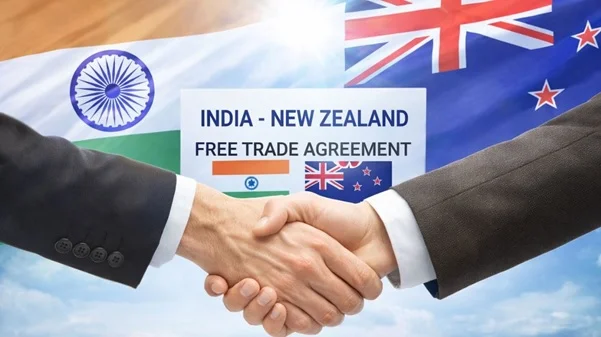
What Is a Free Trade Agreement?
- A Free Trade Agreement is an arrangement between economies to reduce or eliminate trade barriers according to agreed conditions.
- It may cover goods, services, investment cooperation, customs procedures and other areas of economic engagement.
- Unlike a customs union, an FTA generally allows each participating country to maintain its own tariffs on non-members.
Evolution of the India–New Zealand Agreement
- Negotiations began on 16 March 2025 and concluded on 22 December 2025.
- The agreement was signed in New Delhi on 27 April 2026.
- It supports the India–New Zealand Strategic Partnership: Roadmap to 2030, which sets an aspirational target of doubling bilateral trade in goods and services to NZ$7 billion by 2030.
Duty-Free Access for Indian Goods
- New Zealand has eliminated customs duties across all tariff lines for eligible Indian exports.
- This removes tariffs that previously reached 10% on certain products.
- Major sectors expected to benefit include:
- Textiles and apparel.
- Leather and footwear.
- Gems and jewellery.
- Engineering goods and automobile components.
- Chemicals and pharmaceuticals.
- Agricultural products and processed foods.
A tariff line is a product category in a country’s customs schedule. Coverage of all tariff lines does not remove the requirement to satisfy origin rules and product regulations.
Calibrated Market Opening by India
- The commitments of the two countries are not identical.
- According to New Zealand’s official assessment, India’s concessions cover approximately 95% of New Zealand’s current exports over time.
- Around 57% of current exports receive immediate tariff elimination, rising to 82% over time, while a further 13% receive tariff reductions.
- These percentages refer to export coverage, not the proportion of tariff lines.
Protection of Sensitive Dairy Products
- India has retained protection for sensitive dairy products such as milk, cream, yoghurt and cheese.
- However, describing the entire dairy sector as excluded would be inaccurate.
- Certain products including bulk infant formula and specified dairy-based preparations have separate phased concessions.
- Special arrangements also exist for designated inputs used to manufacture goods for export.
Services and Professional Mobility
- The agreement covers services alongside merchandise trade.
- Its provisions address professional services, financial services, telecommunications, temporary movement of people, student mobility and post-study work.
- It also includes health-related and traditional medicine services.
- These arrangements create a framework for deeper services cooperation, subject to the relevant commitments and eligibility requirements.
Investment Cooperation
- New Zealand has committed to facilitate US$20 billion of investment into India over 15 years.
- This is a forward-looking commitment; it should not be interpreted as investment already received.
- Its economic impact will depend on actual projects, commercial decisions and implementation.
Rules of Origin
- Preferential tariffs apply only to goods meeting the agreement’s Rules of Origin.
- Exporters and importers must maintain valid origin documentation and supporting records.
- Shipping a third-country product through India does not automatically make it eligible for preferential treatment.
- These requirements help ensure that concessions benefit qualifying production within the partner countries.
Customs and Regulatory Cooperation
- The agreement includes commitments to facilitate customs clearance.
- It provides for general release within 48 hours, subject to documentation and inspection conditions.
- For express and perishable goods, it seeks faster release, with an endeavour to release them within 24 hours, subject to applicable requirements.
- Customs, biosecurity and product regulations continue to apply.
Challenges
- Limited market size: New Zealand offers a high-income consumer base, but its relatively small population limits the scale of demand.
- Compliance costs: Testing, certification, traceability and documentation can remain expensive for smaller exporters.
- Logistics: Distance, freight costs and delivery times may reduce the commercial advantage of tariff concessions.
- Established competition: Indian firms must compete with suppliers already serving the New Zealand market.
- Uneven utilisation: Businesses with stronger information, financing and compliance capacity may capture benefits more quickly.
- Implementation gap: Investment commitments and improved market access do not automatically translate into investment inflows, exports or jobs.
Way Forward
- Strengthen exporter awareness: Provide sector-specific guidance on tariff schedules, origin requirements and market opportunities.
- Support MSME compliance: Expand access to affordable testing, certification and export documentation assistance.
- Improve logistics: Develop reliable shipping arrangements and cold-chain facilities for perishable exports.
- Build commercial partnerships: Encourage buyer–seller meetings, distribution agreements and industry cooperation.
- Monitor actual outcomes: Track preference utilisation, export diversification, investment inflows and employment generation.
- Address regulatory problems: Use bilateral mechanisms to resolve avoidable delays while maintaining legitimate safety standards.
- Protect sensitive producers: Review import trends and use applicable safeguards when justified.
Conclusion
The India–New Zealand FTA creates a broader framework for trade, services and investment cooperation. For India, its central opportunity lies in converting preferential market access into stronger export competitiveness. Sustained gains will require quality production, efficient logistics, regulatory compliance and effective support for smaller enterprises.
Prelims MCQ
Under the India–New Zealand FTA, duty-free access to New Zealand’s market is available across what proportion of its tariff lines for qualifying Indian goods?
(a) 50%
(b) 70%
(c) 90%
(d) 100%
Mains Question
“Preferential market access alone cannot ensure export competitiveness.” Discuss with reference to the India–New Zealand Free Trade Agreement.
|
FAQs
1. When did the India–New Zealand FTA enter into force?
It entered into force on 20 October 2026, following its signing on 27 April 2026.
2. Which Indian sectors are expected to benefit?
Key sectors include textiles, apparel, leather, footwear, engineering goods, pharmaceuticals, chemicals and processed foods.
3. Has India completely opened its dairy market?
No. Sensitive dairy products remain protected, while certain specified dairy-related products and arrangements receive separate concessions.
4. Why are Rules of Origin important?
They determine whether a product qualifies for preferential tariffs. Exporters must demonstrate that their goods meet the agreement’s origin requirements.
5. Does zero customs duty remove all import requirements?
No. Applicable taxes or charges, product standards, biosecurity controls and other regulatory requirements may still apply.
|







 Contact Us
 New Batch : 9555124124/ 7428085757
 Tech Support : 9555124124/ 7428085757
