Prelims: (International Relations + CA)
Mains: (GS 2 - Bilateral Relations; GS 3 - International Trade, Economic Deevelopment) |
Why in News ?
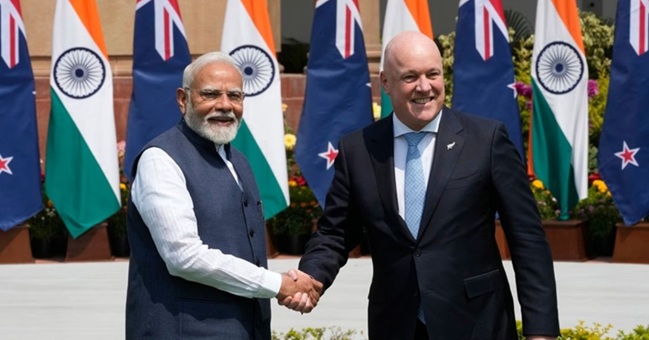
India and New Zealand have concluded negotiations on a Free Trade Agreement (FTA), aiming to double bilateral trade to USD 5 billion within five years and attract USD 20 billion in New Zealand investment over 15 years. The agreement is expected to be formally signed in the first half of 2026.
Background & Context
India’s trade diplomacy has increasingly focused on comprehensive FTAs with developed economies to expand export markets, attract investment, and strengthen strategic partnerships in the Indo-Pacific. For New Zealand, India represents a large growth market, while for India, the FTA provides access to a high-income, rules-based economy, complementing India’s broader engagement with Australia, ASEAN, and Pacific partners.
India–New Zealand Bilateral Relations
Historical Foundations
- Diplomatic relations established in 1952
- Shared legacy of:
- Commonwealth membership
- Democratic governance
- Common law traditions
Strategic Vision
- New Zealand’s policy initiatives:
- “Opening Doors to India” (2011)
- NZ Inc. India Strategy
- “India–NZ 2025: Investing in the Relationship”
- Focus areas: political trust, economic cooperation, innovation, education, and people-centric ties.
Trade & Economic Engagement
- New Zealand is India’s 11th largest two-way trading partner.
- Total trade (2023–24): USD 1.75 billion
- Indian exports: Pharmaceuticals, gems & jewellery, textiles, motor vehicles, apparel
- Indian imports: Logs, forestry products, wool, fruits, nuts
Defence & Maritime Cooperation
- Regular Indian Navy port calls and naval visits
- Senior-level defence exchanges
- Cooperation under Combined Task Force-150, contributing to maritime security in the Indian Ocean Region.
Education & Knowledge Cooperation
- India is the second-largest source of international students in New Zealand (~8,000).
- Institutional linkages:
- NZ Centre at IIT Delhi
- Joint research in cancer, robotics, cybersecurity, waste management
- Education cooperation with GIFT City and IIM Ahmedabad
People-to-People Ties
- Indian-origin population: ~292,000
- Hindi is the fifth most spoken language in New Zealand
- Strong cultural, sporting, and mountaineering connections.
India–New Zealand FTA: A New Phase in Engagement
- Negotiations began in March 2025 during Prime Minister Christopher Luxon’s visit to India.
- Talks concluded in record time (9 months), reflecting high political commitment.
- The FTA marks a shift from sectoral cooperation to a comprehensive economic partnership.
India–New Zealand FTA: Key Highlights
1.Trade Expansion & Investment
- Target to double bilateral trade within five years.
- USD 20 billion investment from New Zealand into India over 15 years.
- Strengthens cooperation beyond trade—defence, education, innovation, sports, and mobility.
2. Tariff Liberalisation
- 95% of New Zealand exports to India to face eliminated or reduced tariffs.
- 57% duty-free access from Day One, rising to 82% after full implementation.
- India protected sensitive sectors:
- Dairy, onions, sugar, spices
- Edible oils, rubber, rice, wheat, soya
3. Boost to Indian Exports & Jobs
- Major gains for labour-intensive sectors:
- Textiles, apparel, leather, footwear
- Home décor, rubber products
- Enhanced exports of:
- Automobiles and auto components
- Machinery, electronics, electricals
- Pharmaceuticals
4. Services Trade & Mobility
- 5,000 temporary employment visas annually for Indian professionals (valid up to 3 years).
- Market access in:
- 118 services sectors
- MFN status in 139 sectors
- Coverage includes:
- IT, engineering, healthcare, education
- Construction, AYUSH, yoga instructors
- Chefs, music teachers, niche professionals
5. Healthcare & Traditional Medicine
- Dedicated health and traditional medicine annex
- First such agreement signed by New Zealand with any country.
Strategic Significance for India
- Strengthens India’s Indo-Pacific economic footprint
- Enhances access to developed markets without compromising sensitive domestic sectors
- Reinforces India’s position as a services and skills hub
- Complements India’s broader FTA strategy with Australia, UAE, and the UK.
FAQs
Q1. What is the India–New Zealand FTA ?
It is a comprehensive trade agreement aimed at expanding goods, services, investment, and people-to-people ties between the two countries.
Q2. When will the FTA be signed ?
The agreement is expected to be formally signed in the first half of 2026.
Q3. Which sectors benefit most for India ?
Textiles, apparel, pharmaceuticals, automobiles, electronics, and services such as IT and healthcare.
Q4. Did India open its dairy sector under the FTA ?
No. India protected sensitive sectors including dairy, agriculture, and edible oils.
Q5. What is the significance of MFN status in services ?
MFN ensures Indian service providers receive treatment no less favourable than other trading partners, expanding professional opportunities.
|






 Contact Us
  New Batch : 9555124124/ 7428085757
  Tech Support : 9555124124/ 7428085757