New
Hindi Medium: (Delhi) - GS Foundation (P+M) : 14th Oct. 2026, 06:00 PM Hindi Medium: (Prayagraj) - GS Foundation (P+M) : 23rd Oct. 2026, 11:00 AM English Medium: (Delhi) - GS Foundation (P+M) : 12th Oct. 2026, 5:30PM English Medium: (Prayagraj) - GS Foundation (P+M) : 19th Aug 2026, 11:00 AM Hindi Medium: (Delhi) - GS Foundation (P+M) : 14th Oct. 2026, 06:00 PM Hindi Medium: (Prayagraj) - GS Foundation (P+M) : 23rd Oct. 2026, 11:00 AM English Medium: (Delhi) - GS Foundation (P+M) : 12th Oct. 2026, 5:30PM English Medium: (Prayagraj) - GS Foundation (P+M) : 19th Aug 2026, 11:00 AM

India’s BrahMos-NG Missile: Key features, India’s roadmap, Significance and Challenges

Prelims: BrahMos Missile, BrahMos-NG, DRDO, India-Russia Defence Cooperation, Supersonic Cruise Missile, Defence Indigenisation, Defence Exports, Operation Sindoor.
Mains: GS Paper III: Science and Technology, Defence Technology, Indigenisation, Defence Manufacturing, National Security, Defence Exports.

Why in news?

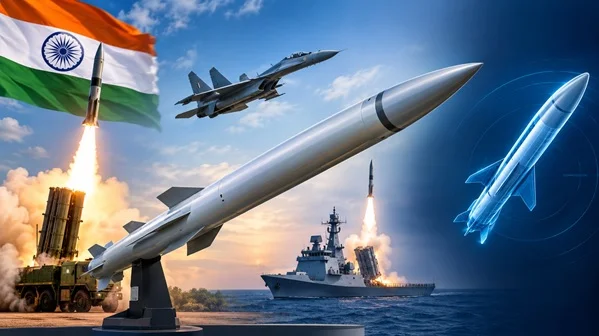
  • BrahMos Aerospace has announced that it expects to develop the first prototype of its next-generation BrahMos-NG (Next Generation) missile by 2027-28.

What is BrahMos Missile?

  • BrahMos is a supersonic cruise missile jointly developed by India and Russia. It is designed to strike targets with high speed and precision and can be launched from different platforms.
  • Cruise missile: A missile that travels through the atmosphere using its own propulsion during much of its flight.
  • Supersonic: Speed greater than the speed of sound. Mach 1 represents the speed of sound; Mach 2.8 means approximately 2.8 times that speed under comparable atmospheric conditions.

Feature

Details

Missile type

Supersonic cruise missile

Joint venture

India-Russia

Indian partner

DRDO

Russian partner

NPO Mashinostroyeniya

Developer

BrahMos Aerospace

Initial reported strike range

290 km

Launch platforms

Land, Sea and Air

Speed

Around Mach 2.8

Main role

Precision strike against designated targets

What is BrahMos-NG?

  • BrahMos-NG stands for BrahMos Next Generation. 
  • It is being developed as a smaller, lighter and more advanced version of the existing BrahMos missile. 
  • The objective is to improve its versatility and allow more flexible integration with different military platforms.

Key features of BrahMos-NG

  • Smaller dimensions and reduced weight.
  • Higher indigenous content.
  • Use of advanced materials and new technologies.
  • Improved integration with modern aircraft and other platforms.
  • Enhanced flexibility for future operational requirements.
  • The first prototype is planned in an air-launched configuration. 
  • The system is intended for integration with the Su-30MKI and is also envisaged for adaptation to the Tejas aircraft.
  • After successful development and testing, further versions may be adapted for land and naval platforms.

1,500-km Range Missile: India's Future Roadmap

  • The original reported strike range was approximately 290 km.
  • Range-extension efforts have demonstrated longer-range capabilities through tests conducted from ground, sea and air platforms.
  • A missile with a proposed range of 1,500 km is included in the company's future roadmap. The 1,500-km variant is currently at the conceptual stage.
  • Further upgrades are being discussed with the Russian joint-venture partner.

BrahMos-NG vs Existing BrahMos

Feature

Existing BrahMos

BrahMos-NG

Generation

Existing system

Next-generation variant

Design

Larger missile system

Smaller and lighter design

Indigenous content

Existing level of indigenisation

Higher indigenous content planned

Technology

Established system

New technologies and advanced materials

First planned configuration

Multiple platforms

Air-launched

Development status

Existing missile system

Under development

Prototype timeline

—

2027-28 target

Importance for India

  • Strengthening air-launched strike capability: The smaller and lighter design is intended to improve integration possibilities with fighter aircraft. The initial airborne configuration is planned for the Su-30MKI, with future adaptation to Tejas envisaged.
  • Defence indigenisation: The next-generation missile is expected to incorporate higher indigenous content. This can support India's broader objective of reducing dependence on foreign technologies and strengthening domestic defence manufacturing.
  • Technological development: The programme requires research into advanced materials, new technologies and missile-system development. This can contribute to India's aerospace and defence technology ecosystem.
  • Defence exports: Foreign countries have expressed interest in air-launched BrahMos systems and BrahMos-NG. Countries operating the Su-30 platform have shown interest in exploring integration with their air forces. 

BrahMos Production and India's Defence Manufacturing

  • BrahMos Aerospace is working to fulfil existing orders from India's Armed Forces while expanding production and research capabilities.

Location

Importance

Hyderabad

BrahMos production activities

Nagpur

Missile manufacturing

Pilani

Production and industrial support

Lucknow

Newer production facility

  • Completing existing Armed Forces orders.
  • Accelerating research and development.
  • Establishing specialised technology facilities.
  • Strengthening the supply chain.
  • Expanding industrial participation and production capacity.

Defence Exports and International Interest

  • According to the October 2026 report, the company's leadership highlighted growing interest from foreign militaries following the missile's reported combat performance.
  • Foreign countries have shown interest in air-launched BrahMos.
  • Countries operating Su-30 aircraft have explored the possibility of integration.
  • Some foreign customers have also expressed interest in BrahMos-NG.
  • BrahMos Aerospace is in discussions with interested countries.
  • India's defence exports have reached ₹38,400 crore, according to the report.

Operation Sindoor and BrahMos

  • BrahMos was reported to have been used during Operation Sindoor in May 2025. 
  • The October 2026 report stated that the missile system was deployed in active warfare for the first time during the operation.

Challenges 

  • Research and development: BrahMos-NG requires extensive R&D because of its new technologies, advanced materials and higher indigenous content.
  • Testing and validation: The system must undergo development and testing before its operational capabilities can be confirmed.
  • Supply-chain capacity: Increasing production requires reliable suppliers, manufacturing capacity and quality control.
  • Export requirements: Foreign customers may require platform compatibility, technical arrangements and government approvals.
  • Range-extension development: The proposed 1,500-km missile remains conceptual and requires further development.

Prelims MCQ 

Q. BrahMos missile is jointly developed by which of the following?

A. India and France

B. India and Russia

C. India and Israel

D. India and the United States

Mains Practice Question

Q. What challenges must be addressed for the development of next-generation missile systems?

FAQs

What is BrahMos-NG?

It is the next-generation, smaller and lighter version of the BrahMos missile.

When is its first prototype expected?

By 2027 or 2028.

What is the proposed range of the future missile?

A 1,500-km range is part of the future roadmap, currently at the conceptual stage.

Which aircraft is planned for BrahMos-NG integration?

The Su-30MKI is an initial planned platform. Adaptation to Tejas is also envisaged.

Is the 1,500-km BrahMos operational?

The reported project is at the conceptual stage.

Have any Query?

Our support team will be happy to assist you!

OR