Prelims : Economy + CA
Mains : GS Paper 3 – Indian Economy; Growth; Inflation; External Sector; Economic Development |
Why in News ?
The notion that India is currently experiencing a “Goldilocks Economy” has come under scrutiny amid recent economic developments that challenge the perception of a perfectly balanced macroeconomic environment.
- The term gained prominence when policymakers suggested that India was witnessing a rare phase of high growth, low inflation, and stable macroeconomic conditions, indicating a favourable economic equilibrium
- However, recent revisions in GDP estimates and emerging macroeconomic pressures have raised concerns that earlier growth assessments may have been overstated, thereby questioning the sustainability of this “ideal” economic phase
- External shocks, particularly geopolitical tensions affecting global energy markets, have led to rising oil prices, which pose inflationary risks for an import-dependent economy like India
- The depreciation of the Indian rupee and volatility in capital flows have highlighted vulnerabilities in the external sector, especially in the context of global financial uncertainty
- Concerns regarding a potential slowdown in growth combined with inflationary pressures have sparked fears of stagflation-like conditions, thereby undermining the “Goldilocks” narrative
Thus, the debate reflects a deeper reassessment of India’s economic resilience and the structural challenges underlying seemingly stable macroeconomic indicators.
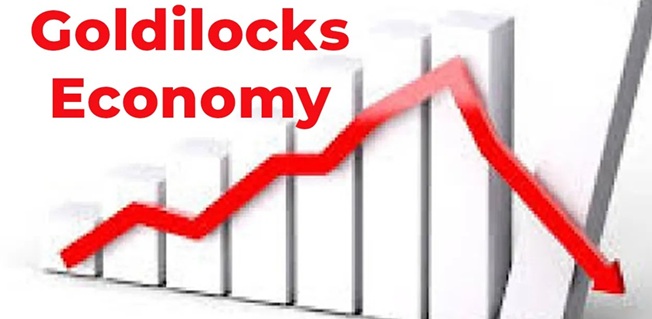
Background and Context: What is a Goldilocks Economy ?
A “Goldilocks Economy” refers to a macroeconomic condition where economic growth is neither too hot nor too cold, but “just right”, ensuring stability and sustainability.
- The concept originates from the idea of achieving a perfect balance between growth and inflation, where the economy expands steadily without overheating or slipping into recession
- Key features include :
- Sustained and moderate GDP growth
- Low and stable inflation levels
- Healthy employment generation
- Stable financial and external sector conditions
- Such an environment allows policymakers, particularly central banks, to maintain accommodative monetary policies without aggressive tightening or loosening
- In the Indian context, this narrative was supported by :
- Strong domestic demand
- Government-led capital expenditure
- Moderation in inflation levels
- Relative macroeconomic stability compared to global uncertainties
However, the Goldilocks phase is often considered temporary and fragile, as it depends on a delicate balance of multiple economic variables that can be disrupted by both domestic and external factors.
Key Indicators Supporting the Goldilocks Narrative
1. Robust GDP Growth Performance
- India recorded strong economic growth driven by domestic consumption, public investment, and structural reforms, positioning it among the fastest-growing major economies
- Government capital expenditure and policy interventions acted as key growth drivers, stimulating infrastructure development and investment cycles
- The resilience of the services sector and expansion of the digital economy further reinforced growth momentum
2. Moderation in Inflation
- Inflation remained within manageable limits due to favourable base effects, supply-side interventions, and prudent monetary policy actions
- Periodic softening in food and fuel prices contributed to overall price stability, supporting consumption and business confidence
3. Stable Financial Conditions
- Improvements in banking sector health, reduction in non-performing assets, and stable fiscal management contributed to macroeconomic resilience
- Coordinated fiscal and monetary policies helped maintain liquidity, control inflation, and sustain growth
4. Strong Domestic Demand
- India’s consumption-driven economy remained resilient, supported by rising incomes, urbanisation, and welfare schemes
- Growth in services and digital platforms further boosted demand and economic activity
Why is the “Goldilocks” Narrative Under Scrutiny ?
1. Overestimation of Growth Due to Data Revisions
- Recent revisions in GDP estimates and methodological adjustments have raised concerns regarding the reliability of earlier high growth figures
- This suggests that the economy may not be as strong as previously believed, leading to a reassessment of macroeconomic performance
2. External Vulnerabilities and Geopolitical Risks
- India’s dependence on imported crude oil exposes it to global price volatility driven by geopolitical tensions
- Rising oil prices increase inflation, widen the current account deficit, and strain fiscal resources, thereby destabilising economic balance
3. Currency Depreciation and Capital Flow Volatility
- The depreciation of the Indian rupee reflects underlying pressures in the external sector and dependence on foreign capital
- Volatile capital flows can lead to financial instability, affecting investment and overall economic confidence
4. Emerging Risk of Stagflation
- The possibility of slowing growth combined with rising inflation presents a complex macroeconomic challenge
- Policymakers face a dilemma, as controlling inflation may slow growth, while stimulating growth may worsen inflationary pressures
5. Structural Weaknesses in Employment
- Despite strong GDP growth, employment generation has not kept pace, particularly in the formal sector
- A large portion of the workforce remains engaged in low-productivity and informal jobs, raising concerns about the inclusiveness of growth
6. Global Economic Headwinds
- Slowdown in major economies, tightening global financial conditions, and disruptions in trade affect India’s exports and investment inflows
- Increasing geopolitical fragmentation and protectionist tendencies further complicate the external environment
Significance of the Debate
1. Reassessment of Economic Fundamentals
- The debate highlights the need to go beyond headline indicators and examine deeper structural aspects such as productivity, employment, and income distribution
2. Implications for Policy Formulation
- Policymakers must recalibrate strategies to address emerging risks while maintaining growth momentum and macroeconomic stability
3. Impact on Investor Confidence
- Perception of economic stability plays a critical role in attracting investments; any uncertainty may influence capital flows
4. Focus on Quality of Growth
- Emphasises the importance of ensuring that growth is inclusive, sustainable, and capable of generating employment
Challenges Highlighted
1. Balancing Growth and Inflation
- Achieving high growth without triggering inflationary pressures remains a persistent policy challenge
2. Managing External Sector Risks
- Heavy reliance on imports, particularly energy, exposes the economy to global shocks
3. Data Reliability Issues
- Frequent revisions in economic data create uncertainty and may affect policy credibility
4. Employment Generation Gap
- Bridging the gap between economic growth and job creation is essential for inclusive development
5. Fiscal Constraints
- Sustaining public investment while maintaining fiscal discipline remains a key challenge
Way Forward
1. Strengthening Economic Data Systems
- Enhance transparency and accuracy in data collection and estimation to improve policy reliability
2. Building Domestic Resilience
- Promote self-reliance in critical sectors such as energy, manufacturing, and supply chains
3. Encouraging Employment-Intensive Growth
- Focus on sectors like MSMEs and manufacturing that generate large-scale employment
4. Diversifying Energy Sources
- Invest in renewable energy to reduce dependence on imported fuels
5. Maintaining Policy Flexibility
- Adopt a balanced fiscal and monetary approach to respond effectively to evolving economic conditions
Practice Questions
Prelims
Q. A “Goldilocks Economy” is best described as :
(a) An economy with high inflation and high growth
(b) An economy with balanced growth, low inflation, and stable employment
(c) An economy facing recession and deflation
(d) An economy driven entirely by exports
Mains
“India’s so-called ‘Goldilocks Economy’ masks underlying structural vulnerabilities.” Critically examine.
FAQs
Q1. What is a Goldilocks Economy ?
It refers to a situation where economic growth is steady, inflation is low, and macroeconomic conditions are balanced.
Q2. Why is India’s Goldilocks phase under scrutiny ?
Due to data revisions, external shocks, inflation risks, and structural issues in employment.
Q3. What is the biggest risk ?
Rising oil prices and global economic uncertainty.
Q4. What does this debate indicate ?
The gap between headline indicators and real economic conditions.
Q5. What is the key takeaway ?
Sustainable growth requires strong structural fundamentals, not just short-term stability.
|





 Contact Us
  New Batch : 9555124124/ 7428085757
  Tech Support : 9555124124/ 7428085757