Prelims : (Polity + Governance + CA)
Mains : GS 2 – Governance, Policy Reforms, Law Making; GS 3 – Indian Economy, Ease of Doing Business |
Why in News ?
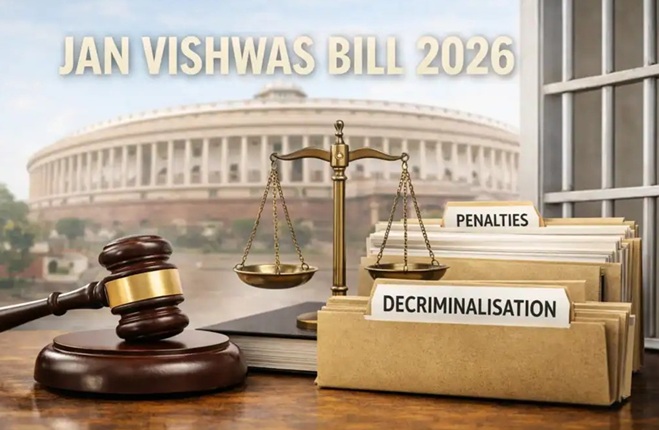
- The Jan Vishwas (Amendment of Provisions) Bill, 2026 has been passed by both Houses of Parliament, marking a major reform in India’s regulatory framework.
- The legislation aims to promote a trust-based governance system by reducing criminal penalties for minor offences.
- A total of 784 provisions across 79 Central Acts have been amended to rationalise legal compliance.
- Out of these, 717 provisions have been decriminalised, while 67 provisions have been amended to enhance ease of living.
Background and Context
- India’s regulatory framework has historically been characterised by a large number of criminal provisions, even for minor procedural violations.
- Such provisions have often led to excessive compliance burden on businesses and individuals, affecting economic efficiency.
- The need for decriminalisation emerged from concerns over ease of doing business and investor confidence.
- Earlier efforts were initiated through similar legislative reforms aimed at reducing outdated and redundant provisions.
- The Bill builds upon earlier reform initiatives by expanding the scope of decriminalisation across multiple sectors.
- It reflects a shift from punitive regulation towards facilitative and trust-based governance.
What is the Jan Vishwas (Amendment of Provisions) Bill, 2026 ?
- The Jan Vishwas (Amendment of Provisions) Bill, 2026 is a comprehensive legislative reform aimed at rationalising and decriminalising minor offences across various laws.
- It seeks to replace criminal penalties with civil penalties for procedural and technical violations.
- The Bill focuses on reducing unnecessary legal hurdles while maintaining regulatory discipline.
- It aims to create a more business-friendly and citizen-centric governance framework.
Key Features of the Bill
1. Large-Scale Decriminalisation
- The Bill decriminalises 717 provisions by removing imprisonment clauses for minor and technical offences.
- These changes aim to reduce fear of legal action for procedural lapses and encourage voluntary compliance.
2. Amendment of Multiple Laws
- A total of 784 provisions across 79 Central Acts administered by 23 Ministries have been amended.
- This reflects a comprehensive and cross-sectoral reform approach covering diverse areas of governance.
3. Promotion of Ease of Living
- Around 67 provisions have been specifically amended to improve the daily lives of citizens by simplifying regulatory procedures.
- These changes reduce bureaucratic hurdles and make governance more citizen-friendly.
4. Rationalisation of Offences
- The Bill seeks to rationalise more than 1,000 offences by removing redundant and minor violations from the criminal framework.
- This helps in reducing litigation and easing the burden on the judicial system.
Legislative Journey of the Bill
- The Bill was initially introduced in the Lok Sabha on 18 August 2025 as the Jan Vishwas (Amendment of Provisions) Bill, 2025.
- It proposed amendments to 355 provisions across 16 Central Acts administered by 10 Ministries.
- The Bill was referred to a Select Committee of the Lok Sabha for detailed examination.
- The Select Committee, chaired by Tejasvi Surya, conducted 49 sittings and undertook extensive stakeholder consultations.
- The Committee submitted its report on 13 March 2026, recommending further expansion of decriminalisation.
- It also examined additional provisions and suggested reforms across 62 more Central Acts.
Objectives of the Bill
- The Bill aims to reduce compliance burden on businesses and individuals by eliminating criminal penalties for minor offences.
- It seeks to promote a trust-based governance model that encourages voluntary compliance instead of punitive enforcement.
- The legislation focuses on improving India’s business environment by simplifying legal frameworks.
- It also aims to enhance administrative efficiency and reduce unnecessary litigation.
Significance
- The reform is expected to significantly improve India’s ranking in ease of doing business by simplifying regulatory requirements.
- It reduces the criminalisation of economic activities, thereby encouraging entrepreneurship and investment.
- The Bill helps in decongesting courts by lowering the number of cases related to minor offences.
- It reflects a shift towards modern governance practices that prioritise efficiency and trust.
- The initiative strengthens the balance between regulation and economic freedom.
Core Analysis: Decriminalisation vs Regulatory Oversight
Strengths
- The Bill reduces fear of criminal prosecution for minor violations, thereby encouraging compliance and business expansion.
- It simplifies the regulatory framework, making it more predictable and investor-friendly.
- The reform enhances governance efficiency by reducing administrative and judicial burdens.
Concerns
- Excessive decriminalisation may weaken deterrence against certain violations if not properly balanced.
- Implementation challenges may arise in ensuring uniform adoption across ministries and departments.
- There is a risk that regulatory authorities may face difficulties in enforcing compliance without strong penalties.
Way Forward
Short-Term Measures
- Clear guidelines should be issued to ensure uniform implementation of amended provisions across all sectors.
- Awareness campaigns should be conducted to inform businesses and citizens about the changes.
Long-Term Measures
- Periodic review of laws should be undertaken to identify and remove outdated provisions.
- Strengthening civil penalty mechanisms can ensure compliance without resorting to criminalisation.
Structural Reforms
- Institutional capacity building is required to shift from punitive to facilitative governance.
- Digitalisation of compliance processes can further reduce regulatory burdens.
- Greater stakeholder consultation should be institutionalised in future law-making processes.
Practice Questions
Prelims
Q. With reference to the Jan Vishwas (Amendment of Provisions) Bill, 2026, consider the following statements :
- It aims to decriminalise minor offences across multiple Central Acts.
- It replaces criminal penalties with civil penalties in certain cases.
- It applies only to economic laws related to business activities.
Select the correct answer :
(a) 1 and 2
(b) 2 and 3
(c) 1 and 3
(d) All of the above
Mains
“Decriminalisation of minor offences is essential for improving governance and economic efficiency.” Discuss in the context of the Jan Vishwas Bill, 2026.
FAQs
1. What is the Jan Vishwas Bill, 2026 ?
It is a legislative reform aimed at decriminalising minor offences and simplifying compliance.
2. How many provisions have been decriminalised ?
A total of 717 provisions have been decriminalised.
3. What is its main objective ?
To promote ease of doing business and ease of living through rationalised laws.
4. Does it remove all penalties ?
No, it replaces criminal penalties with civil penalties in many cases.
5. Why is it important ?
It reduces compliance burden, improves governance, and boosts economic activity.
|






 Contact Us
  New Batch : 9555124124/ 7428085757
  Tech Support : 9555124124/ 7428085757