
- UPSC Exam
- State PCS
- One Day Exam
- Current Affairs
- PT Quiz
- Downlaods
- About Coaching
- Blog
- Videos

| Prelims: (History & Culture + CA) Mains: (GS 1 - Indian Culture, History; GS 2 - Judiciary, State–Religion Relations, Constitution) |
The Madras High Court allowed the lighting of the Karthigai Deepam lamp at Thiruparankundram hill near Madurai, while rejecting the Tamil Nadu government’s apprehensions of communal unrest as speculative. However, the court barred public participation, permitting the ritual to be performed only by a limited temple team under official supervision.
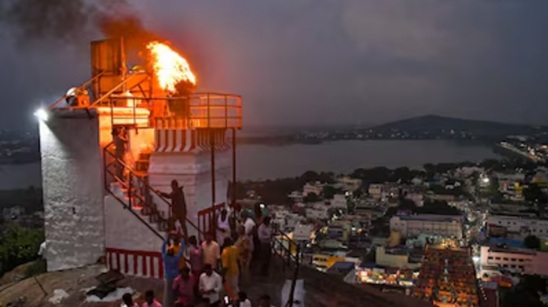
Thiruparankundram hill, rising around 1,050 feet on the outskirts of Madurai, is a site of layered religious and cultural history. At its foothills stands the ancient Arulmigu Subramanian Swamy Cave Temple, one of the six abodes (Arupadai Veedu) of Lord Murugan. Over centuries, the hill also developed Jain associations, evidenced by rock beds and inscriptions.
At the summit lies the burial site of the Sufi saint Sikkandar Badhusha, around which a dargah evolved. This has given the hill multiple identities—Thiruparankundram, Samanar Hill, and Sikkandar Hill—making it a shared sacred landscape. Due to this overlapping religious significance, the site has historically required tight administrative regulation, especially during festivals.
This judgment continues to form the legal foundation for managing competing religious claims.
Disputes over ritual practices, access, and structures have surfaced repeatedly, reflecting the sensitive coexistence at the site.
In November 2025, worshippers sought permission to light the Karthigai Deepam on December 3 at a stone pillar known locally as the “Deepathoon” near the summit.
The State government, HR&CE Department, and representatives of the dargah challenged the Single Judge’s order before a Division Bench.
The Bench held that the structure was indeed a Deepathoon, noting the carved cavity designed to hold oil and wicks, rejecting the State’s alternative explanations.
The court termed the State’s apprehensions an “imaginary ghost”, observing that:
FAQs1. Why is Thiruparankundram considered sensitive ? Because it is a shared religious site with Hindu, Jain, and Islamic associations, making ritual practices and access politically and socially sensitive. 2. What is Karthigai Deepam ? It is a Tamil festival of lights symbolising spiritual illumination, traditionally marked by lighting lamps, often on hills or temple premises. 3. Why did the State oppose the ritual ? The government cited potential communal unrest, questioned the religious significance of the Deepathoon, and argued procedural issues under the HR&CE Act. 4. How did the High Court balance competing interests ? By allowing the ritual while restricting public participation and ensuring ASI and administrative safeguards. 5. What is the broader constitutional implication ? The judgment reinforces that religious freedom cannot be curtailed on vague security fears and must be balanced with heritage conservation and public order. |

Our support team will be happy to assist you!

 Contact Us
  New Batch : 9555124124/ 7428085757
  Tech Support : 9555124124/ 7428085757