(Prelims: Current Events of National Importance, General Science)
(Mains, General Studies Paper 3: Infrastructure: Energy, Ports, Roads, Airports, Railways, etc.) |
Context
Recently, the Cabinet Committee on Economic Affairs (CCEA), chaired by Prime Minister Narendra Modi, approved the construction of a six-lane greenfield corridor connecting Nashik, Solapur, and Akkalkot in Maharashtra at a total cost of ₹19,142 crore.
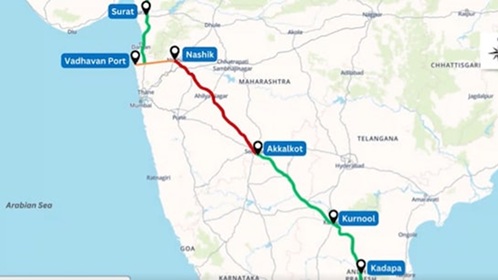
Project Structure and Model
- This approximately 374-km-long corridor will be developed under the Build-Operate-Transfer (BOT) toll model. The project is part of the Pradhan Mantri GatiShakti National Master Plan.
- It aims to improve regional and inter-state connectivity while strengthening India's integrated transport infrastructure under the Pradhan Mantri GatiShakti National Master Plan.
Route and Connectivity
- The proposed corridor will connect Kurnool to major regional centers such as Nashik, Ahilyanagar, and Solapur. It is planned to connect it to several important national highways and expressways, including:
- Delhi-Mumbai Expressway near the Wadhawan Port Interchange
- Agra-Mumbai Corridor in Nashik
- Samruddhi Mahamarg near Pangri
- Upon completion, the project will ensure seamless connectivity between India's western and eastern coasts.
Impact on Travel Time and Logistics Efficiency
- According to government estimates, the construction of this corridor will significantly reduce travel time. The current journey time of approximately 31 hours will be reduced to 17 hours, a reduction of approximately 45%. This will also reduce travel distance by approximately 201 kilometers.
- This will improve freight and logistics efficiency, especially for National Industrial Corridor Development Corporation (NICDC)-linked hubs like Kopparthi and Orvakal.
Employment Generation
- In terms of employment generation, the project is estimated to generate approximately 25.1 million man-days of direct employment and approximately 31.4 million man-days of indirect employment.
- Additionally, additional employment opportunities are expected to be created through increased economic activity along the corridor.
Other Facts
- The Nashik-Talegaon Dighe section of the project will also complement the Pune-Nashik Expressway, which has been identified by the NICDC and is being implemented by the Maharashtra government.
- Designed as a high-speed and controlled corridor, the highway will be able to accommodate an average vehicle speed of 60 kmph, compared to its design speed of 100 kmph. per hour.
- The project is expected to reduce traffic congestion, improve road safety, reduce operating costs, and ensure seamless movement of passenger and freight traffic.
- The corridor is also expected to contribute to regional economic development by improving infrastructure in Nashik, Ahilyanagar, Dharamshala, and Solapur districts.






 Contact Us
  New Batch : 9555124124/ 7428085757
  Tech Support : 9555124124/ 7428085757