
- UPSC Exam
- State PCS
- One Day Exam
- Current Affairs
- PT Quiz
- Downlaods
- About Coaching
- Blog
- Videos

| Prelims: (Polity & Governance + CA) Mains: (GS 2 – Health Governance, Social Sector Reforms) |
India has crossed a major public health milestone, with 50,373 public health facilities across all States and Union Territories certified under the National Quality Assurance Standards (NQAS). This marks a significant leap in institutionalising quality, safety, and patient-centric care across the public healthcare system.
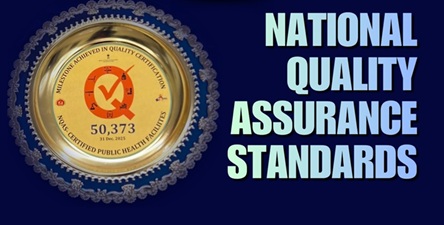
India’s public healthcare system serves a vast and diverse population, often under conditions of high patient load, limited resources, and regional disparities.
Historically, the focus remained on expanding access—building hospitals, increasing manpower, and rolling out national health programmes—while quality assurance remained uneven.
With rising health awareness, epidemiological transition towards non-communicable diseases, and increased public expectations, quality of care emerged as a critical governance challenge.
In this context, the Ministry of Health and Family Welfare (MoHFW) institutionalised a national framework to move beyond infrastructure and ensure standardised, measurable, and patient-focused healthcare delivery.
The National Quality Assurance Standards (NQAS) are a comprehensive quality framework developed by the MoHFW to improve and standardise healthcare services in public health facilities.
The core philosophy of NQAS is to shift public healthcare from service delivery based only on availability to care based on safety, effectiveness, and patient dignity.
At present, NQAS standards apply to a wide spectrum of public health institutions:
Crossing 50,000 certified facilities reflects deep penetration of quality benchmarks from tertiary hospitals to the grassroots level, aligning with the vision of comprehensive primary healthcare under Ayushman Bharat.
NQAS standards are structured around eight interlinked domains that together define healthcare quality:
This structure ensures that certification goes beyond infrastructure to assess processes and outcomes.
Standardised care protocols and emphasis on patient rights enhance public confidence in government facilities.
NQAS complements the Ayushman Arogya Mandir vision by ensuring that expanded access is matched with assured quality.
Uniform national benchmarks help reduce inter-State and rural–urban variations in healthcare quality.
The self-assessment and audit process builds managerial and clinical capacity within health institutions.
NQAS aligns India’s public healthcare quality framework with global best practices in quality assurance.
FAQs1. What is the main objective of NQAS ? To ensure standardised, safe, patient-centric, and continuously improving healthcare services in public health facilities. 2. Which ministry implements NQAS ? The Ministry of Health and Family Welfare (MoHFW). 3. Is NQAS mandatory for public health facilities ? No, it is voluntary, but strongly encouraged as a quality improvement and certification framework. 4. How is NQAS linked with Ayushman Bharat ? NQAS ensures quality assurance for Ayushman Arogya Mandir facilities delivering comprehensive primary healthcare. 5. Why is NQAS important for health governance in India ? It institutionalises accountability, improves patient trust, and shifts focus from mere access to quality outcomes. |



Our support team will be happy to assist you!

 Contact Us
  New Batch : 9555124124/ 7428085757
  Tech Support : 9555124124/ 7428085757