New
GS Foundation (P+M) - Delhi : 19th Jan. 2026, 11:30 AM Republic Day offer UPTO 75% + 10% Off, Valid Till : 28th Jan., 2026 GS Foundation (P+M) - Prayagraj : 09th Jan. 2026, 11:00 AM Republic Day offer UPTO 75% + 10% Off, Valid Till : 28th Jan., 2026 GS Foundation (P+M) - Delhi : 19th Jan. 2026, 11:30 AM GS Foundation (P+M) - Prayagraj : 09th Jan. 2026, 11:00 AM

New Ganga Basin Initiative to Safeguard the Endangered Indian Skimmer

Prelims: (Environment + CA)
Mains: (GS 3 – Environment, Biodiversity, Conservation, Sustainable Development)

Why in News?

The Bombay Natural History Society (BNHS) has launched a new conservation project under the National Mission for Clean Ganga (NMCG) at Dehradun to protect the Indian Skimmer in the Ganga Basin.

The initiative aims to strengthen habitat protection, monitor populations, and address threats facing this endangered riverine bird species.

Background: Indian Skimmer — Taxonomy and Identity

The Indian Skimmer (Rynchops albicollis) is one of the three species belonging to the skimmer genus Rynchops in the family Laridae.

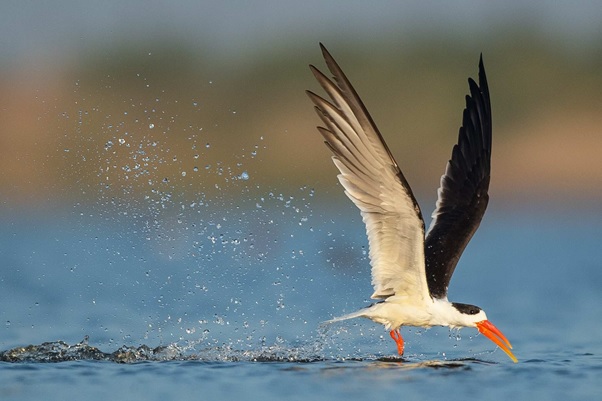
The bird derives its name from its unique feeding behaviour — it flies low over water surfaces and “skims” for fish using its specialised beak.

The Indian Skimmer is a flagship species for riverine ecosystem conservation, particularly in large, sandy, lowland rivers of South Asia.
endangered-indian-skimmer

Habitat and Distribution

Habitat

  • Primarily found on:
    • Large, sandy, lowland rivers,
    • Around lakes and adjacent marshes,
    • In estuaries and coastal areas during the non-breeding season.

Geographical Distribution

  • Native to South Asia.
  • Mainly found in:
    • India, Bangladesh, and Pakistan,
    • With smaller populations extending into Nepal and Myanmar.

Key Indian Habitat

  • The Chambal River is one of the most important strongholds for Indian Skimmers in India.

Physical Features and Feeding Adaptations

The Indian Skimmer has a distinctive and striking appearance:

  • Plumage: Black upper body with a contrasting white underbelly.
  • Beak: Bright orange with a lower mandible significantly longer than the upper one.
  • This elongated lower mandible allows the bird to skim the water surface to catch small fish and aquatic organisms.
  • Wings: Long and angular, adapted for fast, low, and precise flight over water bodies.

These specialised traits make the species highly dependent on undisturbed riverine habitats.

Conservation Status and Threats

IUCN Status: Endangered

Major Threats

  • Loss and degradation of river habitats due to:
    • River regulation,
    • Floodplain encroachment.
  • Unplanned water releases from dams, leading to nest flooding and breeding failure.
  • Sand mining, which destroys nesting grounds on river sandbars.
  • Predation by dogs, birds of prey, and other animals, particularly at nesting sites.
  • Disturbance from human activities such as fishing, boating, and tourism.

BNHS–NMCG Conservation Initiative: Objectives and Significance

The newly launched project under NMCG seeks to:

  • Identify and protect key breeding and foraging habitats in the Ganga Basin.
  • Conduct scientific population monitoring and ecological studies.
  • Work with local communities to promote river stewardship and reduce disturbance at nesting sites.
  • Strengthen coordination with government agencies for river management and biodiversity conservation.

Significance

  • The project integrates river cleaning and biodiversity conservation, reflecting the broader ecological mandate of the National Mission for Clean Ganga.
  • Protecting the Indian Skimmer contributes to the health of riverine ecosystems, benefiting multiple species and human livelihoods dependent on rivers.

Strategic Importance for Riverine Biodiversity Conservation

The Indian Skimmer serves as an indicator species for river health. Its decline signals:

  • Degradation of sandy riverbanks,
  • Altered river flows, and
  • Declining fish populations.

Conserving this species supports:

  • Maintenance of ecological integrity of rivers,
  • Sustainable water management,
  • Alignment with India’s commitments under global biodiversity frameworks.

FAQs

1.What is the Indian Skimmer?

It is an endangered riverine bird species known for its unique feeding behaviour of skimming fish from the water surface.

2.Why is the Indian Skimmer endangered?

Due to habitat loss, dam-related flow changes, sand mining, predation, and human disturbance.

3.Who has launched the new conservation project for Indian Skimmer?

The Bombay Natural History Society (BNHS) under the National Mission for Clean Ganga (NMCG).

4.Where is the Indian Skimmer mainly found in India?

Major populations are found along large rivers, especially the Chambal River.

5. What is the significance of protecting the Indian Skimmer?

It helps conserve riverine ecosystems and serves as an indicator of river health.

Have any Query?

Our support team will be happy to assist you!

OR