Prelims: (Economy + CA)
Mains: (GS 2: Governance, Social Sector Policies; GS 3: Employment, Human Capital, Economic Development) |
Why in News ?
Over the last decade, India has created one of the world’s largest skilling infrastructures, with the Pradhan Mantri Kaushal Vikas Yojana (PMKVY) alone training about 1.40 crore candidates between 2015 and 2025.
However, despite this scale, skilling has not emerged as an aspirational or rewarding career pathway. Data from the Periodic Labour Force Survey (PLFS) show limited and inconsistent wage gains from vocational training—particularly in the informal sector, where most certified trainees eventually find employment.
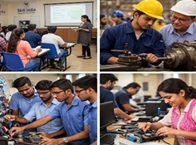
Background & Context: India’s Skilling Push
India’s skilling strategy emerged against the backdrop of:
- A young demographic profile
- Low formal skill certification
- A labour market dominated by informality
To harness the demographic dividend, successive governments invested heavily in short-term vocational training, ITI reforms, apprenticeship promotion, and institutional mechanisms such as Sector Skill Councils (SSCs).
Yet, the gap between training outputs and labour-market outcomes has persisted, raising concerns about whether skilling has become a numbers-driven welfare intervention rather than an economic transformation tool.
Why Skilling Struggles to Attract Aspirations
Weak Integration with Formal Education
- India’s Gross Enrolment Ratio (GER) in higher education stands at about 28%, with a target of 50% by 2035 under NEP 2020.
- Achieving this requires embedding skilling within degrees and diplomas, rather than expanding parallel vocational tracks that operate outside mainstream education.
Limited Reach of Formal Vocational Training
- Only about 4.1% of India’s workforce has formal vocational training, marginally up from 2% a decade ago.
- This remains far below OECD standards, where vocational education is widespread and socially accepted.
Global Comparison Gap
- In OECD countries, about 44% of upper-secondary students pursue vocational education.
- In several European economies, this figure rises to 70%, making skilling a mainstream choice rather than a fallback option.
Weak Post-Degree Skilling Culture
- The India Skills Report 2025 shows that graduates rarely pursue skilling after completing degrees.
- This highlights a structural disconnect between higher education and employability-oriented skill development.
Industry’s Limited Role in Strengthening Skilling
High Dependence on Skilled Labour
- Sectors such as retail, logistics, hospitality, and manufacturing face:
- 30–40% attrition
- Long onboarding periods
- Productivity losses due to skill gaps
Low Trust in Public Certifications
- Most employers do not rely on government skilling certificates for recruitment.
- Hiring decisions are often based on:
- Internal training pipelines
- Referrals
- Private digital platforms
Uneven Apprenticeship Outcomes
- Although the National Apprenticeship Promotion Scheme (NAPS) has expanded participation, benefits remain uneven.
- Large firms participate selectively, while SMEs face compliance and cost barriers.
Lack of Co-Design and Accountability
- Industry is neither strongly incentivised nor mandated to:
- Design curricula
- Set standards
- Conduct assessments
- This keeps skilling misaligned with real labour-market needs.
Why Sector Skill Councils Are Underperforming
Original Mandate vs Current Reality
- SSCs were envisioned as industry-led institutions to:
- Define occupational standards
- Ensure relevance
- Certify employability
- In practice, this mandate remains largely unmet.
Fragmented Accountability
- Training, assessment, certification, and placement are handled by different actors.
- This diffusion of responsibility removes any single entity’s accountability for outcomes.
Weak Employer Signalling
- SSC certifications carry limited hiring value.
- Employers prefer degrees, brand institutions, or work experience, even when SSC standards exist.
Contrast with Global Industry Certifications
- Certifications by AWS, Google, Microsoft, etc., succeed because:
- Certifiers own outcomes
- Assessments are rigorous and graded
- Credibility is directly at stake
Need for Outcome Ownership
- Without clear responsibility for employment and wage outcomes, SSC certifications remain symbolic rather than transformative.
Skilling as a Driver of Long-Term Economic Growth
Accountability Is the Core Gap
- India’s skilling challenge is not a lack of policy intent or funding, but weak accountability for outcomes.
Workplace-Embedded Skilling
- Expanding apprenticeships and integrating training into workplaces can:
- Improve job readiness
- Reduce onboarding costs
- Align skills with real tasks
Industry-Led Execution Models
- Initiatives such as ITI modernisation and PM-SETU show that outcomes improve when industry shares ownership.
From Welfare to Economic Strategy
- When skills are integrated into degrees and industries are co-owners, skilling becomes:
- A productivity driver
- A pathway to dignity of labour
- A pillar of economic empowerment
Beyond Jobs
- Effective skilling enhances:
- Worker mobility
- Wage growth
- India’s ability to convert its demographic advantage into sustained growth
Rethinking India’s Skills Strategy
Skills Must Translate into Better Pay
- Skilling cannot succeed unless wages and benefits reflect skill acquisition.
- Training must align with sectors capable of paying productivity-linked wages.
Shift to Demand-Led Training
- Curriculum design should be guided by:
- Real-time labour market data
- Stronger industry–institution linkages
- Transparent placement outcomes
Remove Wage-Suppressing Constraints
- Regulatory hurdles, limited access to finance and land, corruption, and trade barriers restrict firms’ ability to pay higher wages.
- Skilling reform must go hand-in-hand with industrial and regulatory reform.
Scale Placement-Linked Models
- Skilling works best when combined with:
- Rigorous selection
- Quality instruction
- Assured placement through credible public–private partnerships
Make Skilling Aspirational
- Only pathways offering dignity, mobility, and clear career progression can move India’s skilling agenda from headline numbers to real economic impact.
FAQs
Q1. Why has large-scale skilling not improved employability significantly ?
Because certifications are weakly linked to wages, industry demand, and accountability for outcomes.
Q2. What is the main weakness of Sector Skill Councils ?
Lack of ownership over employment and wage outcomes.
Q3. How can skilling be made aspirational in India ?
By integrating it with degrees, ensuring wage premiums, and creating clear career progression pathways.
Q4. Why is industry participation crucial in skilling ?
Industry best understands skill requirements and can align training with productivity and wages.
Q5. What role do apprenticeships play in skilling reform ?
They embed learning in real workplaces, improve job readiness, and reduce hiring risks.
|






 Contact Us
  New Batch : 9555124124/ 7428085757
  Tech Support : 9555124124/ 7428085757