Prelims : Polity + CA
Mains : GS Paper 2 – Governance, Representation of People Act, Electoral Reforms |
Why in News ?
The ongoing controversy surrounding the Special Intensive Revision (SIR) of electoral rolls conducted by the Election Commission of India has triggered a nationwide debate on the distinction between the right to vote and the right to contest elections, bringing into focus critical issues related to electoral integrity and democratic participation.
The controversy has intensified due to :
- Allegations of large-scale deletion of voter names, including claims that genuine and eligible voters have been excluded during the verification process.
- Rising concerns over disenfranchisement, particularly among vulnerable and marginalised sections of society who may lack proper documentation.
- Legal challenges and judicial scrutiny, with petitions questioning the transparency, fairness, and procedural safeguards of the SIR exercise.
This situation has raised fundamental questions about how administrative processes intersect with democratic rights in India.
What is SIR (Special Intensive Revision) ?
The Special Intensive Revision is a comprehensive and large-scale exercise undertaken to verify and update electoral rolls to ensure their accuracy and credibility.
It involves the following key features :
- House-to-house verification by Booth Level Officers (BLOs), where officials physically visit households to verify voter details, making the process highly detailed but also prone to human error.
- Objective of ensuring electoral integrity, which includes :
- Removal of duplicate or ineligible voters
- Inclusion of all eligible citizens
- Undertaken in exceptional circumstances, where routine revisions are insufficient and a complete overhaul of electoral rolls is required.
However, due to its scale and reliance on verification processes, SIR often becomes contentious, especially when it leads to exclusion of voters.
Understanding the Core Debate: Right to Vote vs Right to Contest
The SIR controversy highlights a crucial distinction in Indian constitutional and electoral law.
1. Right to Vote
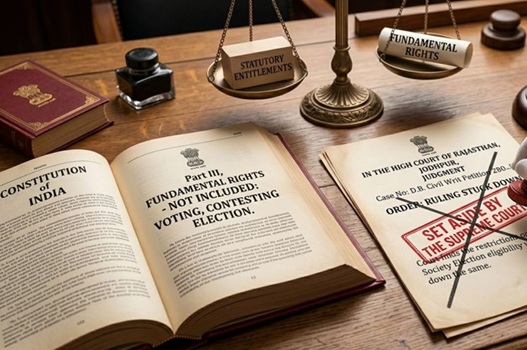
- The right to vote is a statutory right granted under the Representation of the People Act.
- It is not a fundamental right but is essential for democratic participation.
- Key features include :
- It is available to every citizen above 18 years of age, subject to eligibility conditions.
- It ensures participation in governance through elections.
- It forms the foundation of representative democracy.
Any disruption to this right directly affects democratic legitimacy.
2. Right to Contest Elections
- The right to contest elections is also a statutory right, subject to stricter conditions.
- It involves :
- Fulfilment of eligibility criteria such as age, citizenship, and absence of disqualification.
- Compliance with nomination procedures and deposit requirements.
- Adherence to legal and electoral regulations.
Unlike voting, contesting elections is more restrictive and regulated.
3. Interrelationship Between the Two
- While both are statutory rights, the right to vote is broader and more inclusive, whereas the right to contest is selective.
- Disruptions in voter lists (through SIR) can indirectly affect electoral outcomes, thereby influencing the right to contest.
Constitutional and Legal Framework
1. Article 326 of the Constitution
- Provides for universal adult suffrage, ensuring that all citizens above 18 years have the right to vote.
- It establishes the democratic principle of equality in political participation.
2. Article 324 of the Constitution
- Grants the Election Commission of India the authority to :
- Supervise and control elections
- Conduct electoral roll revisions
- Ensure free and fair elections
This creates a balance between administrative powers and citizens’ rights.
3. Representation of the People Acts, 1950 & 1951
- These Acts provide the legal framework for :
- Preparation and revision of electoral rolls
- Eligibility and disqualification of voters and candidates
- Regulation of elections
SIR derives its legal validity from these statutory provisions.
Why Has SIR Become Controversial?
1. Large-Scale Deletion of Voters
- One of the primary concerns is the removal of a significant number of names from electoral rolls.
- While deletion is necessary to remove duplicates and ineligible entries, problems arise when :
- Genuine voters are mistakenly excluded due to verification errors
- Lack of proper notice or communication prevents timely correction
- This creates a serious risk of disenfranchisement, undermining democratic participation.
2. Procedural and Documentation Challenges
- The verification process often requires voters to produce documents or confirm historical records.
- This creates difficulties for :
- Migrant workers who frequently change residence
- Elderly individuals who may lack updated documents
- Economically weaker sections with limited access to paperwork
- Even minor discrepancies in records, such as spelling errors or address changes, can lead to exclusion.
3. Timing of the Exercise
- Conducting SIR close to elections raises concerns about :
- Impact on voter turnout
- Perceived political motivations or biases
- Reduced time for correction and grievance redressal
- This timing increases the sensitivity and controversy surrounding the exercise.
4. Judicial Scrutiny and Legal Challenges
- Courts have been approached to examine :
- Whether large-scale deletions violate democratic rights
- Whether due process is being followed
- Judicial observations have emphasised :
- Transparency in procedures
- Adequate opportunity for correction
- Protection of voter rights
Impact on Right to Vote
1. Risk of Disenfranchisement
- Exclusion from electoral rolls directly prevents citizens from voting.
- This undermines the principle of universal suffrage and weakens democratic legitimacy.
2. Disproportionate Impact on Vulnerable Groups
- The impact is not uniform and affects certain groups more severely :
- Migrant workers
- Rural and poor populations
- Elderly citizens
- These groups face structural disadvantages in documentation and awareness.
3. Erosion of Trust in Electoral System
- Repeated controversies may lead to :
- Reduced confidence in electoral processes
- Perception of bias or unfairness
- Lower voter participation
Impact on Right to Contest Elections
1. Alteration of Electoral Demographics
- Changes in voter lists can influence:
- Voting patterns
- Electoral outcomes
- Political representation
2. Reduced Representativeness
- If sections of the population are excluded :
- Election results may not reflect the true will of the people
- Democratic legitimacy is weakened
3. Political Polarisation
- Electoral roll controversies often lead to :
- Accusations of bias
- Increased political tensions
- Heightened electoral disputes
Core Issue: Administrative Efficiency vs Democratic Inclusion
The SIR controversy highlights a fundamental tension :
- The Election Commission of India must ensure accurate and clean electoral rolls to maintain electoral integrity.
- At the same time, it must guarantee that no eligible voter is excluded, ensuring inclusive democracy.
Balancing these two objectives is the central challenge.
Significance for Indian Democracy
1. Ensuring Free and Fair Elections
- Accurate voter lists prevent fraud and duplication, which is essential for credible elections.
2. Safeguarding Democratic Rights
- Protecting the right to vote ensures citizen participation and legitimacy of governance.
3. Institutional Accountability
- The controversy highlights the need for transparency and accountability in electoral processes.
Way Forward
1. Strengthening Verification Mechanisms
- Use of technology such as digital databases and automated systems can reduce human error and improve accuracy.
2. Enhancing Transparency
- Public disclosure of deleted names and reasons for exclusion can build trust and accountability.
3. Simplifying Documentation Requirements
- Accepting multiple forms of identification and reducing procedural complexity can prevent exclusion.
4. Robust Grievance Redressal
- Establishing fast and accessible mechanisms for correction and inclusion is essential.
5. Judicial and Institutional Oversight
- Continued monitoring by courts and independent bodies can ensure fairness and legality.
Practice Questions
Prelims
Q. Which of the following is/are statutory rights in India ?
- Right to vote
- Right to contest elections
(a) 1 only
(b) 2 only
(c) Both 1 and 2
(d) Neither
Mains
“Electoral roll revision exercises like SIR highlight the tension between electoral integrity and democratic inclusion.” Discuss.
FAQs
Q1. What is SIR ?
It is a comprehensive electoral roll verification exercise.
Q2. What is the main issue ?
Deletion of genuine voters and its impact on voting rights.
Q3. Is voting a fundamental right ?
No, it is a statutory right.
Q4. Who conducts SIR ?
The Election Commission of India.
Q5. What is the key challenge ?
Balancing accuracy of rolls with inclusiveness.
|






 Contact Us
  New Batch : 9555124124/ 7428085757
  Tech Support : 9555124124/ 7428085757