
- UPSC Exam
- State PCS
- One Day Exam
- Current Affairs
- PT Quiz
- Downlaods
- About Coaching
- Blog
- Videos

| Prelims: (Polity & Governance + CA) Mains: (GS 2 – Governance, Accountability, Rule of Law) |
A two-judge Bench of the Supreme Court of India has delivered a split verdict on the constitutional validity of Section 17A of the Prevention of Corruption Act, 1988, which mandates prior government approval before initiating enquiries or investigations against public servants for actions taken in official capacity. Due to divergent judicial opinions, the matter has been referred to the Chief Justice of India (CJI) for the constitution of a larger Bench.
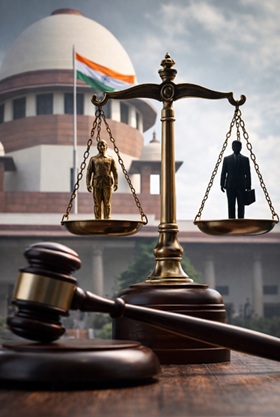
Section 17A was inserted in 2018 to address concerns of policy paralysis, where civil servants feared investigative harassment for bona fide administrative decisions. The provision was premised on the belief that excessive scrutiny could discourage officers from taking bold or innovative decisions in public interest.
Justice K V Viswanathan emphasised that civil servants constitute the “Steel Frame of India,” a phrase attributed to Sardar Vallabhbhai Patel. He cautioned that without safeguards, honest officers may adopt a risk-averse “play-it-safe” approach, impairing governance and national development.
Justice Viswanathan, while upholding Section 17A, acknowledged a critical flaw:
the power to grant or deny approval rests with the executive itself, which could compromise the independence of corruption investigations.
To preserve the provision’s constitutionality, he adopted a constructive interpretation, holding that:
This approach aims to balance administrative autonomy with anti-corruption accountability.
Justice B V Nagarathna took a sharply contrasting view, holding Section 17A to be unconstitutional.
She argued that the provision:
Justice Nagarathna rejected the assumption that the government can act impartially when allegations involve senior officials or political leadership, highlighting the risk of executive bias.
Justice Nagarathna found Section 17A violative of Article 14 (Right to Equality):
She also warned that the provision gives the government a “Damocles’ sword” over public servants, enabling selective approvals and political control.
The split verdict reflects differing interpretations of landmark rulings:
The case highlights a fundamental dilemma in governance:
The final resolution now rests with a larger Bench, whose ruling will shape the future of administrative accountability and corruption control in India.
FAQs1. What is Section 17A of the Prevention of Corruption Act ? It mandates prior government approval before investigating public servants for official decisions. 2. Why was Section 17A introduced ? To prevent policy paralysis and protect honest officers from frivolous investigations. 3. Why did the Supreme Court deliver a split verdict ? Judges differed on whether the provision protects governance or undermines anti-corruption efforts. 4. What role did the Lokpal feature in the judgment ? One judge proposed independent screening by Lokpal/Lokayuktas to safeguard constitutionality. 5. Why is the matter referred to a larger Bench ? Due to conflicting interpretations on constitutionality and precedent. |



Our support team will be happy to assist you!

 Contact Us
  New Batch : 9555124124/ 7428085757
  Tech Support : 9555124124/ 7428085757